Trade spends, on average, cost FMCG companies 20% to 30% of their revenue. And there is no guarantee that the investments will generate sales growth or profit.
Avoiding promotions isn’t an option, as they often remain the most effective way to generate sales volume.
So, how then can companies track whether hundreds of running promotions across multiple products, channels, and markets are truly profitable?
Some brands still rely solely on Excel, while others use it alongside other generic tools. But since these solutions aren’t designed for trade promotions planning, their effectiveness is limited.
That’s why leading companies have shifted to dedicated Trade Promotion Management (TPM) solutions to improve visibility into trade promotion in CPG.
With TPM, they can monitor campaigns in real time, identify underperforming promotions, and take control of effectiveness before losses escalate.
In this article, we will answer the question “What is Trade Promotion Management?”, explain what specific problems a Trade Promotions Management solution solves, and how to implement it so you can finally see the real numbers behind your promos.
Why Excel Can’t Keep Up with Today’s Trade Promotion Demands
Imagine Maria, a Key Account Manager who juggles 40+ promotions a month with a budget that already 25% of the company’s revenue.
What Maria faces every day:
- Budget stretch – eCommerce growth and technology leap force her to split funds between online and offline channels, while retail partners refuse cuts.
- Data chaos – Properly evaluating promos requires pulling sales, pricing, competitor, and inventory data from multiple sources.
- Time pressure – The process of pulling data is so complex and time-consuming that she can’t manually do it for every campaign.
- AI hype – The company discusses using AI and ML to optimize promotions, but AI needs clean, consistent, centralized data. All Maria has is a patchwork of spreadsheets and fragmented reports, with no universal KPI rules and no system to share data across the company’s ecosystem. Implementing AI in trade promotion in such conditions wouldn’t do a thing.
What the company has as a result of not equipping Maria and her colleagues with a tool tailored specifically for managing trade promotions:
- Unprofitable promotions slip through
- Millions spent on promotions that don’t meet ROI targets
- Fragmented decision-making with conflicting numbers and interpretations
- Missed opportunities to test, compare, or forecast promotions with confidence
- Lost competitive advantage
The history of Trade Promotion Management shows how companies have attempted to cope with the challenge of managing numerous promotions.
The Evolution of Trade Promotion Planning
Before the pandemic, Trade Promotion Management systems worked in isolation. Their data was disconnected from other tools like Trade Promotion Optimization. Staff often had to re-enter data between systems, making Excel the go-to.
Each company had its own specifics when it needed to manage trade promotions. Pre-pandemic TPMs usually couldn’t offer a universal process that’d fit every fast-moving consumer goods company. When these systems weren’t adjustable enough, Excel again filled the gaps.
Anyone can manipulate data with spreadsheets, but they are still flexible in terms of custom reporting and running “what-if” scenarios.
Read also: The Evolution of FMCG Merchandising
By 2025, the need for unified numbers became truly critical, building trust for TPM data. With shorter product life cycles, eCommerce growth, and shifting shopper behaviors, promotional strategies had to be adjusted in near real time.
That’s how the need for interconnected trade promo systems emerged. Trade promotion planning, trade promotion execution, and monitoring can all now happen in one environment, which was nearly impossible to achieve with legacy setups or Excel-based business planning.
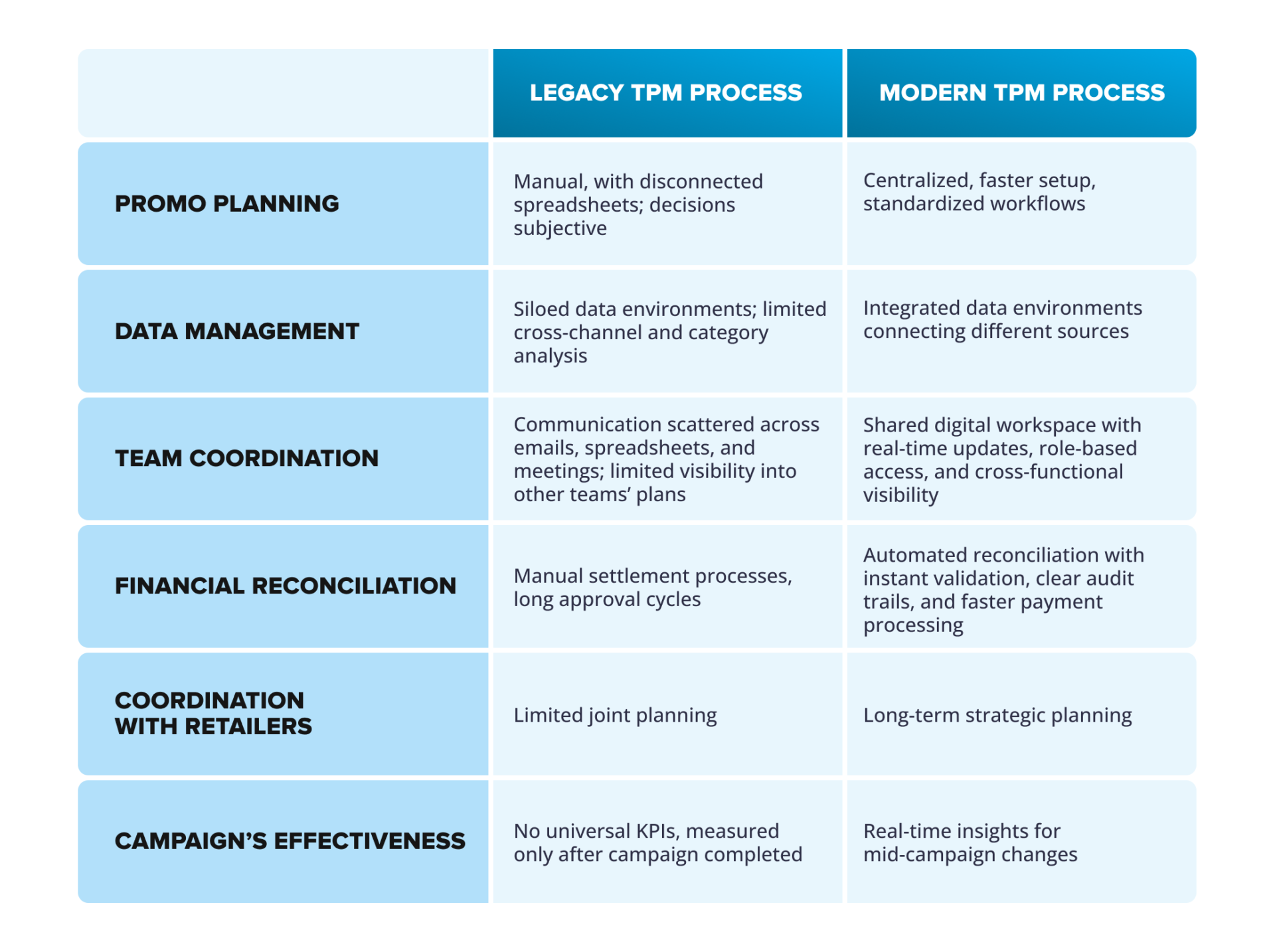
Now that we understand how TPM evolved, let’s look at the key components of its modern functionality.
Key Components of TPM
Here are the main building blocks of a modern Trade Promotion Management software and the value they bring to FMCG companies.
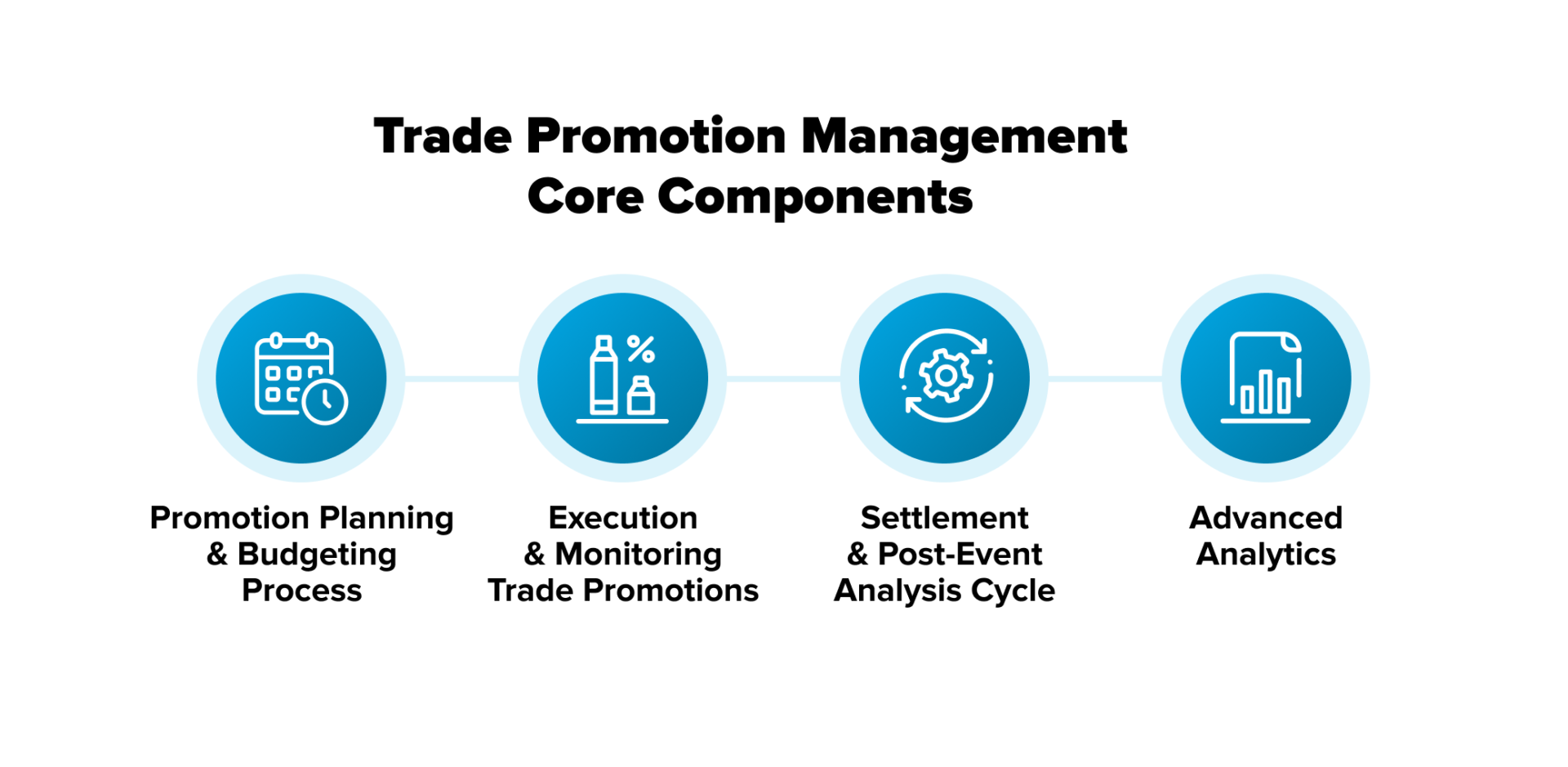
Promotion Planning & Budgeting Process
Each promotion goes through creation, approval, and adjustment. At creation, there are two main points that are crucial for defining and measuring properly:
- sales baseline (sales under the “normal” market condition)
- minimum expected uplift (extra sales volume or ROI level to avoid running a loss)
The calculations of these points require plenty of historical data – without it, baselines can be inaccurate. Factors like seasonality, competitor actions, and pricing changes can distort short-term trends, so historical data helps filter out this noise.
And with the clear dataset, a proper Trade Promotion Management solution can set reasonable and realistic KPIs.
It’s also worth noting that baseline logic and promotion mechanics often differ significantly depending on the channel — the dynamics of general trade vs modern trade require tailored approaches to planning and measurement.
The first job of a solid TPM system is to automate data collection and perform baseline calculation, uplift projection, and outcome simulation. It also streamlines approvals, giving all stakeholders a clear view of proposed TPM promotions, budgets, and expected returns.
Execution & Monitoring Trade Promotions
Promotion performance information is crucial for many teams, and they should be constantly updated on that:
- Sales reps use Image Recognition (IR) to capture shelf compliance, pricing, and display setups. The data is then transferred to a Sales Force Automation (SFA) tool, which in turn goes to TPM, among other tools.
- Key customer managers are kept informed about campaign progress, ensuring retailers stay aligned with promotion requirements.
- The trade marketing team tracks sales uplift, inventory levels, and compliance metrics via TPM’s dashboards, identifying issues immediately.
- Supply chain and logistics teams are interested in FMCG distributor management data that can be connected through SFA to the TPM’s data to see sales volume and avoid both out-of-stock and overstock during the campaign.
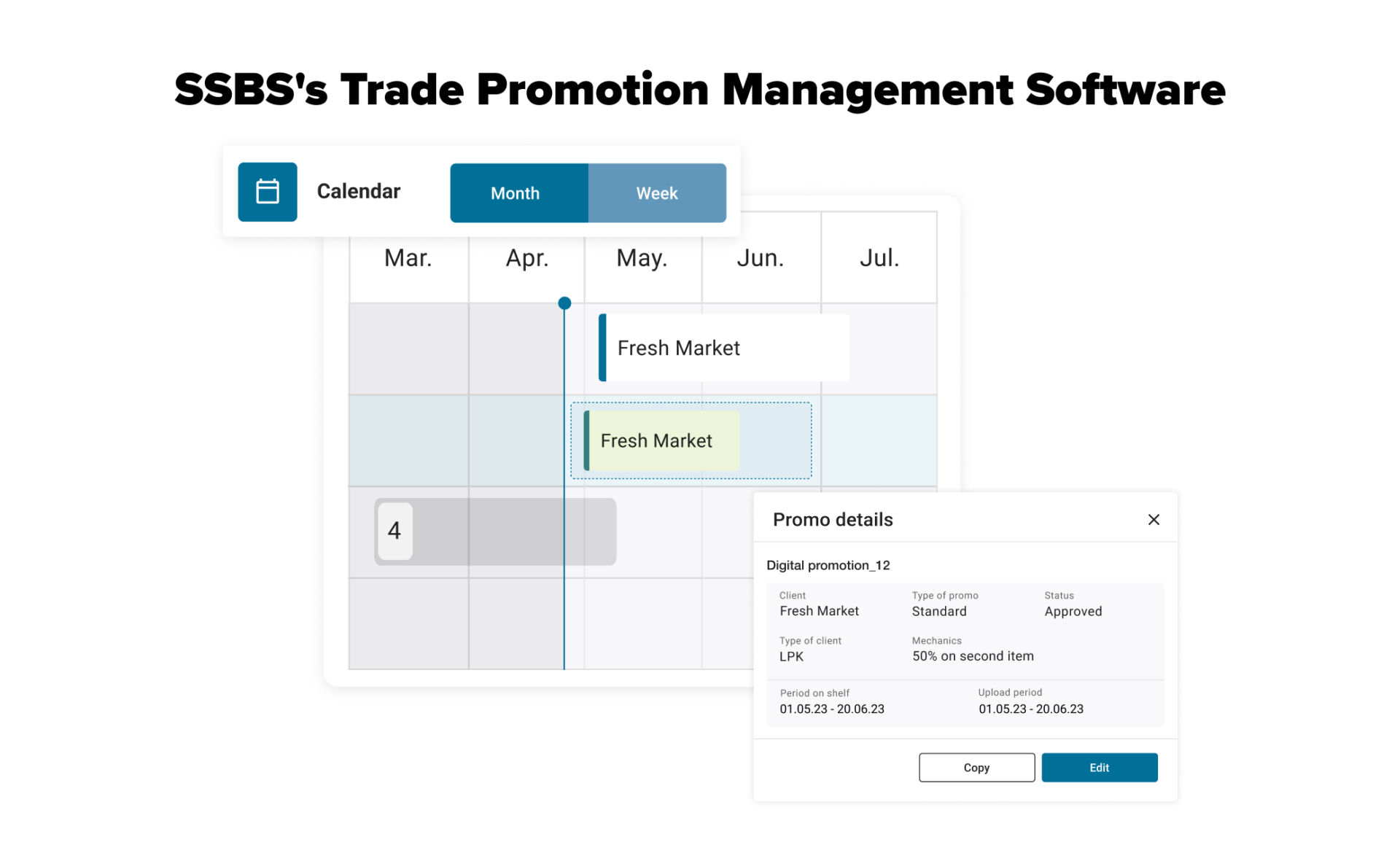
A Trade Promotion Management solution exists in this situation, first of all, as a data hub. The information it collects and categorises (like demand, sales volume, promotion budget, etc.) can be displayed in easy-to-read dashboards, calendars, and tables.
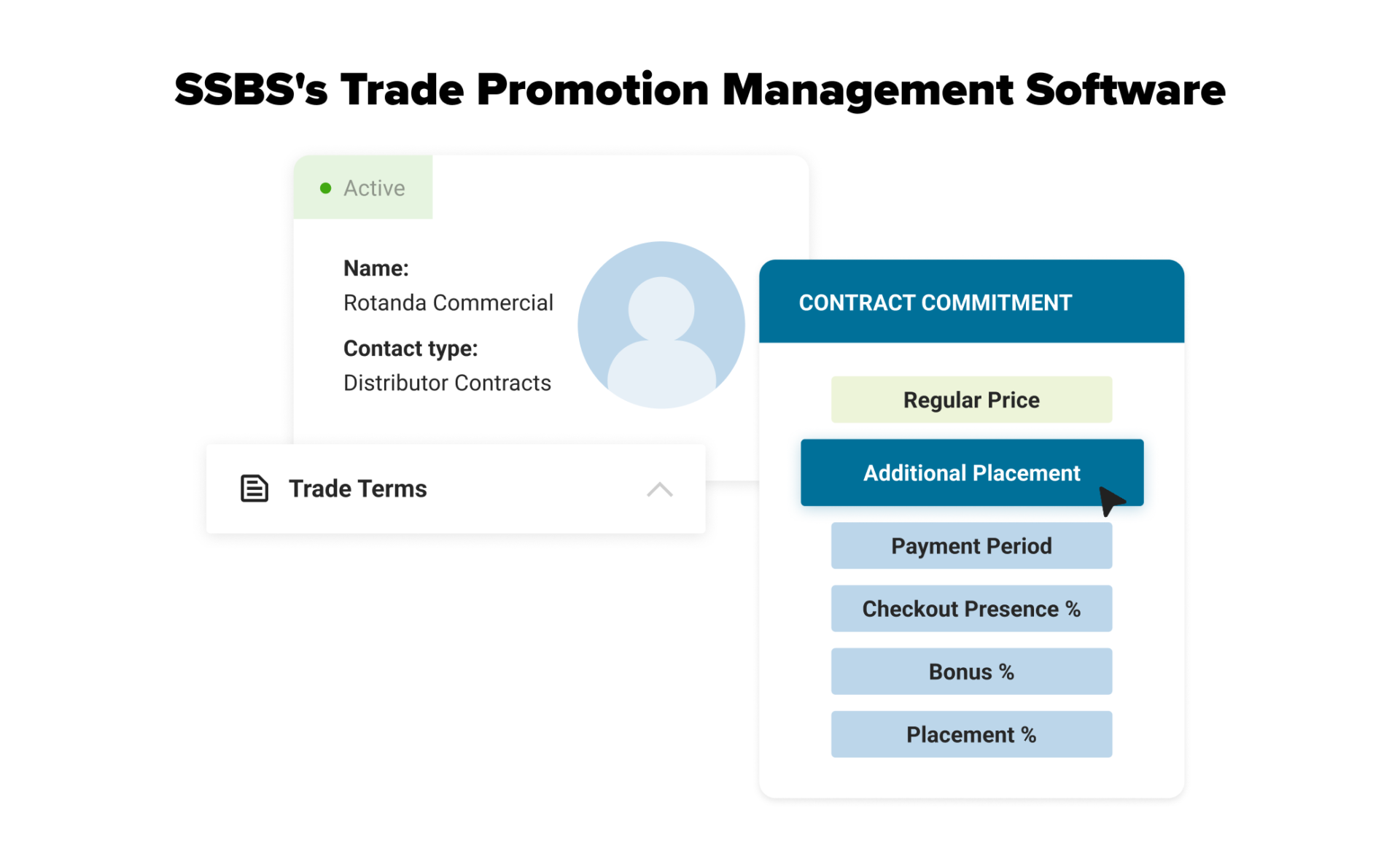
This single source of truth has pre-set rules for KPI calculations. Meaning, all the teams see performance the same way, and no one can tweak it.
Settlement & Post-Event Analysis Cycle
After a promotion is completed, all the data about it is stored in the TPM solution and matched against the original plan, budgets, and expectations. The system calculates the actual ROI and other agreed-upon KPIs.
When we talk about ROI, we mean first of all whether trade spend management ensures that promotional investments actually paid off, and the extra sales volume and revenue growth cover the costs of discounts, displays, and any other promotional expenses. If not, the system helps pinpoint where the promotion underperformed – whether it was due to:
- Poor compliance with the promotion plan
- Low on-shelf availability
- Weak shopper engagement
- Inventory issues

Moreover, the data becomes historical and can be compared with previous promotions or used as a benchmark for future ones. Over time, this creates a valuable knowledge base inside the TPM solution, helping teams spot patterns, predict results more accurately, and avoid repeating past mistakes.
Advanced Analytics
One of the most talked-about parts of Trade Promotion Management. AI predictions and other advanced features in TPM are only possible after fixing the fundamental data problems:
- Too many disconnected data sources
- Missing or incomplete data
- Untimely data updates
- Limited access to relevant data
- The same KPIs calculated using different data sets
- Different methods are used to calculate the same KPIs
Once these challenges are resolved, the TPM can be integrated with what is called Trade Promotion Optimization (TPO) – an advanced set of algorithms that use clean, consistent data to model scenarios, forecast outcomes, and recommend the most effective promotion strategies.
Basically, TPM vs TPO is not a choice between two separate systems, they can be part of one solution. Yet, before moving to TPO, you must ensure your promotion data is reliable, up to date, and consistent across all teams (TPM’s core job).
How TPM Helps Every Team in an FMCG Company
When all teams share the same, reliable source of promotion data through a TPM system, cross-functional collaboration becomes much more effective. Here’s how TPM technology impacts FMCG companies and creates unique value for every team.
Optimizes Spending and Resource Allocation
TPM gives a clear view of the budget, which is crucial for these teams:
- Finance and management – See the same KPIs, keep budgets under control, and see ROI in real time.
- Sales and trade marketing – Direct funds to the promotions that deliver the best results.
- Supply chain and logistics – Plan inventory accurately, preventing stockouts or overstocks.
Drives Sales & Profitability Growth
With accurate data at their fingertips, teams can focus on initiatives that truly drive revenue.
- Sales teams – Spot high-performing promotions and replicate customer success.
- Marketing – Invest more time and creative resources in campaigns that generate the highest returns.
Enhances Retailer Relationships and Partnerships
Since TPM provides real-time sales and promotion data, the people responsible for retailer negotiations can be fully informed about promotion plans, compliance, and results. This ensures discussions are based on accurate insights, which helps in this way:
- Sales and Key Account Management specialists – Use TPM data to support negotiations, demonstrate past performance, and make informed recommendations to retailers.
- Trade marketing – Leverage insights on which displays, SKUs, or tactics to drive the best results to guide retailer-facing strategies.
Improves Brand Visibility and Market Position
TPM helps align campaigns with store execution for maximum impact.
- Marketing – Schedule and optimize campaigns for the right timing and locations.
- Sales – Ensure products are on the right shelves to strengthen brand presence.
If teams don’t see the value of TPM and fall back on Excel, it’s often a sign of the incorrect Implementation of Trade Promo Management. How to avoid this trap – read on.
Three Main Steps of Trade Promotion Management Adoption
The difference between failure and success in TPM often comes down to following the right phases of TPM rollout. Let’s break down the main ones.
Step 1. Data Preparation
Start by collecting as much relevant historical and current data as possible – including sales volumes, promotion calendars, pricing, trade spend, and retailer agreements. Ensure it’s clean, complete, and consolidated in one place. The more accurate and structured your data, the better your TPM system will deliver reliable insights and forecast future promotional outcomes.
Step 2. Implementing Basic TPM Functionalities
Begin with the core features that will bring the fastest value:
- promotion planning
- budgeting
- approval workflows
Configure the system to match your existing business processes, but also be ready to adapt those processes to take advantage of TPM best practices.
Stage 3: Scale Using AI, ML, and Real-Time Insights
Once the TPM foundation is in place, promotion management can be taken to the next level – optimization.
AI and ML algorithms are used at this stage to uncover patterns in past promotions, predict future performance, and recommend the most effective strategies.
Real-time data integration enables on-the-fly campaign adjustments, helping you react instantly when promos underperform.
Conclusion
Without a dedicated TPM system, brands risk falling into data chaos, wasting up to 30% of their revenue on ineffective campaigns, and missing the opportunity to enhance their promo operations with AI in the near future.
A modern Trade Promotion Management system gives everyone the same clear view of promotion performance. Finance, sales, marketing, and supply chain all rely on one source of truth. No more mixed-up reports or debates over whose data is correct.
Want to stop wasting money on weak promotions, avoid data chaos, and get ready for AI? Drop us a line and we’ll help you get started.