Gen AI was overhyped, and, according to Gartner, businesses are disappointed with the technology. The spotlight has now shifted to agentic AI.
Within the FMCG TPM process, the new technology risks the same fate. If only companies would stop using trending AI for the sake of having it, not for solving real business problems.
For example, relying on gen AI in trade promotion optimization to predict promotion outcomes. Such a task should be handled by ML. Otherwise, the result is creative text output instead of reliable forecasts.
Every technology has its specific applications and only flips when used inappropriately. However, AI can indeed solve all at once when different types are used in synergy, complementing each other.
This article discusses how to achieve that. Here, you will learn:
- How to improve your TPM solution – the technical core of your process – using different AI types and their combinations.
- How to choose the right AI type for your specific task.
- How these approaches work in practice, as seen in real-life use cases.
Everyone Talks About AI in Trade Promotion Optimization. But Is It Something You Genuinely Need?
Short answer: yes – unless you’re fine with falling behind and losing money quietly.
Here’s the longer story.
What Companies Are Ready for AI in Trade Promotion Management
FMCG isn’t known for quick change, especially when it comes to processes that have “worked” for decades, like trade promotion management. Many companies still haven’t even moved from Excel to even a basic, non-AI-powered TPM solution.
Adopting AI in trade promotion optimization without first addressing the issues of fragmented data, manual reporting, and inconsistent metrics (which TPM solutions are designed to manage) is like putting the cart before the horse.
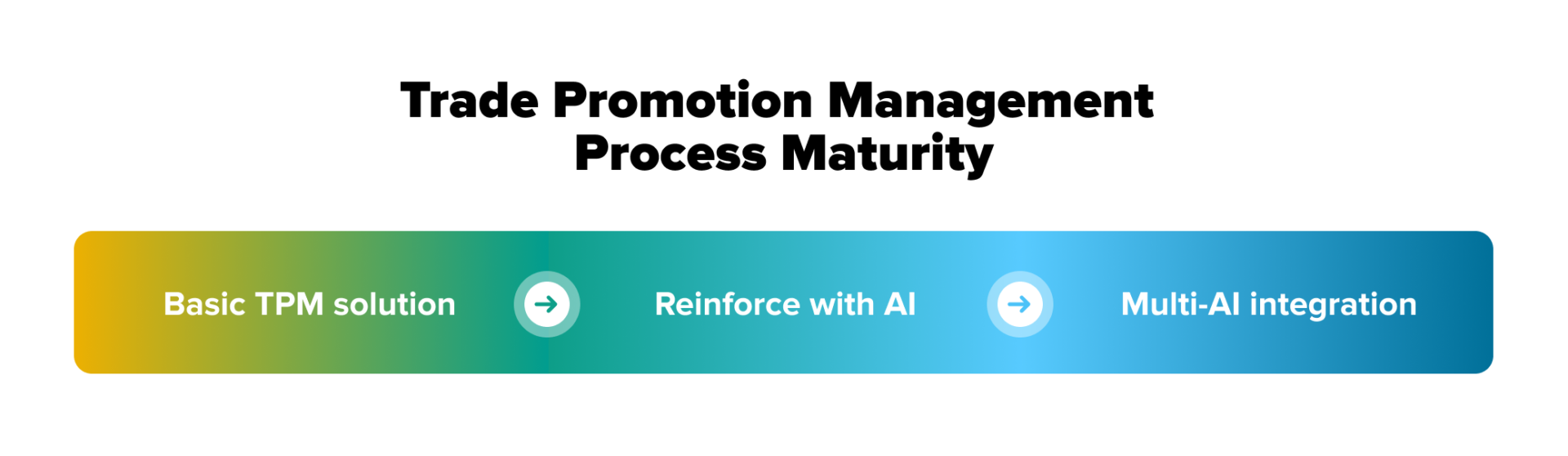
ML adoption for accurate forecasting, gen AI for assistance, or an AI agent for turning insights into automated decisions – each of these goes only after a strong technical foundation is prepared, since they are all highly data-driven.
AI types collaborating within one ecosystem mark the highest maturity level of TPM as a process.
So, despite AI in the CPG industry having been around in Trade Promotion Management for quite some time, not everyone is ready to adapt it.
For Those Who Are Ready – Why’s the Rush?
Imagine two companies in 2025.
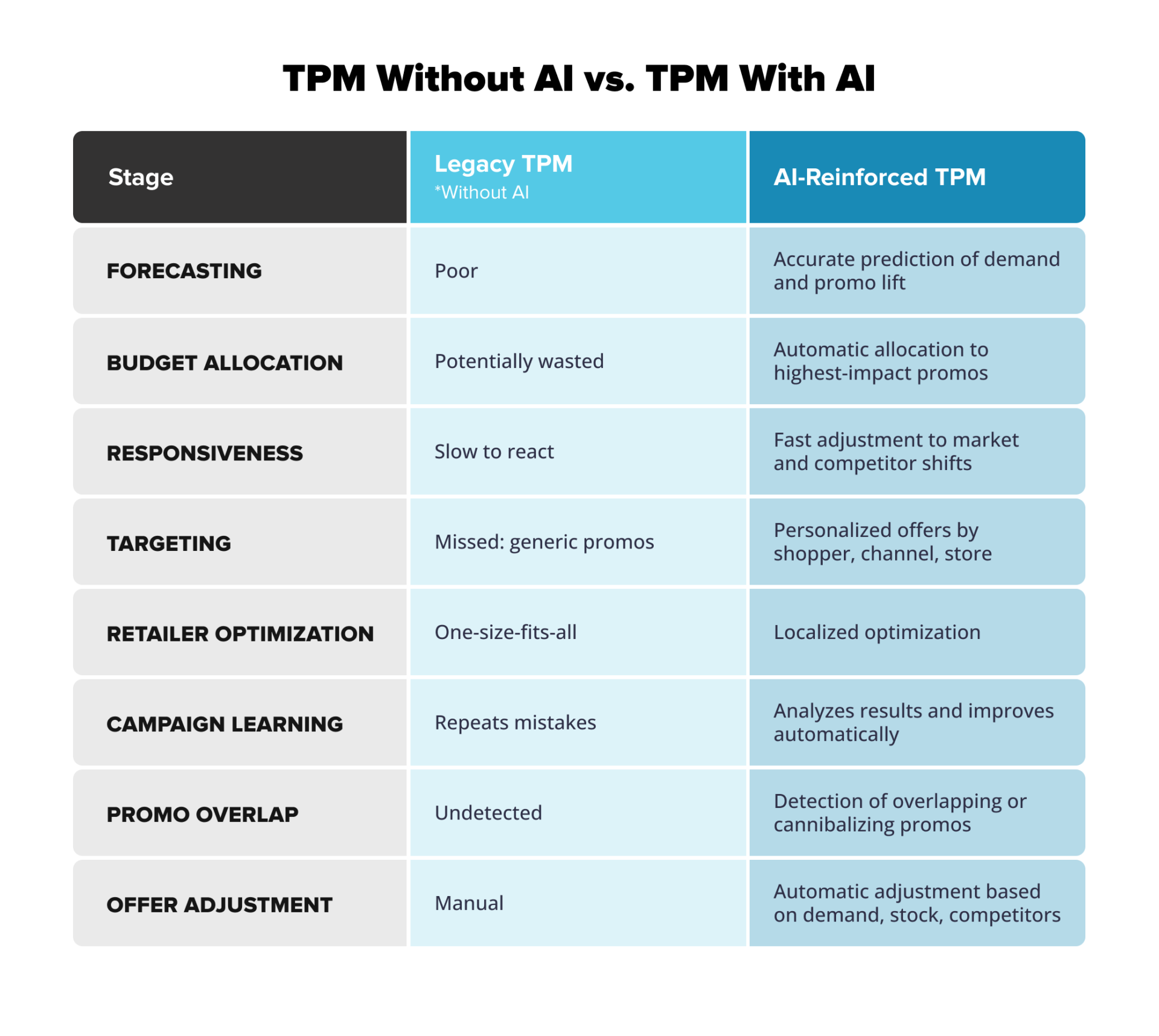
The first manages thousands of promos a year with a basic, legacy TPM. It results in:
- Poor forecasting without ML
- Investments in potentially underperforming promos
- Slow reaction to market shifts or competitor moves
- Missed targeting: can’t tailor to shopper groups or local patterns
- Zero retailer-level optimization: one-size-fits-all across stores and channels.
The second runs its promotions through an AI-reinforced TPM ecosystem. It experiences:
- Prediction of demand and promo lift with high accuracy
- Automatic allocation of budgets to the highest-impact promotions
- Analysis of results and improvement of future campaigns on its own
- Automatic adjustment of offers based on demand, stock, and competitor activity
- Detection of overlapping or cannibalizing promotions
- Delivery of personalized offers for different shopper segments, channels, and stores
And here’s the twist – they’re direct competitors.
While the first company struggles to keep up, the second is already testing new promo scenarios, adjusting plans in real time, and reinvesting savings into growth.
It’s not hard to guess which one will save more in the long run, and which will quietly lose, never fully knowing where or why.
Add to this picture a few more market and economic urgencies where artificial intelligence can step in:
- Rising costs and tighter margins mean there’s little room for mistakes.
- Retailers and price-sensitive consumers are raising the stakes for promotions.
- Ineffective campaigns now hit profitability directly.
- Companies need to make faster, smarter, and more precise decisions.
Let’s sum it up by briefly examining the key benefits that artificial intelligence brings to trade promotion, as well as the challenges companies face when implementing it.
Benefits of AI in Trade Promotion
Artificial intelligence is redefining how CPG companies plan, execute, and evaluate promotional strategies. What exactly does trade promotion using artificial intelligence bring to the table?
Increased ROI and Revenue Growth
AI identifies the most effective promotions and channels, ensuring that spent resources deliver measurable returns.
Improved Forecast Accuracy and Resource Allocation
By analyzing historical data and market trends, the technology enables more precise demand forecasting and more informed budget distribution.
Enhanced Customer Engagement and Loyalty
The technology helps personalize offers and tailor promotions to specific shopper segments or retail customer.
Faster, Data-driven Decision-making
Automated analytics and real-time insights allow teams to react quickly to market changes and optimize promotions on the go.
Challenges of AI in Trade Promotion
Despite being the core of digital transformation in the FMCG industry and its potential, implementing AI in trade promotion management isn’t without obstacles. Many companies face difficulties related to data quality, integration, and organizational readiness. The obstacles exactly are:
Data Security, Privacy, and Compliance
AI systems rely on large volumes of sensitive data, making it crucial to safeguard information and prevent unauthorized access.
Integration with Existing Legacy Systems
Connecting advanced models with outdated platforms and fragmented data sources often requires significant technical effort and investment.
Managing Algorithm Bias and Fairness
Without proper monitoring by the vendor, models can learn from biased data and make skewed decisions.
Change Management and Adoption Barriers
Teams used to traditional ways of working may face resistance to AI-driven approaches, especially when recommendations contradict their hard-won experience.
Now that we’ve discussed the advantages and challenges, let’s examine different AI use cases in FMCG TPM (or CPG; the FMCG vs CPG distinction isn’t relevant here).
Predictive, Generative, and Agentic AI in Trade Promotion – What Each Does
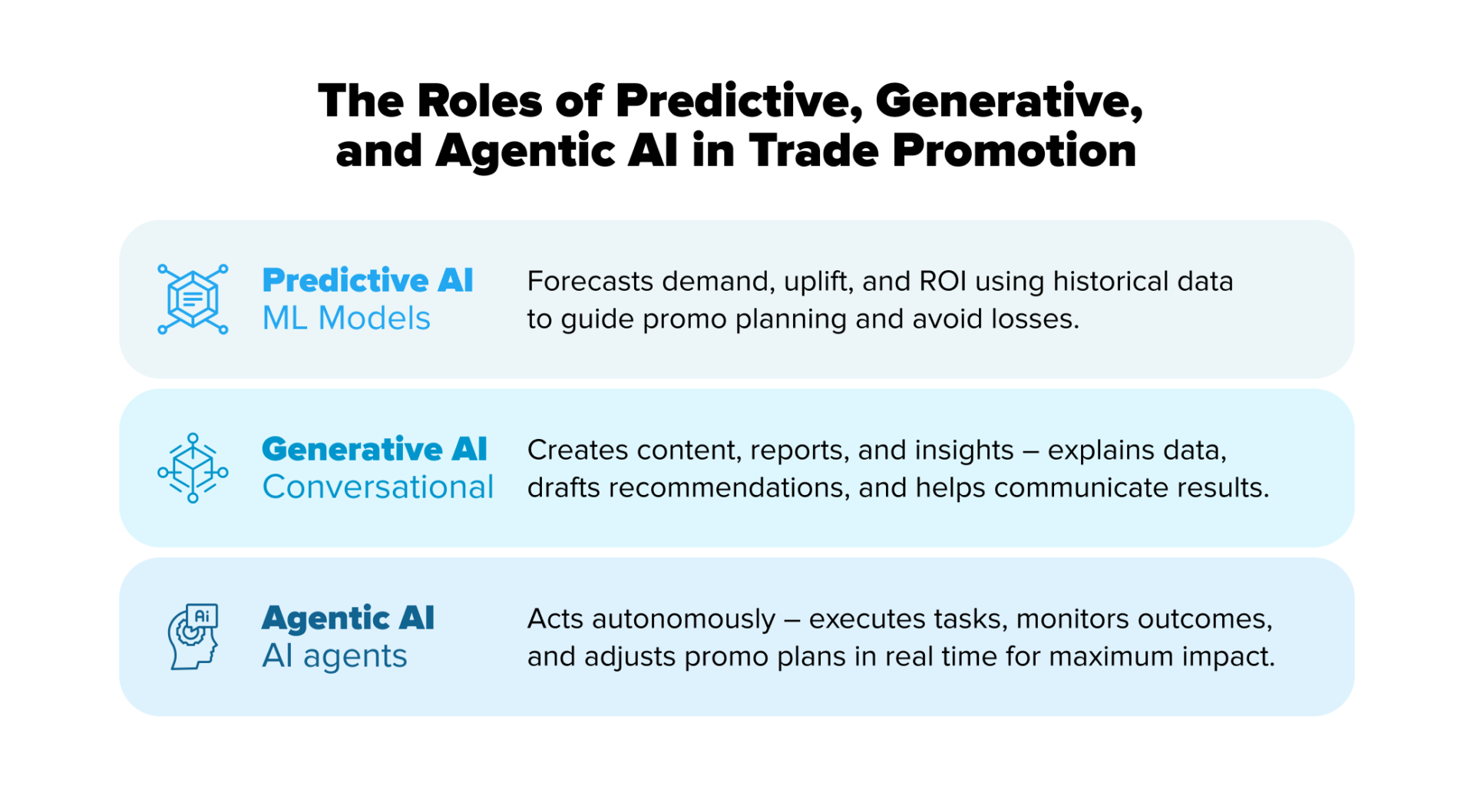
We will start with the base of every modern analytics – machine learning.
Use Cases of Predictive AI (ML Models)
Machine learning in FMCG relies on patterns in past data to make better decisions about the future. By studying sales information, promo results, and market trends, it predicts how well a promotion will perform and what timing, discounts, and mechanics could maximize results.
That’s exactly what ML brings to SSBS’s Trade Promotion Management software, PromoTool. Here’s what it does:
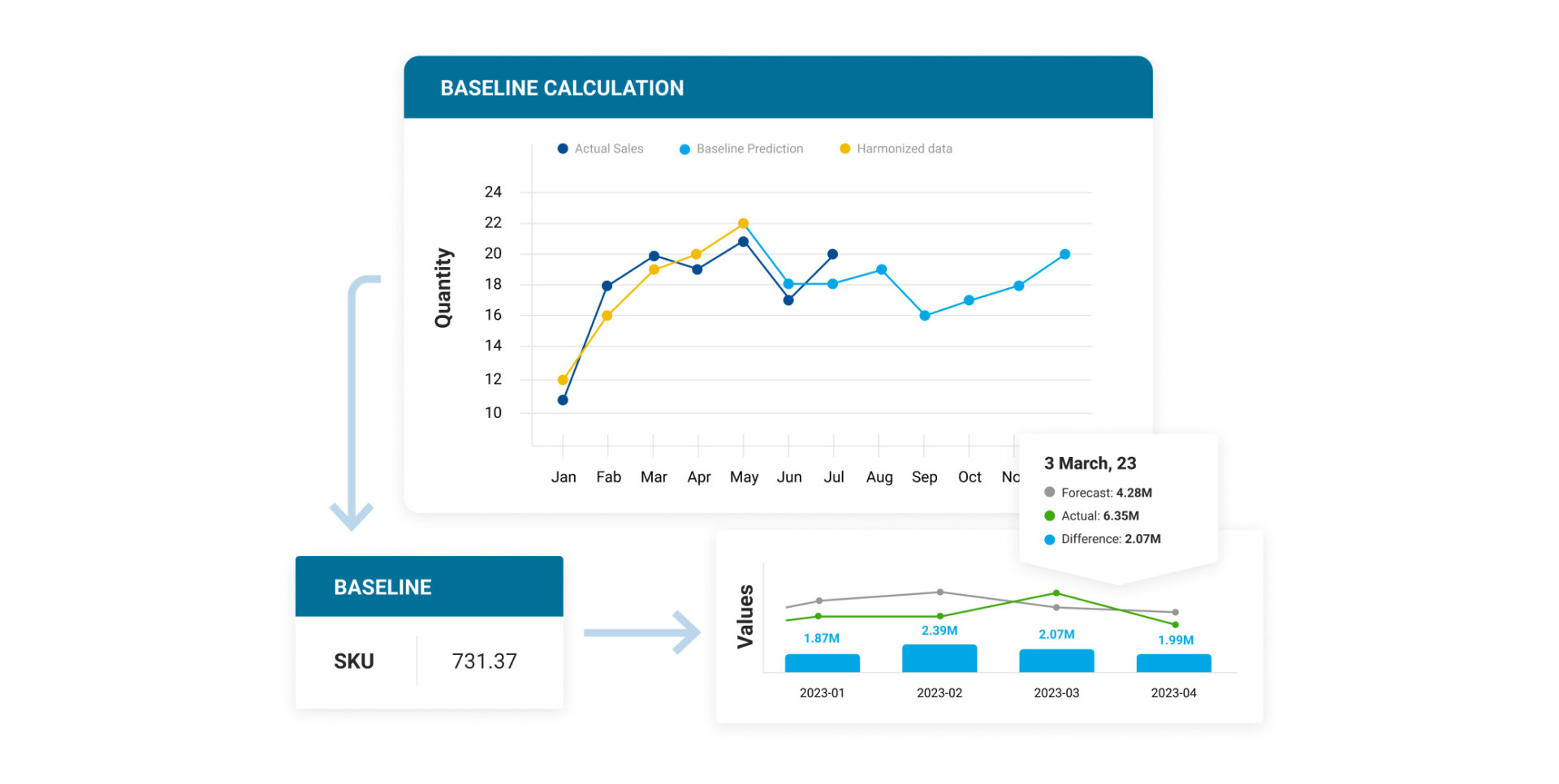
Baseline Calculations
Figuring out the baseline requires tons of historical data on past sales. The data must be sifted out from everything that distorts the “normal” picture: past promotions, out-of-stocks, pricing fluctuations, and distribution gaps.
This process takes days of manual work and still leaves plenty of room for error. Predictive AI simplifies the process by automatically cleaning, structuring, and analyzing data to determine a reliable baseline in minutes.
Uplift and Profitability Predictions
Trained on historical data, artificial intelligence analyzes hundreds or even thousands of past promotions, factoring in seasonality, competitor actions, and promo mechanics. The result: instant uplift predictions that form the basis for profitability and ROI estimates.
Cannibalization Prediction
Predictive AI helps identify when one promotion might steal sales from another, allowing you to adjust plans before launch and protect total category performance.
Optimization Suggestions
Going a step further, predictive AI tests multiple combinations of promo parameters, identifies the optimal scenario, and recommends it.
Use Cases of Generative AI and Agentic AI in Trade Promotion Optimization
Depending on the model, generative AI is trained on text, images, video, or audio data to process these formats and generate original content in response to users’ instructions.
The instructional part (or prompt) is crucial for understanding why there’s so much buzz around AI agents.
Rather than waiting for a prompt, agentic AI determines business objectives, makes decisions, and carries out tasks autonomously.
At SSBS, we see great potential for CPG trade promotion management using AI to transform how companies plan, execute, and evaluate promotions. The combination of generative AI and AI agents is particularly powerful.
We’ve developed use cases and demos that combine these two types of artificial intelligence. While they haven’t been fully integrated into our TPM solution or some of our clients’ TPM processes yet, the results we’ve observed so far are auspicious.
We’ve identified three key roles for the generative-agentic combination, which guide how we put them into practice:
Assistant – for Training and Guidance
Generative AI can act as an on-demand assistant. Imagine a newcomer on their first day. The person can simply ask an assistant how to perform a promotional activity within the system or locate the necessary reports. The conversational technology, which explains the purpose of each TPM module, guides users through complex processes and provides step-by-step instructions.
Instead of reading long manuals, users can simply ask, “How do I adjust promo parameters for a specific retailer?” and get an instant, clear response.

Moreover, artificial intelligence can also take instructions from text, voice, or email and automatically fill in the right fields within our AI-based trade promotion planning and analytics system, depending on the context.
Advisor – for Smart Insights and Competitive Context
Artificial intelligence can already collect, interpret, and visualize user data – that’s nothing new. What’s truly interesting is that it can do the same with competitor data. By tapping into open sources or syndicated research, the technology helps teams track market trends and adjust their strategies in real time.
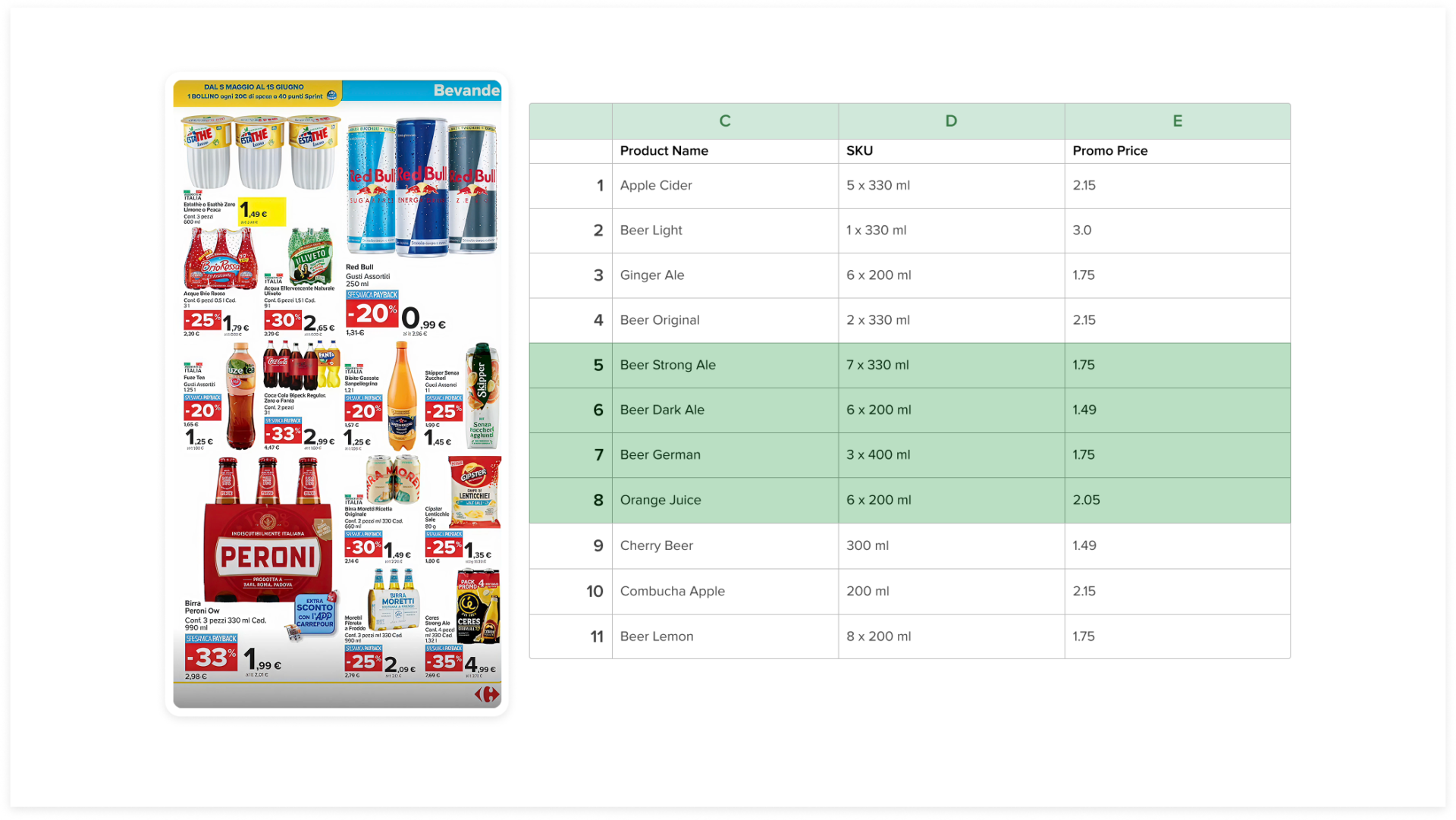
Even complex data, like promotional catalogs, no longer needs to be manually reviewed. The AI agent we built can extract all products and prices directly from catalog images and convert them into a clean, easy-to-analyze table – a game changer for CPG trade promotion using AI.
It’s kind of how AI product recognition solutions work, but tailored specifically for promotional analysis.
Expert – for Predictive Power with Human-Like Reasoning
ML’s predictive models form the foundation that other artificial intelligence types can build on and take several steps further.
For instance, an AI CPG trade promotion management solution user can simply ask the system’s conversational interface to analyze all available data and recommend the best promotion mechanics, optimal discount levels to maintain profitability, tailored to each retail partner.
The system then tests multiple scenarios, explains its reasoning, and suggests the next best action.
That’s just a few of the use cases we’ve been working on. The number of combinations and possibilities is immense.
So, let’s sum up what you’ll gain by not limiting your trade marketing team to one AI type that’s hyping.
Conclusion: Combining Predictive AI and Agentic AI in one CPG TPM Ecosystem
Traditionally, users didn’t interact directly with ML models. They received the results – forecasts, recommendations, and analytics. All the artificial intelligence logic remained buried “under the hood.” This limited user engagement partly prevented businesses from fully realizing the potential of the technology.
By combining agentic and conversational AI with ML models, we create a completely new user experience for AI CPG trade promotions companies.
Now, users can access artificial intelligence capabilities through a simple conversational interface, request exactly the analytics they need, and rely on AI agents to perform routine tasks without prompts or repeated instructions.