Spreadsheets are the least effective instrument on the market for handling trade promotion management. So, when an FMCG company finally decides to move a step higher with the automation of this process, it often faces a challenge:
- to choose an advanced, broad-functional tool that requires deeper process maturity
- or a simpler instrument in implementation, but limited in functionality.
And this is where many brands get stuck, believing they must make the TPO vs TPM choice.
In reality, TPM and TPO solutions aren’t rivals; they’re steps in the same journey toward a more profitable trade promotion process.
In this article, we will explain what TPM/TPO solutions actually do, how brands usually progress from one to the other, and what the adoption typically looks like.
What is Trade Promotion Management?
Trade promotion management is both a process and a tech solution that supports this process.
As a solution, Trade Promotion Management (TPM) is a system for planning, approving, managing, and analyzing promotions.
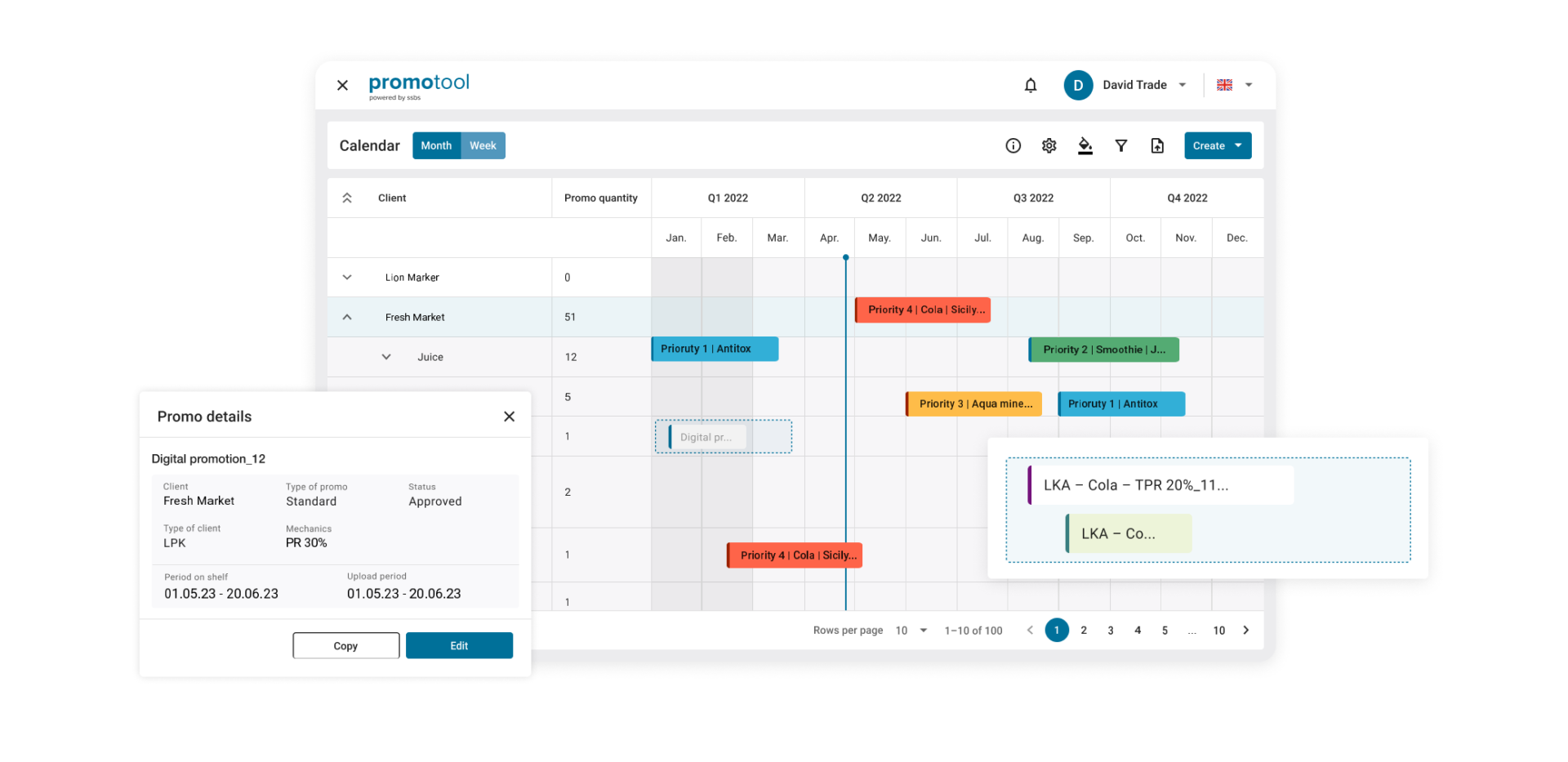
To answer the “What is Trade Promotion Management?” question even better, let’s look at how a typical FMCG brand usually experiences the process in practice.
Most brands start with a familiar problem: promotions are planned in spreadsheets, approvals occur via emails, numbers don’t match across teams, and no one is fully confident about the actual ROI.
This is usually the moment when a company decides it needs a proper TPM system. Once it is adopted, two things happen at the same time:
- The process becomes structured
- The technology supports every step of that structure
Components of TPM and How They Transform a Brand’s Promotion Process
The market offers different TPM tools, and most of them could be, to some degree, tailored to clients’ needs. However, there are some industry standards that outline what a mature TPM setup should include.
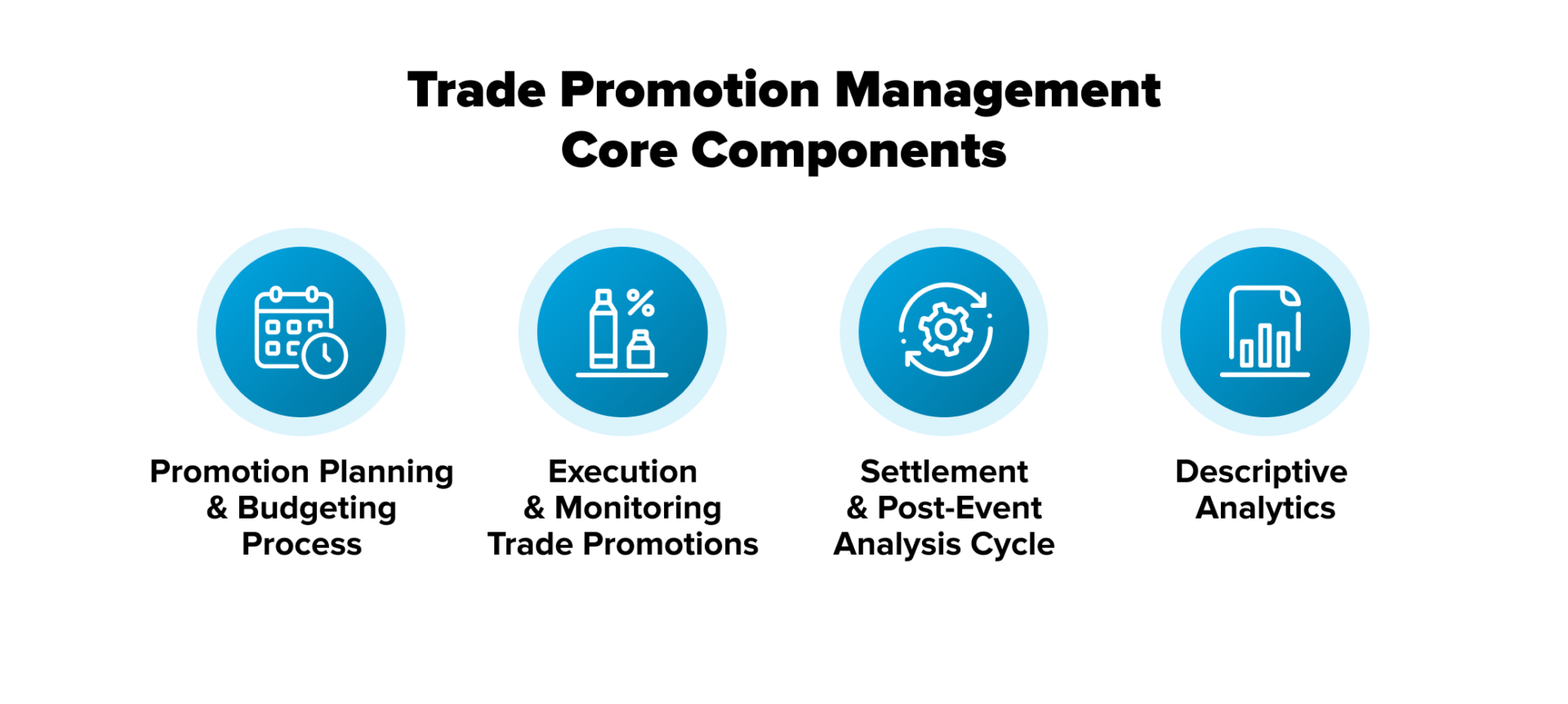
Promotion Planning & Budgeting Process
Most brands begin with two basic questions: the right sales baseline and the necessary uplift to avoid losses.
Before TPM, these answers depended on spreadsheets and intuition. With TPM, the system automatically:
- pulls historical data,
- adjusts for seasonality and competitor activity,
- calculates baselines and expected uplift,
- runs simple simulations,
- guides the approval cycle (create → review → approve).

Suddenly, the brand has a shared plan, a clear budget, and predictable expectations.
Execution & Monitoring Trade Promotions
Execution becomes smoother because TPM becomes the operating backbone:
- Sales reps collect shelf, pricing, and display data via Image Recognition → it goes into SFA → then straight into TPM.
- Key account managers verify whether retailers are adhering to the plan.
- Trade marketing monitors uplift, compliance, and stock levels in real time.
- The supply chain uses distributor data from SFA to foresee demand and prevent out-of-stock issues.
Instead of scattered updates, TPM becomes the hub where every team sees the same picture.
Settlement & Post-Event Analysis Cycle
After a promotion ends, TPM automatically compares the plan with the actuals and calculates ROI, highlighting issues such as:
- poor compliance
- low availability
- weak engagement
- inventory issues
The result doesn’t just explain what happened; it becomes part of the brand’s historical database, feeding the next planning cycle with better insights.
Descriptive Analytics (What TPM Can and Can’t Do)
Here’s where things get tricky. The “real” advanced analytics, predictive and prescriptive, only occur at the TPO adoption level, which highlights the difference between Trade Promotion Management and Trade Promotion Optimization. In TPM, what brands mostly see is descriptive analytics, like dashboards and reports on past and current promotions.
The descriptive analytics is crucial for:
- tracking budgets
- ensuring compliance
- performance evaluation
Now, let’s examine how TPO adds more value to the TPM/TPO journey and why it is the next natural step in this journey.
What is Trade Promotion Optimization?
Trade Promotion Optimization is the new level of analytical maturity. It typically appears on the radar once TPM has brought basic structure and visibility, but the team wants more advanced trade promotion analysis – the kind that uses AI/ML modeling.
Instead of just managing promotions, TPO predicts future outcomes, compares thousands of potential scenarios, and shows which ones deliver the maximum returns.
Some brands use TPO as an add-on to their TPM system; others adopt it as a standalone analytical engine. However, in all cases, TPO cannot function effectively without the basics: consistent data, structured processes, and the transparency that TPM provides. Without this foundation, TPO simply has nothing reliable to optimize.
Components of TPO and How They Transform a Brand’s Promotion Process
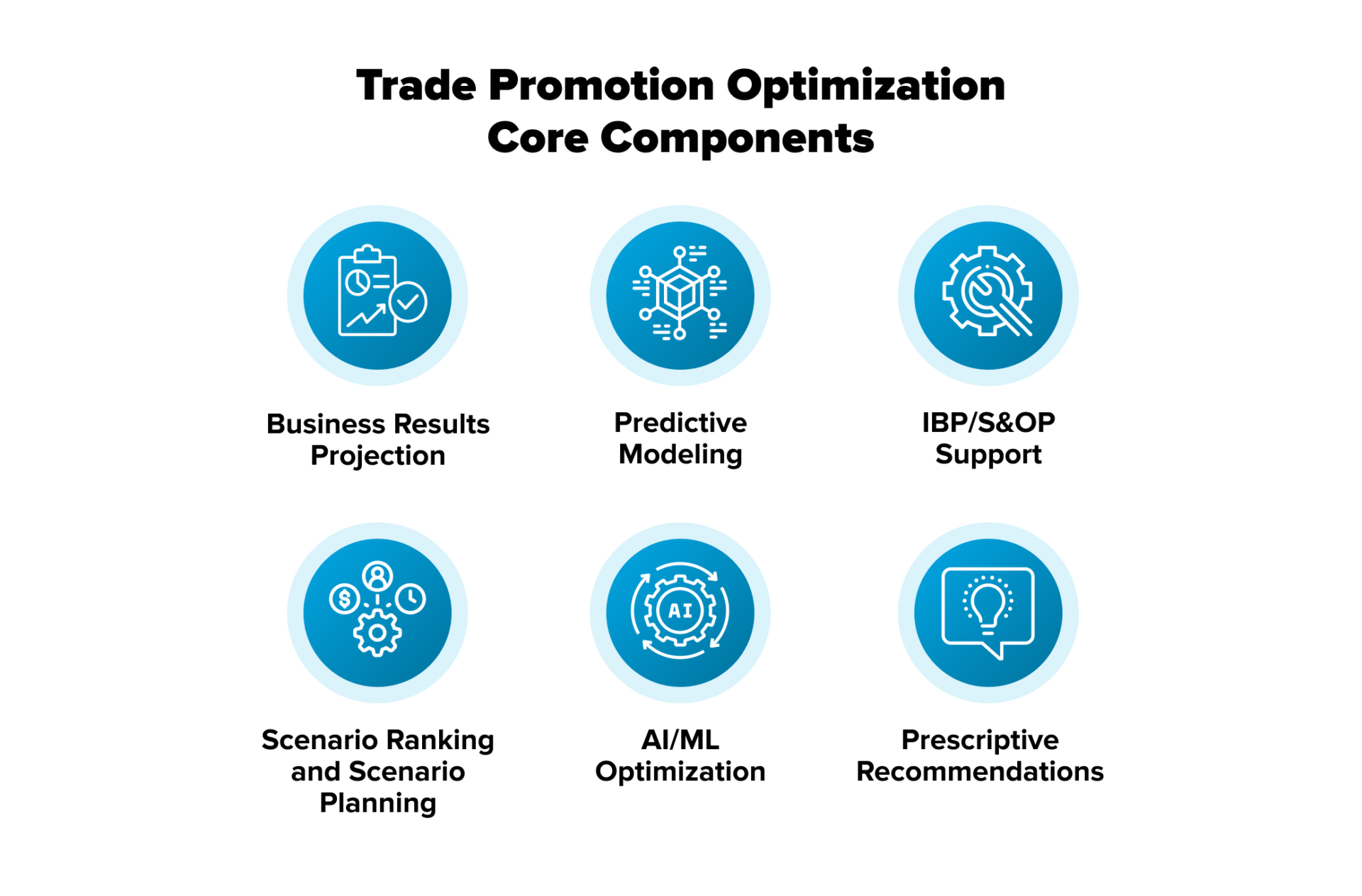
Business Results Projection
The brand can finally see expected sales, volume, and profit before launching a promotion, not afterward.
For example, it can forecast that a 15% discount in Week 32 at Retailer A will generate +18% uplift and €120K profit, while the same mechanic at Retailer B would barely break even.
Scenario Ranking and Scenario Planning
The system tests multiple promo mechanics (price cuts, bundles, displays, discounts) and ranks them by predicted profitability.
For instance, a TPO system may show that a campaign “Buy 2, Get 20% Off” outperforms a simple price cut, or that adding a secondary display delivers twice the ROI of lowering the discount.
IBP/S&OP Support
TPO feeds forecasts into supply chain and planning, helping avoid overproduction, shortages, or costly last-minute adjustments.
Let’s say the model predicts a strong uplift for a specific promotion in Q2. In this case, the system signals the supply chain to adjust production, preventing a stockout during the highest-demand weeks.
Predictive Modeling
Using historical big data, trend and seasonality data, and market behavior, TPO applies predictive analytics to forecast how shoppers and retailers will respond to each promotion.
Suppose a brand notices that discounts in December behave differently because gifting drives demand, so a smaller discount still delivers a strong uplift, saving margin, and supporting more accurate budgeting.
AI/ML Optimization
AI/ML modeling is used to identify patterns humans don’t see (such as promo fatigue or optimal discount levels) and improve recommendations over time.
Let’s say a TPO system detects that a brand overuses 30% discounts at one retailer; uplift has flattened, meaning shoppers are no longer reacting. The model recommends lowering the frequency or changing the mechanics.
Prescriptive Recommendations
Instead of only showing possible outcomes like TPM, TPO solutions give teams concrete recommendations to achieve specific measurable goals.
For example, a brand sets a target to reach a minimum of 20% ROI.
TPO provides a clear, data-driven plan:
- Best week: Week 21
- Best retailer: Retailer C
- Best mechanic: Buy X, Get Y at a discount
- Best discount: 15% off Y
- Expected ROI: +23% (above the target)
Where Does Trade Spend Management Fit In?
Trade promotions are a major component of total trade spend. However, trade spend management is generally outside the scope of TPO/TPM tools.
These systems focus on promotions, while broader trade investments (annual agreements, rebates, and fixed fees) are managed through separate commercial or financial workflows, including the processes involved in reconciling trade spending.
Some TPM/TPO solutions, however, over this gap by adding a trade spend management module. PromoTool offers this functionality, enabling teams to track annual agreements, rebates, and fixed fees alongside promotional activity.
One of our clients, a leading poultry producer and exporter, first implemented PromoTool to systemize trade spend. As the rollout continued, the company realized additional benefits: stronger alignment across departments, smoother promotion planning, and full visibility into contract terms and total investment.
Handling Trade Promotions on Different Maturity Levels
FMCG brands rarely jump from spreadsheets straight to advanced AI-driven optimization.
Instead, they move toward AI in trade promotion through stages of maturity, each one building the foundation for the next.
At each level, the brand gains new capabilities, higher process discipline, and stronger financial impact. The difference between Trade Promotion Management and Trade Promotion Optimization becomes most visible here:
- TPM stabilizes the process.
- TPO enhances and optimizes it.
| TPO TPM Comparison | ||
| Parameter | TPM | TPO |
| Primary Function | Managing and controlling trade promotions |
Identifying the most profitable promotion scenarios
|
| Focus | Execution and compliance | Analytics and forecasting
|
| Data Type | Internal (sales, budgets) | Internal + external (market, consumer)
|
| Tools | Plan/calendar, trade terms, budgets, ROI tracking | AI/ML modelling, simulations, what-if scenarios
|
| Implementation Complexity | Clear implementation path
| Complex when introduced without TPM-level foundations
|
| Expected Outcome | Elimination of unprofitable promotions through transparency and control | Increased profitability
|
Some platforms merge TPM and TPO capabilities. Our PromoTool is one of those TPO/TPM tools. This way, the “TPM vs TPO” decision becomes unnecessary, allowing companies to advance when they’re ready.
This readiness aligns with the broader maturity journey most brands follow. Let’s discuss it in more detail.
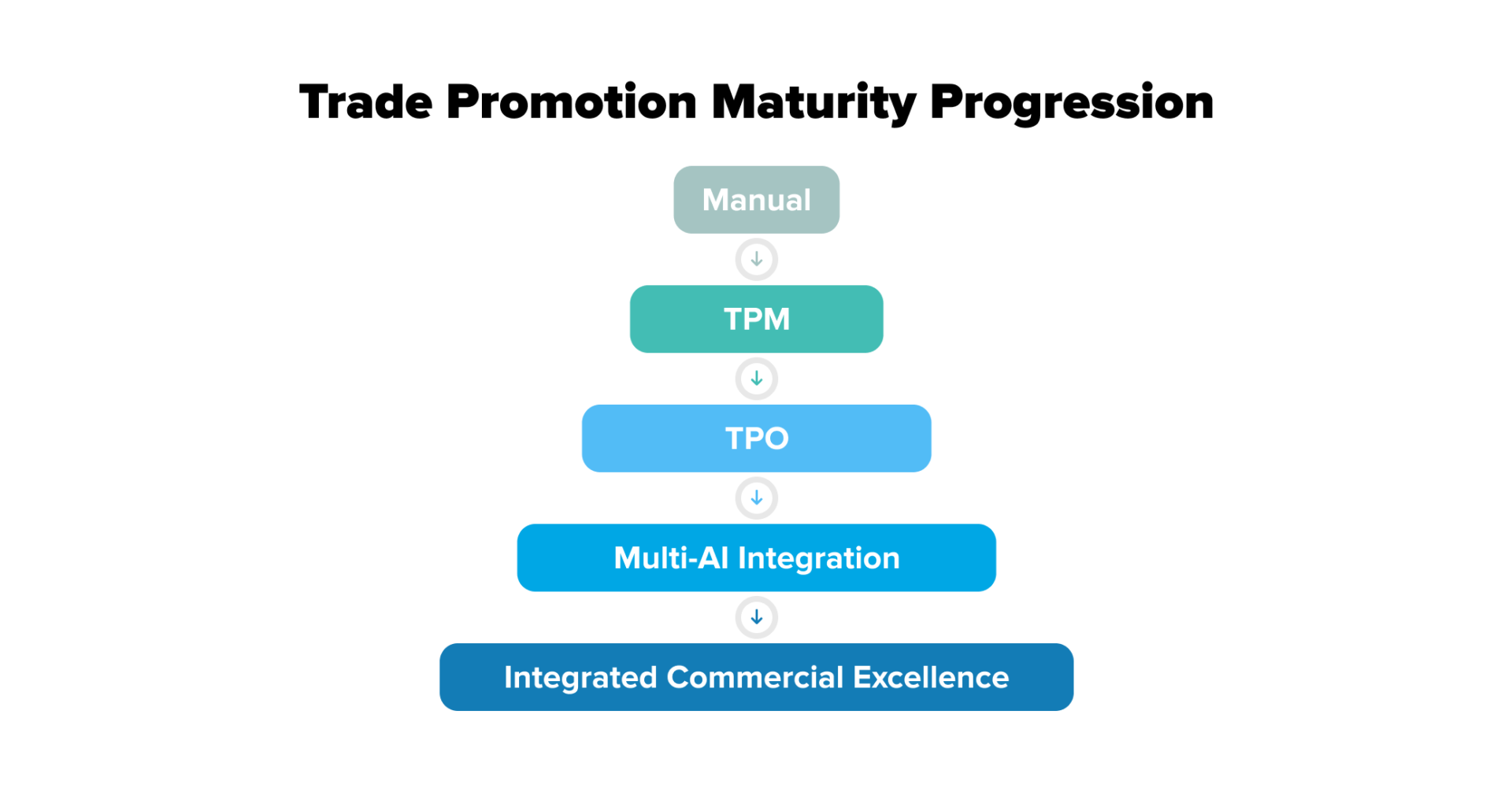
The trade promotion maturity progression typically follows a clear path:
- Brands transition from manual processes with scattered data into TPM, where workflows, budgets, and promotional tracking become structured and transparent.
- As capabilities grow, they adopt TPO, gaining trade promotion forecasting, scenario planning, and optimization through AI/ML models.
- Once TPO is established, brands layer on multi-AI integration, adding specialized AI agents or generative AI features that enhance planning, decision support, and end-to-end analysis.
- Ultimately, this leads to Integrated Commercial Excellence, where TPM, TPO, AI, and cross-functional planning (IBP/S&OP, finance, marketing, supply chain) operate as one predictive, connected ecosystem.
How We Suggest Moving Through TPM/TPO Implementation
Over the years, we’ve seen that brands succeed with TPO/TPM adoption only when it happens in stages, not all at once. That’s why our approach is built around a phased rollout, where each step is a complete, self-sufficient project.
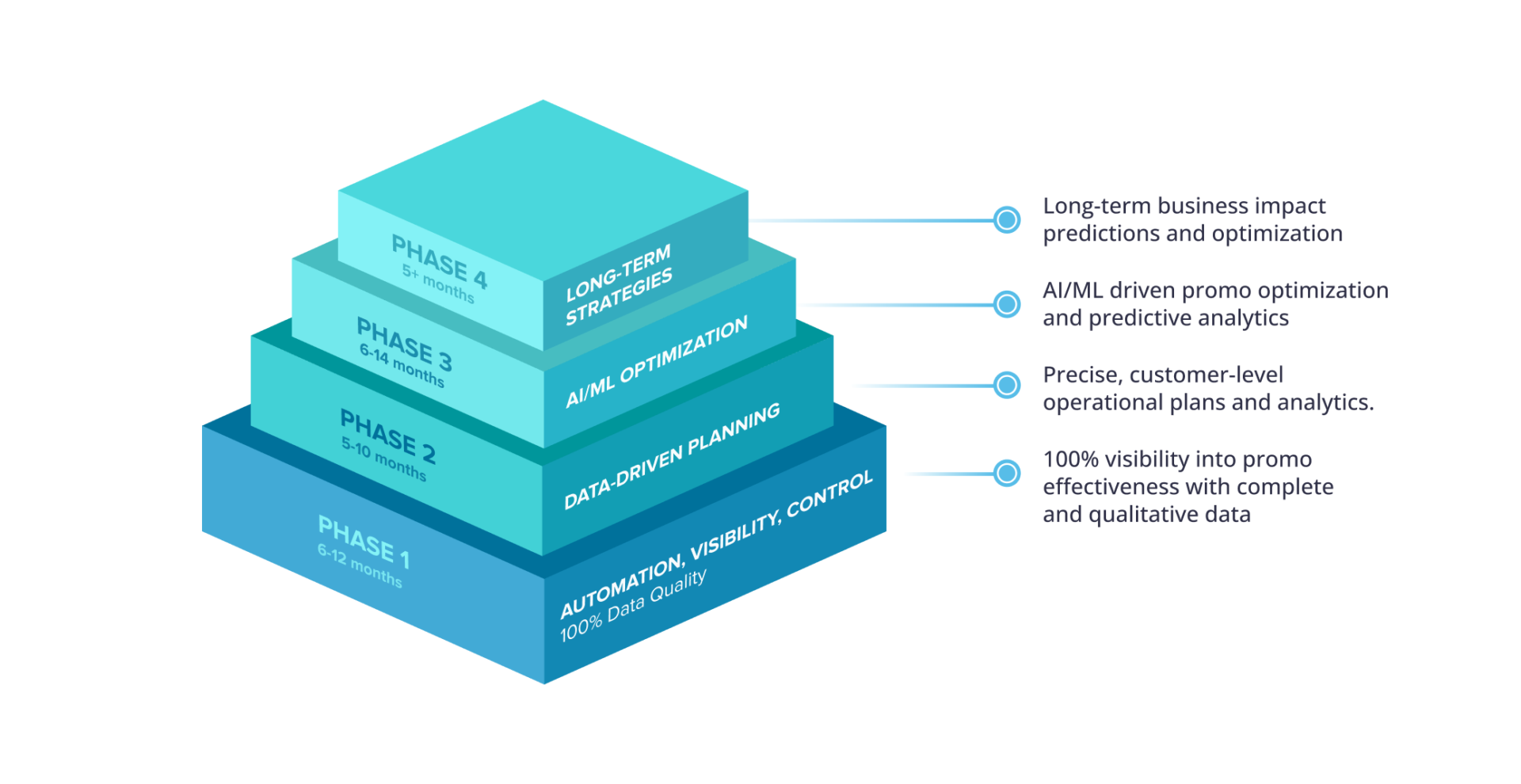
Phase 1: Automation, Visibility & Control
Brands move from spreadsheets to a unified, structured system. Data becomes reliable, plans become consistent, and cross-functional teams finally gain a comprehensive view of promotional activity.
Impact: +20–30% promo uplift, +1–2% sales growth, +1–2% profitability.
Timeline: 6–12 months.
Phase 2: Data-Driven Planning
With the basics stabilized, companies shift from reactive decisions to confident, data-led planning. Forecasts become customer-level, and trade spend planning becomes structured and automated.
Timeline: 5–10 months.
Phase 3: AI/ML Predictive Optimization
With clean data and defined processes, AI/ML begins to deliver real foresight. Promotions can be predicted, scenarios modeled, and baselines generated automatically.
New capabilities: Gen-AI metrics, IBP/S&OP scenario planning, ML baselines.
Timeline: 6–14 months.
Phase 4: Long-Term Strategies
AI/ML expands beyond promotions into strategic, long-horizon forecasting. Companies can apply advanced optimization techniques to project commercial impact months or years ahead and identify the most efficient and profitable strategies to drive revenue growth and long-term business performance.
Capabilities: ML-driven long-term planning, AI-backed RGM tools.
Timeline: 5+ months.
Conclusion
In practice, the real difference between TPM and TPO is not about choosing one or the other but about knowing when your organization is ready for each level. TPM creates structure, transparency, and control.
TPO builds on that foundation to deliver forecasting, scenario planning, and optimization. When combined and implemented in phases, they provide brands with a clear path from manual work to AI-driven decision-making and consistently stronger promotional results.