67% of CEOs say Revenue Growth Management strategies are critical for long-term financial performance. Yet only 33% of RGM leaders feel they are actually equipped to deliver on that promise.
That gap says a lot. RGM is no longer a niche pricing exercise or a marketing add-on. It has become the logic behind how companies protect margins, decide where to invest, and avoid growth that looks good on paper but erodes value in reality.
So, what is RGM in 2026, and what tools support it? Let’s start by exploring the Revenue Growth Management definition.
What is Revenue Growth Management?
Revenue Growth Management (RGM) is a strategy to grow net revenue without depending solely on higher sales volumes.
Basically, RGM meaning comes down to a single question: are we making the most of every product and channel?
Without a Revenue Growth Management framework in place, companies tend to handle pricing, promotions, pack formats, and trade terms as separate tasks. These functions are often owned by different teams, driven by short-term goals, and rarely aligned with one another.
Revenue Growth Management strategies (often discussed alongside Net Revenue Management strategies) bring these decisions together, so fragmentation wouldn’t quietly eat into value and margins.
Goals of Revenue Growth Management
The main goal (maximizing revenue while protecting margins) is achievable if efforts are divided across the following four areas.
| RGM Focus Area | Purpose / Contribution to Main Goal |
| Profitability | Ensures each product and promotion drives margin, not just volume |
| Sustainable Growth | Balances short-term wins with long-term brand and revenue health |
| Consumer-Centric Decisions | Aligns offers, packs, and pricing with real shopper needs |
| Organizational Alignment | Coordinates teams so decisions support the overall strategy |
Profitability
Revenue Growth Management framework shifts the focus from sheer volume to profit per sale.
For instance, a beverage brand runs frequent deep discounts to boost volume. Sales go up, but margins shrink. Their revenue growth manager would look at which promotions truly drive incremental sales versus which ones just train shoppers to wait for deals.
In short, profitable Revenue Growth Management helps companies stop leaking money through poorly designed prices, packs, and deals.
Sustainable Growth
Growth that lasts is more important than quick wins.
Imagine a snack brand that introduces only low-price family packs to drive volume. It works short-term. However, over time, customers stop buying the regular or premium options. The brand becomes known as “cheap,” and profit drops.
By applying a Revenue Growth Management framework, the company would balance entry-level, mainstream, and premium options, so growth doesn’t come from racing to the bottom.
Consumer-Centric Decisions
Understanding how real people choose, compare, and buy products is the key that helps adjusting many factors – from how products are priced to how they’re placed and promoted.
Let’s say a shampoo brand notices that many shoppers want a smaller, cheaper option for travel or trial, but only large bottles are available. Instead of cutting prices, their revenue growth manager would suggest adding a smaller pack at a lower absolute price. That meets a real need without harming the main product’s value.
Organizational Alignment
Scattered decisions from various teams must be gathered into a coordinated system. Without such a unified overview, teams often work against each other:
- Sales pushes for discounts to hit targets
- Marketing pushes premium positioning
- Finance tries to protect margins
- Supply chain tries to simplify the range
- RGM puts everyone on the same logic.
Where RGM Is Used and Why FMCG/CPG Is the Main Focus Today
The Revenue Growth Management framework logic is universal. In theory, it can be applied anywhere where pricing, packaging, promotions, and sales channels affect what people choose.
In practice, FMCG challenges make it especially critical, with constant promotions, complex trade strategies, products easily swamped, and margin pressure.
Why now?
Revenue Growth Management isn’t new. What is new is the level of visibility brands now have.
With tools like Shelf Image Recognition and Trade Promotion Management software, along with real-time sales and execution data, companies can finally see what used to stay hidden: which promotions actually lift demand, which packs cannibalize others, where pricing breaks, and where value quietly leaks out.
Once those patterns become visible, they’re hard to ignore.
That’s why Revenue Growth Management strategies are getting renewed attention. Not as a theory, but as a way to bring structure to decisions that were once made on habit, intuition, or local targets.
Key Components of Revenue Growth Management: The 5 Levers
Those four goals we’ve discussed are embodied by focusing on five main levers within the Revenue Growth Management framework.

Pricing
RGM is tightly linked to marketing because many of its levers shape how the brand is experienced, not just how it performs financially. Prising is one of such things.
Marketing defines the brand’s promise (premium, everyday value, etc.). RGM makes sure pricing, pack sizes, promo mechanics, and channel presence actually support that promise.
For instance, if in marketing a product is positioned as premium but is constantly discounted or sold mainly through discounters, that positioning collapses.
At the same time, the Revenue Growth Management framework must account for rising production, logistics, and trade costs, as well as competitive pressure, so brand image and business reality remain aligned.
Promotions
Traditionally, promotions are handled through TPM and TPO. These processes focus on planning campaigns, booking budgets, executing retailer deals, and verifying whether a promo hits its volume or revenue targets.
Together, they sit under the broader discipline of Trade Spend Management, which tracks how much finances are being poured into discounts, rebates, displays, and other incentives.
With today’s AI-driven TPO tools, companies can already see much more than before: patterns of promo dependency, demand shifting, cannibalization, and margin erosion.
The problem: this setup often looks at promotions in isolation.
Revenue Growth Management zooms out. It asks not just “Did this promo work?” but “Should this promo exist in the first place, and what role should promotions play in our growth model?”
Take a laundry detergent that runs at 30% off every second week. TPM shows strong promo volumes. TPO fine-tunes the depth and timing. But the revenue growth manager connects the dots: shoppers have learned the rhythm. They stop buying at full price. Sales look stable; profit quietly shrinks.
Product Assortment and PPA
Customers rarely decide in absolute terms (“I’ll buy brand X”). They choose between options on the shelf: small vs. large, basic vs. premium, single vs. bundle. PPA (Pack-Price Architecture) is about deliberately shaping those choices.
For instance, a coffee brand sells:
- 200g jar
- 400g jar
- 1kg value pack
If the 400g is priced too close to the 1kg, shoppers jump straight to the biggest pack. Volume looks great, but profit drops.
If the 200g is too expensive per gram, new customers are less likely to try the brand.
If the premium blend is too close to the standard one, it stops feeling premium.
Revenue Growth Management uses PPA to:
- Control how people move between options
- Protect premium tiers
- Keep entry points accessible
- Prevent everyone from drifting to the cheapest choice
Distribution and Sales Channels
Let’s say, a premium organic juice is sold in corner shops at the same price as in specialty shops. In the first channel, it feels expensive. In the specialty shop, it feels ordinary.
Revenue Growth Management takes into account:
- Which products fit which channels
- How pricing should differ by channel
- Whether a product is losing value by being “everywhere”
- The right channel mix protects both brand image and margin
Trade Terms
We’ve already mentioned that TPM and TPO are part of trade spend. Trade spend, in turn, is the financial outcome of trade terms.
Trade terms are the rules and conditions of how a brand does business with a retailer. Trade spend is the finances that flow out due to those rules.
For instance, a brand gives one retailer extra rebates “temporarily.” Three years later, they’re still there. No one remembers why. Finance sees falling margins, sales sees good volume, and no one connects the dots.
Revenue Growth Management analytics makes trade spending more visible and intentional.
RGM vs TPM vs TPO in FMCG: What Each Process Covers
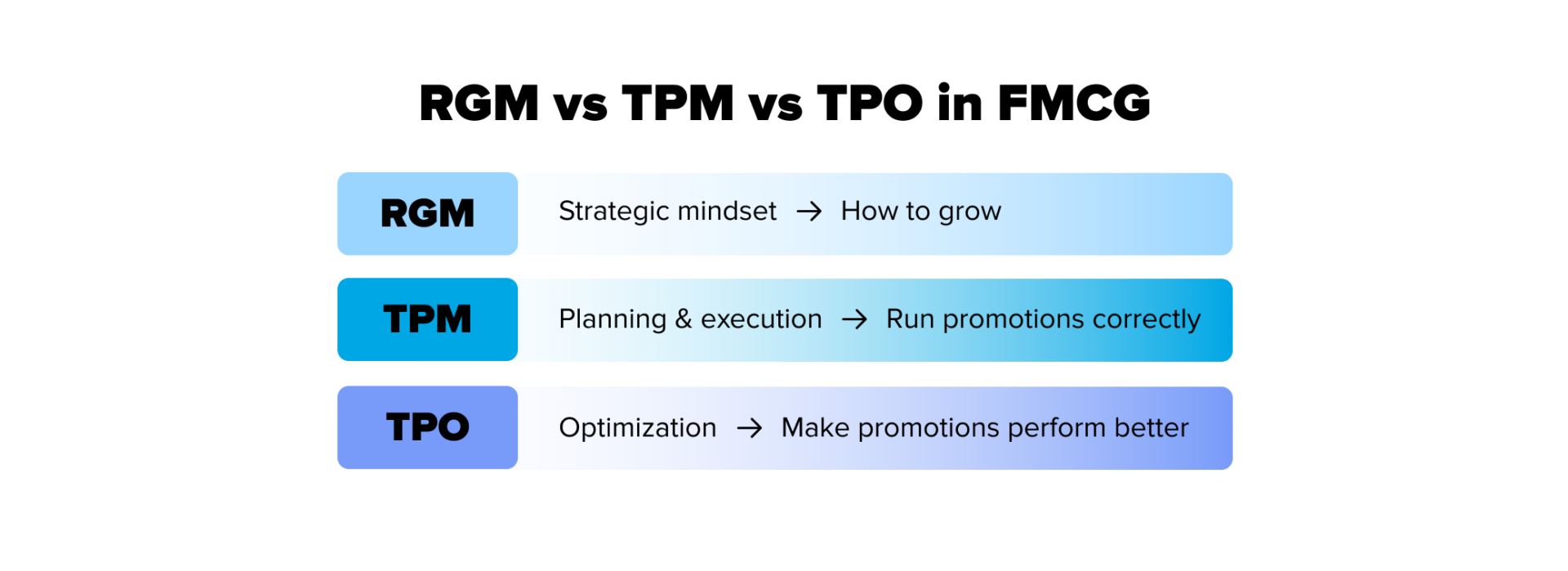
RGM, TPM, and TPO are often confused because they involve similar data and decisions. However, they serve different purposes:
- RGM – decides how the business should grow
- TPM – plans and executes promotions
- TPO – improves promotion results using analytics
TPM and TPO can be both systems and processes. RGM is a mindset for growth.
What TPM Typically Manages
Effective Trade Promotions Management is the operational layer that companies move to after outgrowing a manual, scattered approach to running promotions.

TPM systems usually handle:
- Promo calendars
- Budget allocation
- Retailer agreements
- Funding approvals
- Claims and deductions
- Post-event reporting
What TPO Typically Optimizes
In TPM vs TPO discussions, TPO is a step further. Once a company has control over promotions and basic trade promotion effectiveness analytics through TPM, the next question becomes: Which promotions actually work, why, and what should be changed?
Usually, TPO solutions use AI to quickly analyze huge amounts of data and spot patterns that non-AI-driven automation tools miss.
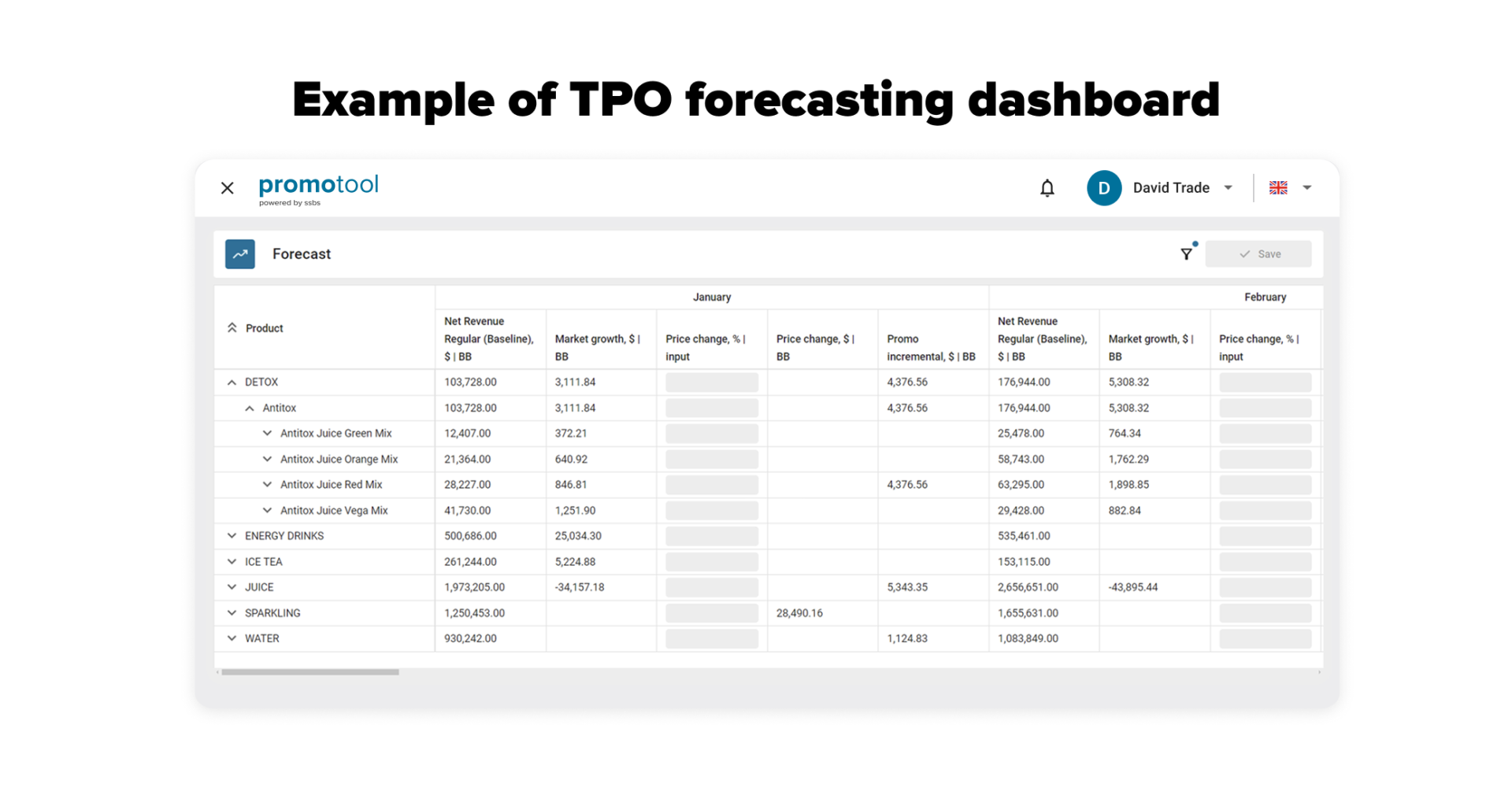
Instead of just explaining the past, AI models offer prescriptive recommendations (for example, suggesting the best discount depth, mechanic, or timing) and forecast what will likely happen if those changes are applied.
TPO improves promo efficiency without redefining the overall financial growth strategy.
Where RGM, TPM, and TPO Overlap: Shared Data and Processes
RGM, TPM, and TPO often use the same data (from sales and promo results to margins, cannibalization, and field conditions in retail). However, they use it differently.
- TPM uses data to run promotions.
- TPO uses data to optimize promotions.
- RGM uses data to decide what promotions are for.
Let’s say, all three might look at the same detergent promo:
- TPM checks if it was executed correctly.
- TPO checks if 25% off would have worked better than 30%.
- RGM asks whether this product should be promoted at all, or whether a different pack, price, or channel strategy would create more value.
| RGM vs TPM vs TPO in FMCG – What Each One Covers | |||
| TPM | TPO | RGM | |
| Core role | Execution & control | Performance improvement | Growth logic & decision framework |
| Focus | Process, compliance, tracking | Uplift, efficiency, ROI | Value creation across all levers |
| Typical scope | Promotions only | Promotions only | Pricing, promotions, PPA, channels, trade terms |
| Simulates the future | No | Yes | Yes |
How Modern Revenue Growth Management Strategies Work in Practice: An End-to-End Workflow
Revenue Growth Management isn’t a one-off project or a deck that gets dusted off once a year. It’s a loop. Decisions are made, executed, measured, corrected, and refined continuously, step by step.

Step 1: Data and Baselines
For many organizations undergoing digital transformation in FMCG, data isn’t the foundation of decision-making; it’s the first obstacle.
Some still operate legacy systems, designed to record transactions, rather than support modern analytics.
Others rely on scattered spreadsheets in business, where numbers are duplicated, sometimes copied with errors, or adjusted to fit expectations.
As a result, calculating baselines becomes almost impossible.
Modern Revenue Growth Management plan reconstructs baselines by combining:
- TPM systems to centralize promotion and trade data
- Integration across sales, finance, supply, and marketing to reconcile inconsistencies
- Data cleansing and AI tools to fix errors, duplicates, and anomalies

Only once this foundation is solid can brands make informed, value-driven decisions.
Step 2: Insights and Diagnostics
When historical data is restored, Revenue Growth Management looks for patterns:
- Which products are promo-dependent?
- Where are shoppers trading down?
- Which packs cannibalize others?
- Where is the margin leaking?
- Which sales channels behave differently?
Step 3: Strategy and Guardrails
Strategy only matters if it survives daily trade-offs: price vs. volume, promo depth vs. brand equity, local freedom vs. global consistency. Step 3 is where brands make those trade-offs explicit.
Instead of letting every pricing or promo decision turn into a negotiation, the Revenue Growth Management framework defines a small set of principles that guide choices before the debates even start.
For example, a useful Revenue Growth Management principle doesn’t say “we’re premium” or “we’re consumer-centric.” It says things like: We protect the price ladder even if it costs us short-term volume.
Or: Promotions must recruit new buyers or trade people up, never just shift volume forward.
Guardrails do a different job. They define the edges of the playing field.
This typically means minimum margin floors, limits on promotional frequency, legal constraints on pricing, and brand commitments that shouldn’t be broken for a quick win.
Step 4: Planning
After rules are defined, they must be converted into concrete commercial actions: specific price changes, a promotional calendar, and assortment decisions that can be executed by sales, trade marketing, and supply chain teams.
In practice, this means three things.
- Pricing moves stop being abstract. Brands are no longer talking about “improving price realization” or “premiumization.”They’re deciding:
- Which SKUs go up or down, by how much, and when
- How price ladders change within and across segments
- Where to simplify price architecture and where complexity is justified
- How to handle gaps between list price, net price, and shelf reality
Every move must pass the principles from Step 3.
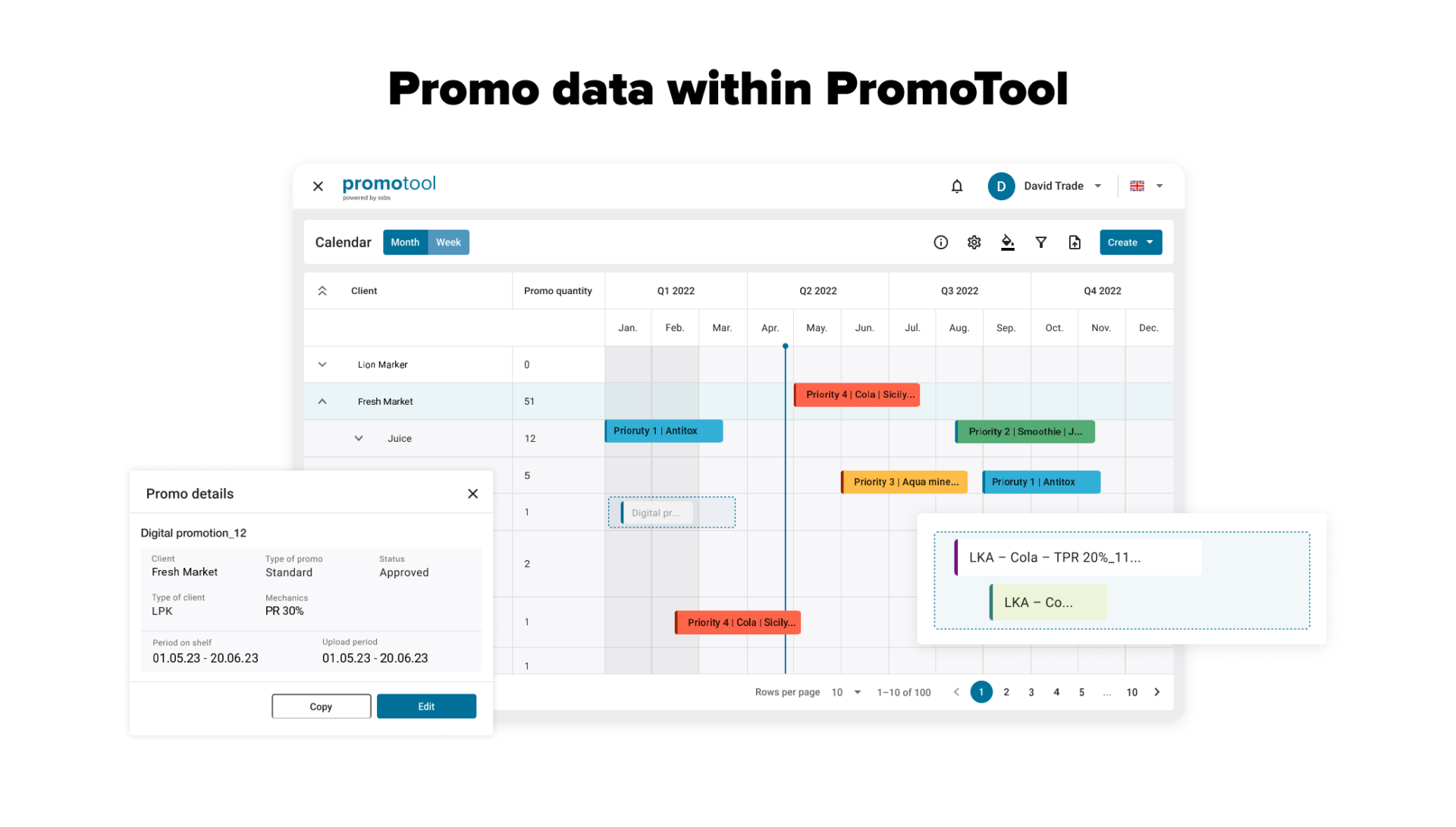
- Promo planning becomes intentional, not historical. Instead of copying last year’s promo calendar and tweaking discounts, companies define:
- What role promotions play in each category (trial, trade-up, traffic, stock-up)
- Which mechanics do you allow and which do you phase out
- Assortment decisions become economic, not emotional. Step 4 is where brands stop debating whether a SKU is “nice to have” and start asking:
- What role does this SKU play in the portfolio?
- Does it earn its shelf space?
- Does it clarify or confuse the price ladder?
- Does it support the segments we actually want to grow?
Step 5: Execution
This is the stage where RGM becomes operational.
Revenue Growth Management strategies fail when execution breaks down, as when mechanics are creatively interpreted, and nobody can tell what actually ran versus what was planned.
TPM is the system layer that prevents that. And AI-driven Shelf Image Recognition closes the last-mile gap between plan and reality by showing what actually happened in-store.

Step 6: Measurement and Optimization
Now, it’s finally time to evaluate whether actions actually created value: did they recruit new buyers, improve mix, protect price integrity, or just subsidize demand?
This step closes the loop between plan and reality.
TPO is the best software for Revenue Growth Management that allows learning at scale. Instead of treating post-promo analysis as a report, it turns it into an input for the next plan. Winning mechanics get reused, weak ones get deprioritized.
What Revenue Growth Management Analytics Businesses Use in 2026
Revenue Growth Management strategies are based on data. In the past, businesses mainly looked at historical information to assume how future sales, promotions, or pricing decisions would perform.
The modern requirements for Revenue Growth Management analytics go far beyond reporting on past events. AI-driven software is now everywhere, and it automatically generates predictions and recommends the best actions to take.

Descriptive Analytics: What Happened and Why
Descriptive analytics explains outcomes: which promos ran, how prices moved, where margins leaked, what sold, and what didn’t. This is your baseline, useful, but backward-looking.
Predictive Analytics: What Is Likely to Happen
Predictive Revenue Growth Management analytics models scenarios: how volume might react to a price change, which mechanics may outperform, and how shoppers could shift between packs or brands. This helps you anticipate impact before acting.
Prescriptive Analytics: What to Do Next
In the prescriptive analytics case, instead of just simulating options, the system suggests the best move: which price to set, which promo to fund, which SKU to delist, which mechanic to scale based on your goals and constraints.
Where PromoTool Fits: Key RGM Functions It Supports Across TPM and TPO
Revenue Growth Management is a complex discipline, but in practice, much of its day-to-day impact is felt most strongly in trade spend–driven roles.
That’s because trade spend is where pricing, promotions, and investment decisions are actually executed.
Traditionally, TPM/TPO tools don’t go beyond tasks related to promotions. However, PromoTool from SSBS supports a more extensive RGM area – trade spending.
Below, we’ll look at the specific features of this solution that support real RGM execution.
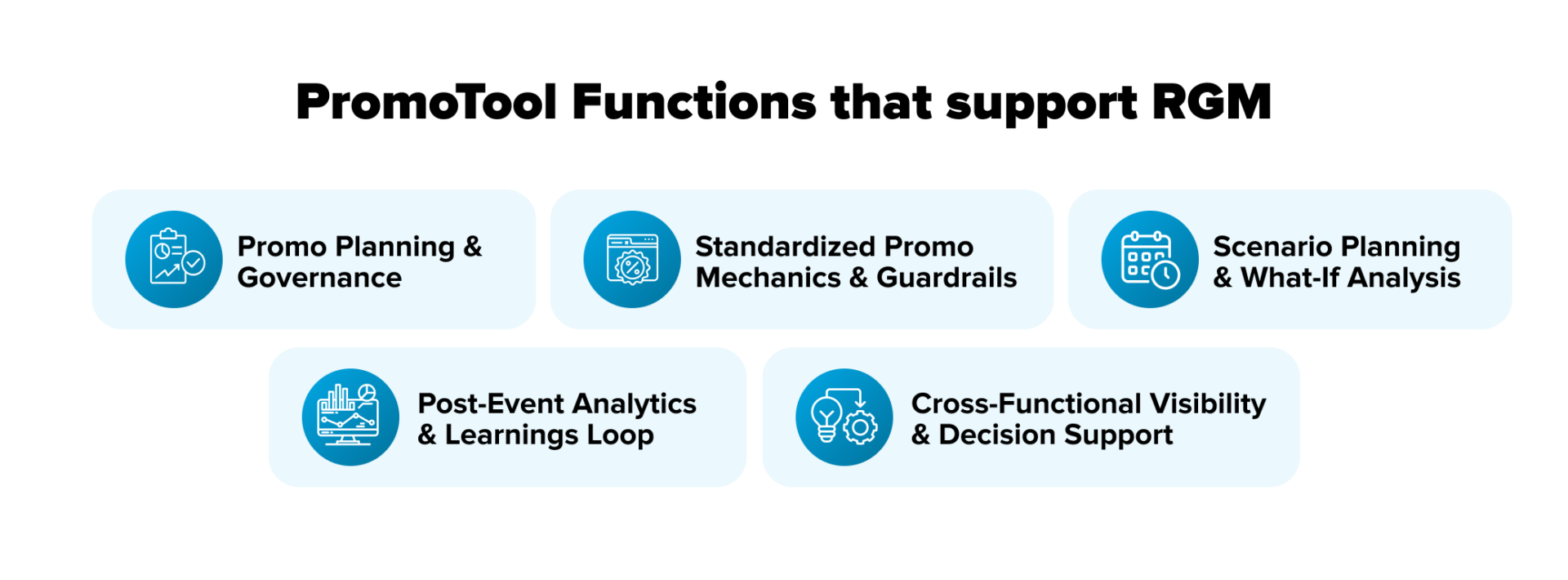
Promo Planning and Governance
PromoTool supports end-to-end promotion planning, from annual calendars to budget allocation across sales channels, customers, and mechanics.
Teams can base plans on past performance, known demand patterns, and retailer strategies instead of repeating last year’s splits.
This allows companies to manage the full promo calendar as a system, rather than treating each promo as a standalone event.
Standardized Promo Mechanics and Guardrails
Our solution is built to embed commercial rules directly into execution. It defines which mechanics are allowed, under what conditions, and within which financial limits.
It also connects planning with real-world execution: what was agreed with the retailer is what gets validated in-store, using automated data flows from field tools, Image Recognition, and SFA systems.
Managers see deviations immediately, not weeks later.
This reduces leakage, delays, and uncontrolled spending.
Scenario Planning and What-If Analysis
PromoTool lets teams simulate multiple promotion scenarios before committing budget.
Instead of evaluating a single plan, users can compare options, see expected uplift, margin impact, and ROI, and choose the strongest scenario. The same mechanic can be profitable in one retailer and weak in another. The system makes those differences visible upfront.
This shifts decisions from intuition to evidence.
Post-Event Analytics and the Learning Loop
PromoTool doesn’t stop at reporting. It links results back into future planning.
Teams can see which promotions generated true incremental volume, which eroded margin, and which simply shifted demand.
These insights automatically feed the next planning cycle, improving forecasts, scenario rankings, and mechanic selection over time.
The system becomes more accurate with every cycle.
Cross-Functional Visibility and Decision-Making Support
Shared ownership of trade spend is essential for an effective Revenue Growth Management plan.
With PromoTool, sales, marketing, finance, and RGM teams work in the same environment, with the same data, assumptions, and approval flows.
This removes fragmentation between planning, execution, and financial reconciliation.
When integrated with FMCG Distributor Management systems, Image Recognition, and execution tools, it becomes a single operational backbone for trade activities.