The FMCG industry is fast, innovative, and highly competitive. But beneath the surface, many barriers go unnoticed. These hidden challenges for FMCG companies can strongly affect how CPG brands operate, grow, and compete.
Across organizations, common FMCG issues include tools that don’t connect, AI projects that never launch, or incomplete consumer data. These are real, daily obstacles that slow teams, raise costs, and weaken even the best strategies.
From our work in the sector, we’ve identified some of the most overlooked FMCG industry challenges.
We’ll also suggest practical solutions to boost your FMCG sales strategy and make your commercial teams more effective.
Key Challenges in the FMCG Industry
| 12 FMCG challenges to be aware of | |
| Challenge | Meaning |
| The tech overload and overcomplexity | Fragmented tools, low adoption |
| Lack of data foundation for AI-powered promo optimization | Incomplete, scattered promo data |
| The AI tools adoption trap | Unused AI, unclear purpose |
| The people challenge in digital transformation | Low adoption, weak leadership |
| Consumer fragmentation | Diverse preferences, indirect engagement |
| Supply chain resilience | The need for anticipation and fast reactions |
| Evolving consumer demands | Digital, informed buyers |
| Intense competition | More choices for consumers, constant innovation |
| Digital transformation & data gaps | Fragmented systems, incomplete info |
| Sustainability & regulation | Eco rules, higher costs |
| Brand loyalty & marketing | Weak retention, limited data |
| Retailer vulnerabilities | Partner risks, disrupted distribution |
The Tech Overload and Overcomplexity
| Challenge | What it means | Recommended strategy |
| Tech overload and overcomplexity | Too many disconnected tools reduce efficiency and adoption | Consolidate systems into a single, integrated digital ecosystem |
Throughout decades, we’ve seen an explosion of CPG software solutions, each promising to solve a specific pain point.
Need a solution for retail execution? There’s a tool for that.
Want to improve trade promotions? Here’s another one.
Looking to build better forecasts? Yet another platform or system.
On paper, these investments appear logical. In practice, they often result in fragmented IT infrastructures made up of disconnected tools from multiple vendors.
What begins as a well-intentioned step toward digital transformation often turns into a complex web of isolated solutions, manual workarounds, and low user adoption. Those are increasingly common examples of challenges for the FMCG sector.
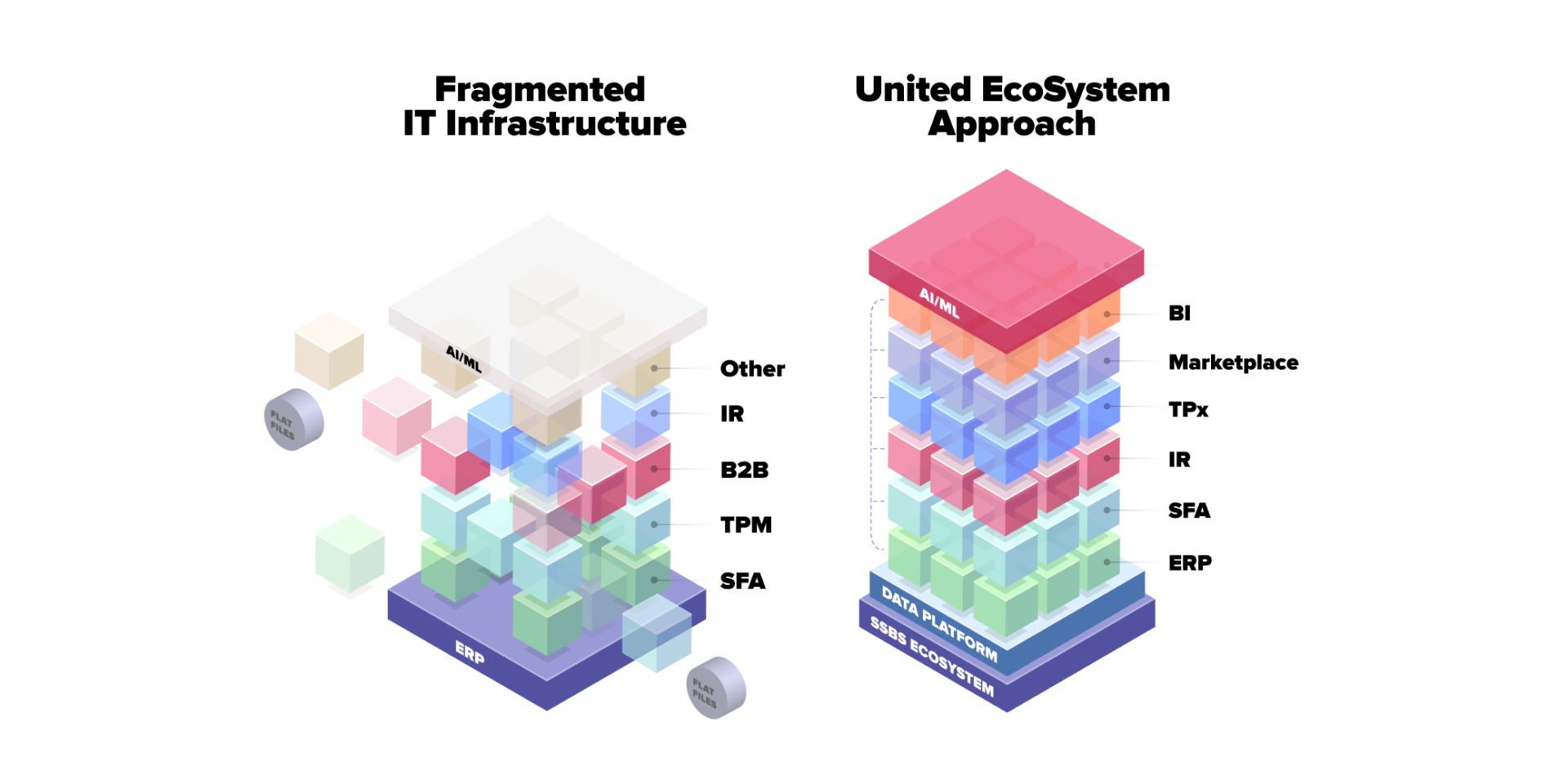
A fragmented digital environment introduces several hidden FMCG challenges that quietly hinder efficiency, increase costs, and limit overall business value:
- Broken Data Flow.
When different teams use different tools, data becomes siloed. Without smooth integration, reusing information for performance tracking, forecasting, or AI initiatives becomes nearly impossible. The business loses visibility, and the ability to make fast, informed decisions is severely limited. - Poor Data Quality.
Even when data is available, it’s often not usable. If not cleaned, mapped, or standardized, it can’t be leveraged by analytics tools or AI. This remains one of the key challenges facing FMCG companies. - Integration Gaps & Finger-Pointing.
When systems fail to sync, responsibility becomes unclear. Overlapping services, disconnected software, and multiple vendors introduce friction that slows down operations and complicates issue resolution. - Maintenance Overload.
Every added solution brings its own licensing terms, contracts, and support requirements. Over time, managing a diverse tech stack becomes an inefficient drain on internal resources, another example of the challenges FMCG industry faces as it scales its digital footprint.
Digital transformation shouldn’t mean simply adding more tools. It should mean building a smarter, more connected digital ecosystem.
What we Recommend
Our approach in this matter lies in integrating our tailored digital solutions, modern off-the-shelf technologies, and existing client systems into a unified, AI-driven platform.
We do the integration iteratively, layering technologies step by step. This supports smoother onboarding, higher user adoption, and seamless workflows across departments, creating a system that supports business agility and sustainable growth.
Lack of Data Foundation for AI-Powered Promo Optimization
| Challenge | What it means | Recommended strategy |
| Weak TPO data foundation | Fragmented promo data undermines AI accuracy | Unify promo, sales, and execution data |
Trade Promotion Optimization (TPO) has emerged as one of the most promising AI applications in the FMCG industry, offering the potential to improve ROI, reduce inefficiencies, and support smarter investment decisions. However, despite strong interest from commercial teams, many TPO initiatives struggle to deliver measurable impact. And more often than not, the issue isn’t the algorithm; it’s the data.
The reality is that a large share of Fast-Moving Consumer Goods companies still operate with fragmented, inconsistent, or incomplete promotional data. Key inputs, such as historical trade spend, sales uplift, execution metrics from Sales Force Automation software for FMCG, and ROI calculation in FMCG are often scattered across disconnected systems or stored in formats that are incompatible with modern analytics tools.
As a result, AI models lack the structured, trustworthy data they need to generate accurate, actionable insights. Without confidence in the underlying data, teams are unlikely to rely on AI-generated recommendations.
TPO is not a plug-and-play solution. It requires a solid data infrastructure that integrates promotional data across business units, aligns KPI definitions, and creates continuous feedback loops between planning and execution. Most importantly, it needs historical data that reflects real market dynamics, only then can AI-driven models deliver reliable strategies that translate into actual revenue uplift.
What we Recommend
At SoftServe Business Systems, we help FMCG organizations address these challenges in FMCG industry by combining technical excellence with domain knowledge.
Our Data Platform services consolidate and clean data across functions, while the best Trade Promotion Management software, PromoTool, enables AI-powered trade promotion planning based on reliable inputs.
This unified approach helps our clients overcome one of the biggest challenges facing FMCG companies: the ability to make promotion decisions that are both data-driven and operationally feasible.
The AI Tools Adoption Trap
| Challenge | What it means | Recommended strategy |
| AI adoption trap | Pilots remain isolated and fail to deliver ROI | Anchor AI initiatives in real business use cases |
AI is both a priority and one of the crucial challenges for the FMCG industry. It must be adopted; however, rushing to implement it often backfires.
Without a clear purpose, AI projects fail to deliver. Pilots never scale. Tools go unused. Decision-makers question ROI.
The problem is treating AI as a checkbox rather than a business enabler. Without a clear objective and integration into daily work, even advanced AI stays disconnected from results. Many FMCG companies run AI as a siloed initiative. It doesn’t impact sales, retail, or execution.
What we Recommend
To avoid this trap:
- Start with a clear use case. AI should directly support business outcomes and improve operations.
- Build a strong data foundation. AI models need accurate, detailed input from the field.
For instance, our AI Image Recognition solution for FMCG automates shelf data collection and improves in-store accuracy. This gives FMCG teams reliable insights to:
- Optimize product availability
- Improve compliance
- Refine field execution
- Reduce costs
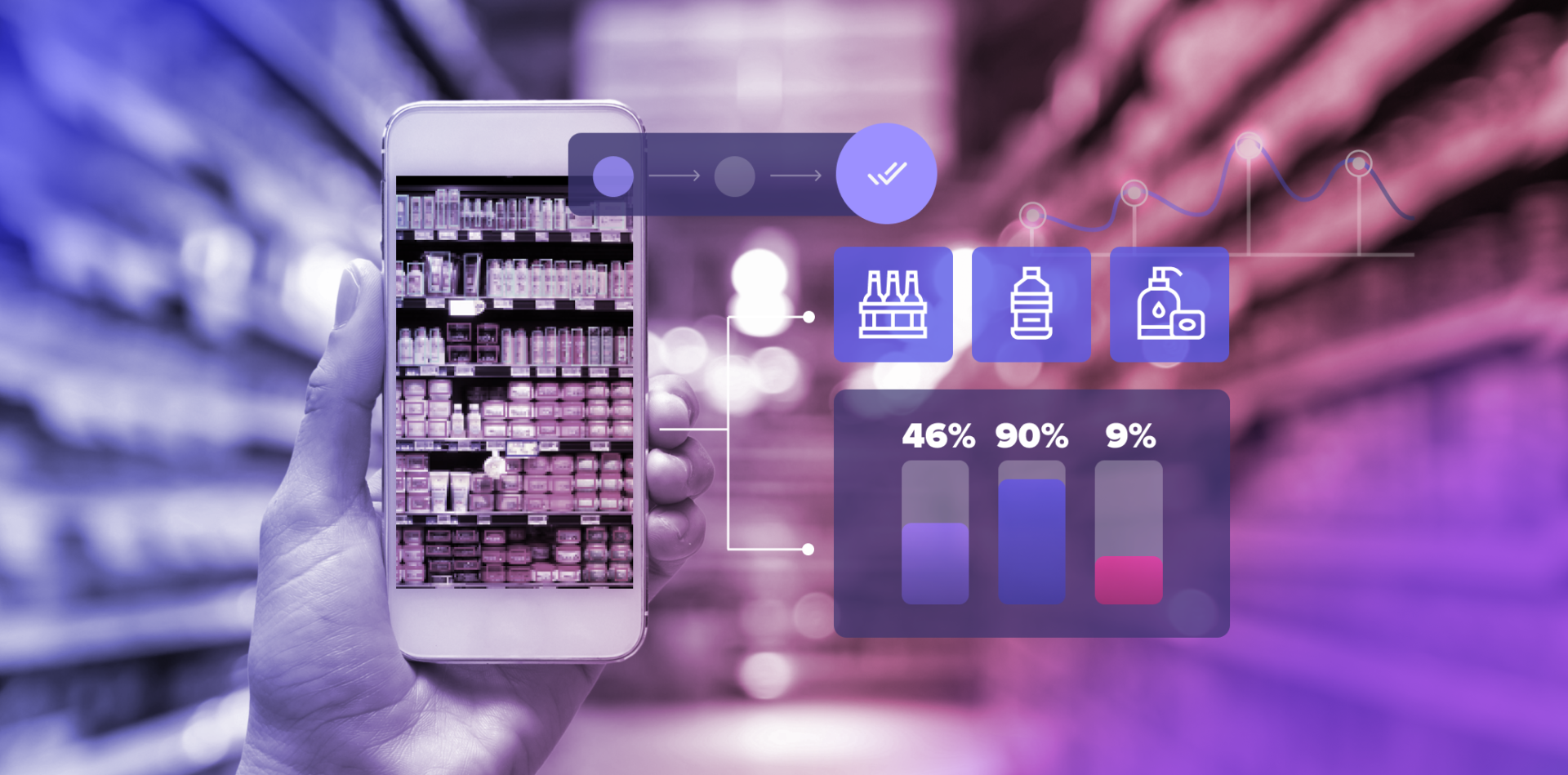
With reliable insights at hand, businesses can optimize product availability, improve compliance, refine field execution, and even reduce costs, demonstrating the real-world impact of well-implemented automation in the FMCG space.
The People Challenge in Digital Transformation
| Challenge | What it means | Recommended strategy |
| People challenge | Teams resist tools they don’t understand or own | Invest in leadership, training, and change management |
Digital transformation in the FMCG industry is often framed around platforms, data, and automation. In reality, its success hinges on people.
No matter how advanced the technology, it’s employees who determine whether a transformation gains traction or falls flat. And yet, this human element is frequently overlooked, making it one of the most underestimated FMCG industry challenges.
Technology doesn’t drive change but people do. Tools alone don’t solve business problems. It’s how teams adopt and apply those tools that make the difference. In many organizations, employees are introduced to new systems without understanding their purpose, how they align with their KPIs, or how the change benefits their roles. This lack of clarity leads to low adoption, skepticism, and lost momentum.
One of the most common internal FMCG challenges is the absence of strong leadership support. Without visible backing from the C-suite and designated digital leaders to take ownership, transformation efforts risk becoming siloed rather than truly embedded across functions like marketing, management, or commercial execution. Just as important is cultivating a culture of innovation, one that supports continuous learning and encourages teams to evolve alongside the tools they use.
We’ve seen time and again that successful transformation doesn’t start with software deployment; it starts with people. It takes a clear change management strategy, structured communication, and solutions that are rolled out with real context and ownership.
The people challenge is often the first barrier we help clients navigate through and it’s where our decades of experience truly come into play. While every organization is different, we consistently guide teams toward sustainable adoption and lasting results, combining technology with proven frameworks for change, training, and long-term engagement across the entire consumer packaged goods business.
Explore an impactful tool for advancing your FMCG digital transformation and handle challenges in FMCG distribution with our Distributor Management System.
Consumer Fragmentation
| Challenge | What it means | Recommended strategy |
| Consumer fragmentation | Brands lack direct insight into diverse customer groups | Build direct, data-driven consumer engagement |
The days of one-size-fits-all marketing in the FMCG industry are over. Today’s consumers are increasingly fragmented, spread across digital channels, influenced by niche communities, and driven by highly individualized expectations. Traditional mass-market promo strategies are losing their edge, while personalization and relevance are now essential to building loyalty and long-term engagement.
This shift presents one of the emerging challenges in FMCG industry. To reach and retain their audience, brands need more than just visibility, they need rich, first-party data, the ability to segment and target with precision, and a direct connection to the customer. Yet, many FMCG companies still depend on indirect retail and media channels, lacking the systems and insights to engage consumers at scale.
The opportunity lies in creating meaningful, direct consumer relationships. This involves capturing behavioral data, understanding individual preferences, and delivering tailored experiences that convert. But to do that effectively, companies need the right technology and strategy.
Related solution: FMCG B2B eCommerce platform for convenient and reliable connection with your customers.
At SoftServe Business Systems, we help address these challenges for FMCG companies through end-to-end consumer engagement solutions. From loyalty platforms to digital activation mechanics, we enable Fast-Moving Consumer Goods organizations to collect and activate transactional data, segment audiences, and launch personalized campaigns that deliver measurable results across the market.
Supply Chain Resilience
| Challenge | What it means | Recommended strategy |
| Supply chain resilience | Disruptions expose a lack of visibility and flexibility | Use real-time data and predictive analytics |
Companies can no longer prepare only for common risks. They must be ready for any disruption – from natural disasters to political crises.
To stay resilient, they need to:
- Anticipate and react fast to problems in supply or demand.
- Use technologies like AI to embrace predictive analytics for tracking risks and improving decisions.
- Work closely with suppliers to share information and solve issues quickly.
- Stay flexible with multiple suppliers, backup stock, and adaptable production.
- Increase visibility and speed across the supply chain.
- Include sustainability in planning without slowing operations.
Evolving Consumer Demands
| Challenge | What it means | Recommended strategy |
| Evolving consumer demands | Buyers expect digital, fast, and transparent experiences | Expand omnichannel and direct-to-consumer models |
Shoppers’ buying habits and priorities have drastically changed in recent years. Impulse purchases have dropped to 18%, while 57% now research products thoroughly before buying.
B2C eCommerce platforms and social media have made information widely available, so consumers compare prices, read reviews, and check brand values before making decisions.
Brands must adapt quickly and go digital instead of relying solely on retail. What they can do:
- Optimize their route to market in FMCG. Decide which channels, retailers, and online platforms to prioritize for faster and more reliable availability.
- Enable direct-to-consumer ordering. For instance, by building eCommerce channels or being present on popular platforms (the strategy that works both for B2B and B2C)
- Use online marketing and collaborate with social media influencers
- Offer mobile apps for gamification and reinforcing loyalty
Intense Competition
| Challenge | What it means | Recommended strategy |
| Intense competition | Crowded shelves and price pressure erode margins | Differentiate through execution and insights |
The dropping of impulsive purchases, as well as trends on underconsumption, healthy diets, and sustainability, has fragmented the market. Consumers now have more choices than ever, including niche brands, local producers, and direct-to-consumer online stores.
FMCG companies face pressure to differentiate their products, win shelf space, and maintain loyalty. Retailers also demand better promotions and faster restocking.
Brands must innovate constantly, adjust pricing, and optimize distribution to stay ahead. Data-driven insights, digital marketing, and eCommerce presence are no longer optional; they’re essential to compete effectively.
Digital Transformation & Data Gaps
| Challenge | What it means | Recommended strategy |
| Digital data gaps | Manual work and silos slow decisions | Automate and connect core commercial systems |
Many FMCG companies still rely on manual processes or fragmented systems. Sales reps might record orders on paper or in disconnected spreadsheets, and marketing insights can be scattered across multiple platforms.
This creates data gaps: incomplete, inconsistent, or outdated information that makes decision-making slow and risky. For example:
- A sales manager may not know which stores are out of stock because the field data hasn’t synced.
- Promotions may underperform because marketing doesn’t have real-time sales feedback.
- Forecasts can be inaccurate if historic sales data is incomplete or siloed.
To address this, brands need digital solutions that unify sales, marketing, and supply chain data, provide real-time visibility, and allow analytics-driven decisions. Implementing integrated SFA, CRM, or trade promotion systems helps close these gaps and accelerates digital transformation.
Sustainability & Regulation
| Challenge | What it means | Recommended strategy |
| Sustainability & regulation | Compliance increases cost and complexity | Align planning, inventory, and execution |
Single-use packaging creates large amounts of waste. Therefore, governments around the globe are responding with tighter regulatory rules – plastic bans, recyclability requirements, and producer responsibility laws. In the EU, for instance, all packaging must be reusable or recyclable by 2030.
Brands must quickly switch to sustainable materials and redesign packaging. This raises costs, complicates supply chains, and can affect product quality. At the same time, consumers expect eco-friendly packaging but rarely want to pay more for it.
Brand Loyalty & Marketing
| Challenge | What it means | Recommended strategy |
| Brand loyalty decline | Limited customer data weakens retention | Activate first-party data and personalization |
Brands compete in crowded categories where products are easy to replace. Shoppers switch brands quickly based on price, promotions, or shelf visibility. Loyalty is weak, repeat purchases are hard to secure, and customer satisfaction is difficult to measure and maintain.
At the same time, most brands don’t sell directly to consumers. They rely on retailers, which limits access to customer data. Brands often don’t know who buys their products, how often, or why. Marketing decisions are made with partial or fragmented information.
As a result, companies depend heavily on discounts and mass campaigns. These drive short-term volume but do little to build lasting loyalty.
One of the challenges faced by FMCG companies is to keep customers coming back without direct relationships or clear insights into the FMCG customer journey.
Retailer Vulnerabilities
| Challenge | What it means | Recommended strategy |
| Retailer vulnerabilities | Partner failures disrupt availability and revenue | Increase visibility across partners and distributors |
Brands depend heavily on retailers, distributors, and logistics partners. Those increasingly rely on digital systems for ordering, inventory, payments, and logistics. Many of such systems are outdated or poorly secured.
Cyberattacks, system outages, or data breaches at a partner’s side can disrupt product availability, delay payments, expose sensitive data, or stop sales altogether.
Because these systems are outside the brand’s direct control, manufacturers often have limited visibility into the risks.
When a single vulnerable partner can interrupt distribution, affect store execution, or damage brand reputation, it becomes one of the major FMCG sector challenges.
Strategies to Address Challenges
| Strategy | What it addresses | How it works in practice |
| Enhance supply chain agility | Disruptions, stock issues, slow reaction | Use real-time visibility across suppliers, inventory, and distribution with ERP, SCM, DMS, SFA, and AI forecasting |
| Embrace personalization | Consumer fragmentation, weak loyalty | Activate real-time promotions, gamified loyalty, and customer data insights |
| Invest in digital tools | Manual work, data gaps, low efficiency | Automate repetitive tasks and connect tools into a single digital ecosystem |
| Focus on sustainability | Waste, write-offs, regulatory pressure | Align sell-out data, inventory, promotions, and execution to reduce excess and emissions |
| Adopt agile test & learn culture | Slow innovation, high-risk decisions | Pilot ideas at a small scale, measure impact, and scale what works using real-time data |
Enhance Supply Chain Agility
Real-time visibility across suppliers, production, and distribution is crucial.
To react quickly to supply chain disruptions and align supply with demand, FMCG companies can use the following tools:
- ERP Systems – Track production, inventory, and overall operations in real time.
- Supply Chain Management (SCM) Platforms – Monitor supplier performance, shipments, and potential bottlenecks.
- AI-Powered Demand Forecasting – Predict shortages, surpluses, and shifting demand patterns.
- Distributor Management System (DMS) – Gain visibility into distributor orders, stock levels, and performance.
- Sales Force Automation (SFA) – Track field execution, capture orders, and monitor in-store compliance.
- B2B eCommerce Platforms – Allow retailers and distributors to place orders online, providing instant demand data.
Embrace Personalization
Customers expect offers and experiences that feel relevant to them. Personalization works best when it’s real-time and engaging. What can help with that:
- Real-time promotion apps – let customers claim discounts or rewards instantly.
- Gamified loyalty programs – turn purchases into games, challenges, or prizes.
- Customer data insights – track behavior to tailor future offers.
Invest in Digital Tools
Manual processes slow teams down and create errors. Spreadsheets, emails, and manual data entry from the field, and disconnected systems make it hard to act on time and trust the data.
FMCG brands need to automate everything that is repetitive, time-consuming, and prone to mistake, and connect those tools into one working ecosystem.
SSBS’s AI-driven EcoSystem, for instance, includes a package of solutions that cover the full FMCG sales and promo cycle. Companies can use only the parts they need, based on how their sales and promo teams are organized, instead of forcing everything into a single rigid system.
Focus on Sustainability
Many sustainability problems come from everyday operations:
- Too many slow-moving SKUs increase complexity and waste. Promotions often start without enough stock or displays ready, leading to missed sales and expired products.
- Stores are overstocked to “play it safe,” and write-offs are discovered too late.
- Logistics teams rely on urgent shipments, which raises costs and emissions.
- Suppliers receive changes late and cannot adjust in time.
- At the store level, plans look good on paper but fail in execution.
These issues are easier to manage when decisions are based on real data and processes are connected:
- Sell-out data helps reduce weak SKUs early.
- Promotions work better when planning, inventory, and field execution are aligned.
- Replenishment should follow actual sales, not fixed buffers.
- Stock age needs to be tracked so products can be redirected before they expire.
- Deliveries should be planned around demand and promo calendars.
- Suppliers need early access to forecasts and plans.
- Store execution should be checked while promotions are still running.
Adopt Agile “Test & Learn” Culture
Automation solutions are crucial to use. However, the way that strategic decisions are made matters just as much. Instead of launching big initiatives at once, FMCG teams should test ideas on a small scale, see what works, and adjust quickly.
This works for:
- Promotions: Try campaigns in a few stores or regions first. Scale what succeeds.
- Assortment: Launch new SKUs or pack sizes with limited retailers before a full rollout.
- Execution: Pilot new in-store standards or sales routes and measure results.
- Digital tools: Start with MVP versions of dashboards, apps, or AI models. Improve based on feedback.
Make it possible with:
- Real-time data from SFA, DMS, POS, and TPM systems.
- Clear KPIs before testing.
- Short feedback loops between planning, execution, and results.
Conclusion
The challenges FMCG industry faces today are not just operational blockers, they’re strategic signals. Signals that it’s time to move from fragmented systems to integrated platforms, from short-term fixes to long-term transformation, and from reactive adoption to proactive, insight-driven growth.
If you recognize any of these key challenges facing FMCG companies in your own organization, it may be time to ask: Are our systems truly connected? Is our data ready to support our goals? And are our digital investments aligned with real business outcomes or just adding noise to the stack?
At SoftServe Business Systems, we help Fast-Moving Consumer Goods companies bring clarity to complexity. Our tailored solutions, purpose-built for the CPG space, bridge the gap between strategy and execution, unlocking meaningful results across sales, management, marketing, and operations.
Let’s talk about how we can support your journey through solutions designed for the realities of the FMCG world, and built for impact.