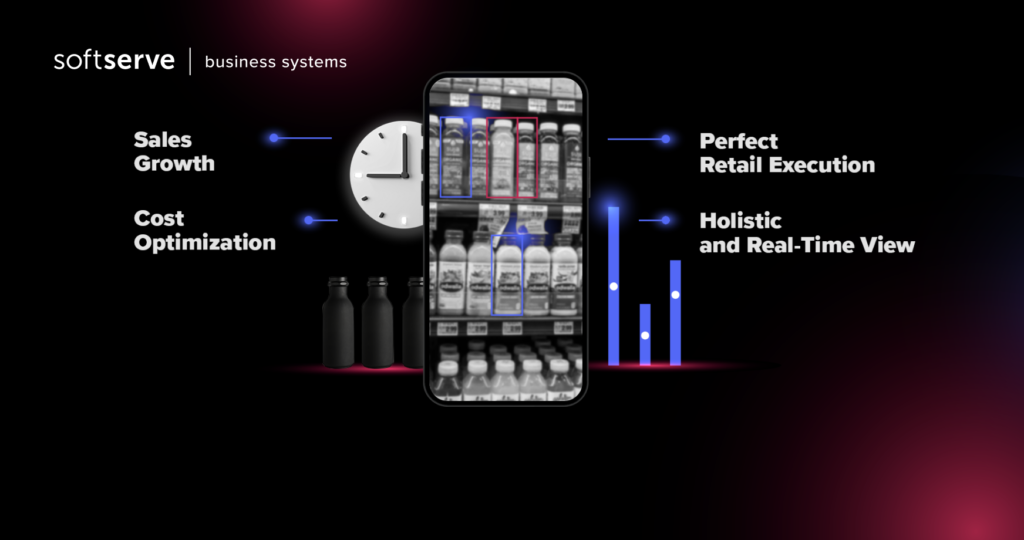
When customers see an empty space where your product should be, 20% will buy a competitor’s item, 15% will delay their decision, and 9% will choose nothing at all. In total, 44% of potential buyers are lost due to poor on-shelf availability (OSA).
In an environment full of sales, deals, and promotions, you can’t afford to give your competitors an easy win. However, that’s exactly what you do by linking supply chain issues solely to shelf availability issues.
Where else to look for the root cause and how to improve on-shelf availability? That’s what we’ll explore in this article — let’s dive in.
The Cost of Poor On-Shelf Availability
Don’t get us wrong: the supply chain issues are real and severe. Data shows that 88% of European FMCG brands had supply chain disruptions in 2024. 35% of them were forced to reduce or halt production. Of course, disruption affects the on-shelf availability. But is it always the only case?
Unfortunately, OSA can have many roots. Not having a product on the shelf does not necessarily mean it is out of stock. That is particularly true for companies that already use best practices to manage their supply operations. For example, integrating artificial intelligence can reduce errors in this area by up to 50%, according to McKinsey. Improving on-shelf availability would be a natural consequence.
Basically, by focusing solely on the supply chain, you will continue to lose those 44%, plus costs on unnecessary optimization of the already well-established process.
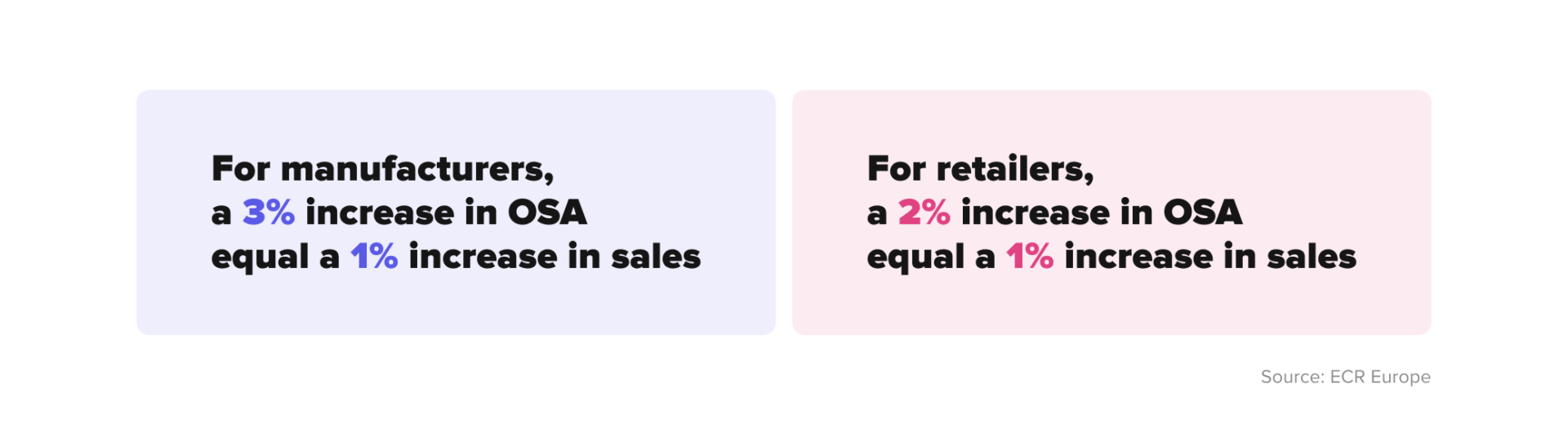
From our experience driving FMCG automation by helping companies streamline their daily operations and gain valuable, real-time insights, we have found that a significant proportion of OSA issues occur at the store level due to breakdowns in execution. Let’s discuss this in more detail.
Why Improving On-Shelf Availability Is Not Just a Supply Problem
Imagine YourCompany, a new soft drinks brand, preparing for a major product launch months in advance. Supply chain teams delivered the product on time to distribution centers, and their inventory management system showed optimal levels across retail stores.
Yet, in the critical first two weeks, during TV ads and digital campaigns, sales data revealed underperformance in several key urban outlets, even though the product should have been on shelves and ready to sell.
What could possibly go wrong?
Backroom or On the Floor, Still in Boxes
Although YourCompany’s soft drink had technically arrived at many stores, the product was still in shipping cartons in the back room or on the sales floor, waiting to be unpacked.
Overwhelmed staff, unclear instructions, and competing priorities meant that the product never made it onto the shelves or the coolers. Without being unpacked or facing out, the drinks remained invisible to shoppers despite being in stock.
Poor Trade Execution
The regional trade marketing team was stretched thin. Key store visits were missed, and planogram compliance went unchecked. Instead of gaining the agreed-upon eye-level shelf space or cooler positioning, YourCompany’s drinks were sidelined. Thus, it became impossible to improve their OSA through premium shelf placement.
In some cases, store staff prioritized established brands they were more familiar with.
Broken Feedback Loop from the Field
Field reps were assigned to audit shelf presence using a digital tool, but the system had a 48-hour lag. By the time problems were reported, valuable sales time had already been lost. Without real-time alerts, managers could not respond quickly enough to correct misplaced stock or unbuilt displays. Meaning there was no way to improve on-shelf availability quickly or proactively, nor to increase responsiveness to in-store issues.
Delayed or Misused Promo Materials
The launch-week marketing materials, including branded racks, aisle displays, and signage, either arrived late or were misused. A breakdown in communication between YourCompany’s logistics and its FMCG merchandising partners caused the delays. In some stores, promotional kits were left in storage or used for unrelated campaigns. As a result, the product blended in rather than standing out.
No Store-Level Incentives
The field team wasn’t briefed on the launch’s importance, and no incentives were provided. Competing brands had long-standing relationships and offered bonuses for prioritizing their products. With no extra motivation, store staff placed YourCompany’s drinks low on the list.
Improvement of an in-store retail execution audit might seem like the obvious solution to prevent these problems. But only if it’s done smarter, not harder. That doesn’t have to mean hiring more people to cover more stores. With the right tools, your existing team can audit faster, more accurately, and at scale. Here’s how to make that happen.
Modern Best Practices for Improving On-Shelf Availability
Improving on-shelf availability doesn’t require reinventing the wheel. The causes of poor OSA could be solved with a few main approaches: launching a platform to engage hard-to-reach stores, increasing the number of store visits, and making these visits as effective as possible to boost in-store performance. By effectiveness, we mean gaining as much data as possible, as fast as possible, and understanding what actions could be taken here and now.
There are three main strategies modern FMCG players use to achieve covering more ground, with greater accuracy and less effort – Image Recognition software, smarter retail execution software, and B2B eCommerce platforms.
Image Recognition
Image Recognition tools are no surprise for modern FMCG. They are the fastest way to capture shelf data – simply by taking a photo. But even among the existing solutions on the market, there’s a wide range of quality, speed, real-world usability, and accessibility.
Here are some of the most essential features that providers of Image Recognition for FMCG should offer to truly support fast and accurate on-shelf availability execution:
- Integration with your existing SFAs systems, so data would flow across departments and doesn’t remain siloed in sales or trade marketing.
- Adaptable, fast-trainable neural models capable of quickly learning new SKUs, changes in packaging, and evolving assortments.
- Detecting not only SKUs but also price tags, promotional materials, and empty shelf space.
- Providing real-time, in-field guidance to help sales reps know exactly what to fix or optimize during the store visit.
- Calculating key KPIs on the spot, like shelf share, planogram compliance, or perfect store scores, so teams stay aligned with internal goals and expectations.
- Transmitting data instantly, ensuring that issues are flagged and resolved in real time, not 24–48 hours later.
It would also be a huge plus if an AI product recognition software was compatible with Android and iOS devices, worked both online and offline, and allowed field teams to make real-time edits and updates.
Smarter Retail Execution
Traditional SFA systems no longer cover everything modern FMCG brands need to drive better business outcomes. That’s why many companies are adding new tools to build more flexible, up-to-date tech ecosystems.
Some of these tools, like the shelf Image Recognition, can work as standalone software and be integrated directly into your existing SFA system. Others are designed to function only as add-ons or completely separate CPG software solutions. Either way, the goal is the same: to create a system that supports your specific retail goals. Let’s look at two practical examples.
The first and perhaps most impactful addition is an extension that boosts the effectiveness of every store visit.
1. Recommended Steps of the Visit to Increase On-Shelf Availability Without Losing Time
Let’s say you already have the IR solution, and it’s fully integrated into your SFA system. Your field reps take the required photos during their store visits, so what happens next? Do they just wait for managers to review the data and tell them what to do?
They don’t have to. With one simple but powerful upgrade to your SFA – Recommended Steps of the Visit – your team can act immediately and more effectively.
This AI-driven feature takes the insights from the IR tool and recurring patterns and turns them into clear, prioritized, store-specific action plans every single day.

Don’t fear the data. Learn why Computer Vision in the FMCG industry might show you what’s wrong, so you can make it right.
2. FMCG Promo Planning and Execution System
What gets planned at headquarters doesn’t always happen in stores. Important details don’t reach field teams in time, leading to gaps in execution, like missing displays or delayed starts.
Furthermore, without real-time visibility into how a promotion is performing, it’s hard to step in and make adjustments when things go off track. That’s one of the key challenges for the FMCG industry, which can hurt results, ROI, your ability to influence shopper behaviour, and ultimately customer satisfaction.
The solution? An AI-driven promo planning software that works hand in hand with your SFA system. Take SoftServe Business Systems’ TPM solution, for example. It helps manage the full promotion cycle, from planning and execution all the way through to tracking results, making adjustments, and driving purchases. As soon as a campaign is ready, key details are sent straight to field teams so everyone is aligned and ready to go.
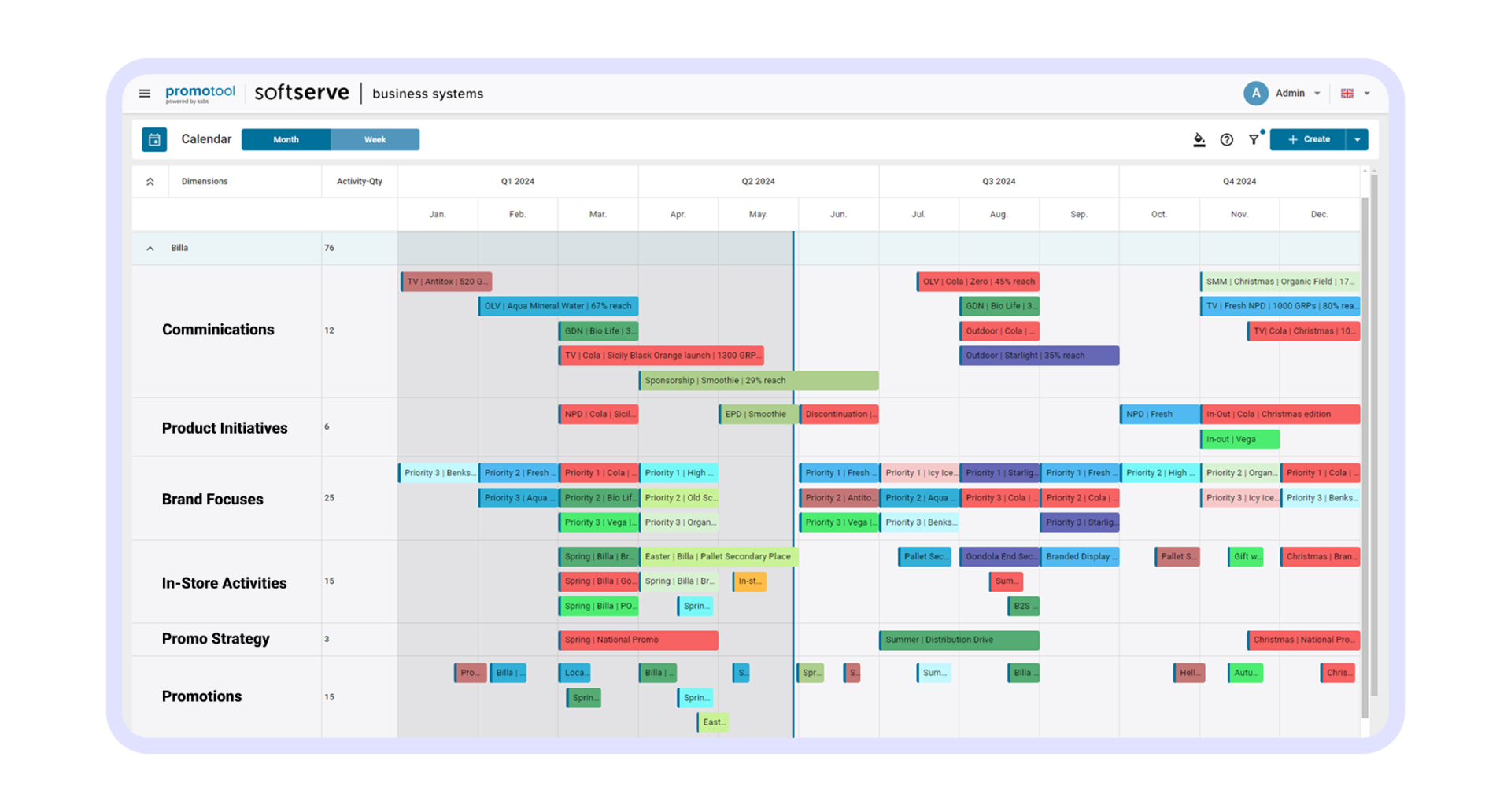
Moreover, TPM allows teams on the ground to share real-time updates from stores, giving planners the visibility they need to track how things are going and step in if needed.
B2B eCommerce Platform
A B2B eCommerce platform supports a modern FMCG sales strategy by giving companies better control over sales in hard-to-reach areas, like remote locations or the on-trade channel. It also helps to ease the workload on sales teams.
Retailers can place orders, see special offers, and get tailored pricing whenever convenient. Furthermore, when paired with Image Recognition, stores can upload shelf photos by themselves to share real-time data on product availability and display. It’s a more innovative, efficient way to manage out-of-stock and increase on-shelf availability without repetitive visits from your side.
Wondering if these tips really work in practice? One of our clients, a global health, hygiene, and nutrition brand, put them into action by adopting our SFA solution with built-in Image Recognition. The results speak for themselves:
- 50% increase in sales volume.
- 20% broader sales outlet coverage.
- 30% faster shelf audit time.
- 60% lower cost per visit.
- 41% increased order frequency.
Impressive, right? And easily achievable with the right tools and a strong digital transformation strategy.
KPIs for OSA Tracking: How to Check Whether You’re Really Improving On-Shelf Availability
So, how can you tell if your sales are growing because of improving on-shelf availability, and not just thanks to seasonality, pricing, or broader marketing efforts? The key is setting clear, measurable goals. By tracking the right KPIs, you can isolate the impact of your retail execution efforts and understand what’s actually helping you increase on-shelf availability in stores.
Some useful KPIs to start with include:
- On-shelf percentage – a direct measure of how often your products are actually available on the shelf when they’re supposed to be.
- Competitor share of shelf – helps you benchmark your shelf presence against competing brands.
- Compliance by SKU – shows which products most frequently miss placement.
- Eye-level sales contribution – evaluates how much of your revenue comes from SKUs placed at eye level.
- Sales lift from promotion – measures whether your promotional efforts lead to real in-store impact.
Conclusion
Poor on-shelf availability can be just as damaging as a supply chain disruption. And while the two are certainly connected, treating them as the same oversimplifies the problem.
Relying solely on supply chain fixes to improve on-shelf availability can lead to wasted resources and delayed results. Every day spent focusing on the wrong cause not only drives up costs but also keeps the real issue unresolved.
The truth is, if you want to understand what’s happening at the shelf, you need to start with data from the shelf. How? With tools that provide better audits for suppliers.
We’re talking here about Image Recognition, as well as smarter retail execution software for promo planning and store visits. These tools help to identify gaps, verify planogram compliance, and provide actionable insights.
Ready to close your OSA gaps with modern AI-driven software? We’re here to help! Check out our complete ecosystem of solutions.