In today’s technology-driven world, the shelf image recognition market is gaining significant momentum, transforming various industries. According to Allied Market Research, the global image recognition market was valued at $28.3 billion in 2022 and is projected to reach $126.8 billion by 2032, with a CAGR of 16.5% from 2023 to 2032.
The growing demand for automation is a major driver of this market expansion, as FMCG businesses seek to enhance productivity and efficiency, making automation a core strategic priority. Additionally, advancements in machine learning and computer vision continue to play a crucial role in shaping the industry’s evolution.
Evolution of Shelf Image Recognition
The development of shelf recognition technology began in 2015, following the Gartner Hype Cycle for Computer Vision. Initially, the technology trigger phase sparked high expectations, with many believing image recognition would solve all challenges. By 2017, enthusiasm and investments surged, anticipating flawless solutions.
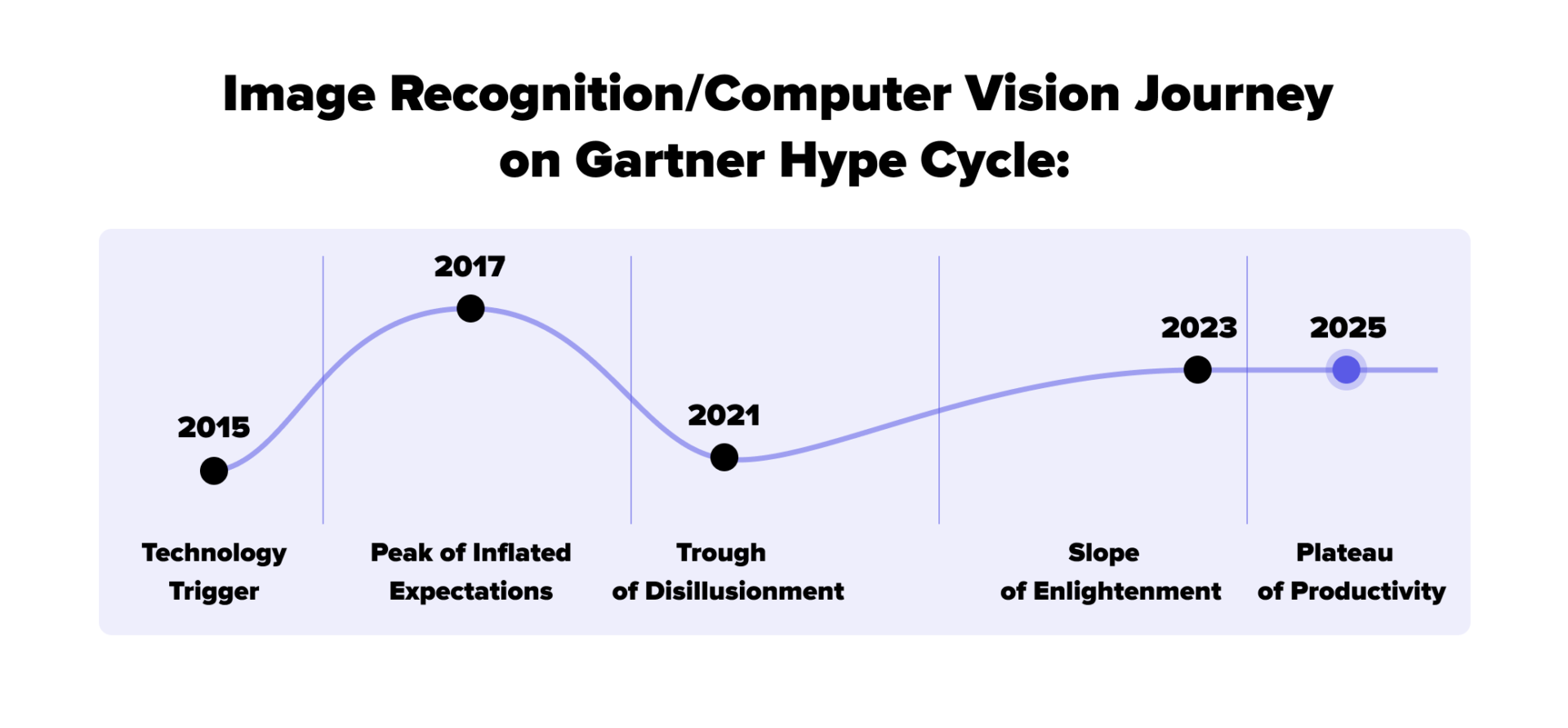
At the time, recognition accuracy and processing speed were key priorities, expected to optimize operations. However, by 2021, industry challenges led to a trough of disillusionment, prompting adjustments. The focus shifted beyond identification to real-time analytics and finding even more effective methods of technology adoption.
By 2023, shelf image recognition neared the plateau of productivity. It started to not only support field teams but also provide valuable insights, becoming a key data source for a variety of business functions. Even more, with technologies like Augmented Reality, the process of scanning shelves has become as fast as ever before.
Manual Shelf Image Recognition
FMCG companies have been relying on manual shelf image recognition as the primary method for auditing retail shelves for decades. This process involves employees manually examining shelves to verify product placement against planograms, confirm product availability, check assortment, and ensure compliance with FMCG merchandising standards.
However, this approach is inherently time-consuming, labor-intensive, and costly. It is also prone to human error, subjective assessments, and incomplete analysis, making it difficult to maintain high-quality retail audit data. By adding subjective factors, FMCG businesses no longer rely on rationality and numbers, which could significantly impact the business. To illustrate, here is an example from our experience:
A UK-based client used a specific set of KPIs to evaluate the field sales team, with one of the key metrics being the number of facings on the shelf. However, for an SKU to count toward KPI achievement, it had to be displayed without any additional packaging. When this process was managed manually, everything ran smoothly, and the team consistently met their targets.
However, after implementing AI-powered image recognition to automate the process, the company discovered that many of these “achievements” were inaccurate. SKUs were often displayed with extra packaging. When the team was asked about this discrepancy, the discussion quickly became subjective, as each person had a different interpretation of what qualified as an SKU without additional packaging.
This misalignment had a significant impact on the business, ultimately causing more than 50% of the KPIs to fail, leading to lost sales and decreased revenue.
That’s what numbers on average you can expect using manual shelf recognition:
| KPI | Manual Shelf Recognition |
| SKU Recognition | 50% on average |
| Price Recognition | 40% on average |
| Data Availability Time | Up to 24 hours |
| Average Audit Time for 1 Visit (Supermarket) | Around 45 minutes |
Additionally, it is important to mention that there’s a common misconception that manual audits are the most accurate. In reality, subjectivity and human error lead to around 30-60% accuracy, with each audit taking well over 20-30 minutes to complete (in a mid-size store).
Despite these drawbacks, a recent global survey published by CGT showed that no matter the difference between FMCG and CPG, 58% of businesses with annual revenues of less than $500M still use Excel to analyze field data. These companies continue using manual shelf image recognition due to budget constraints, lack of technological infrastructure, or reluctance to overhaul established processes. In addition, it’s also a common practice to use 3rd parties performing merchandising activities, which usually cost less than the maintenance of an internal team.
Fortunately, according to the CGT survey, more than one-quarter of decision-makers in CPG companies are considering AI adoption to support their retail execution goals. Naturally, AI shelf image recognition is emerging as the first step toward automation and greater efficiency.
AI Photo-Based Shelf Image Recognition
FMCG Image Recognition solution utilizes photo-based image recognition technology that helps. This tool enables efficient, reliable shelf audits and serves as a real-time data source for shelf management, ensuring greater accuracy and streamlined operations.
The accuracy of standard photo-based shelf image recognition depends on image quality, recognition algorithms, and system training. Many AI-driven solutions now achieve over 95% accuracy, surpassing the manual approach by a mile. Additionally, automated systems significantly reduce audit time — cutting it by around 30% for each audit.
More importantly, AI Image Recognition hugely impacts business results. With advanced tech in place, FMCG organizations can fully transform the decision-making process and reality check, which positively affects revenue and consumer experience.
A good example here would be the case of our client in the hygiene category. Adopting AI shelf Recognition in two phases, we ended up covering 17,000 stores, 500+ sales representatives, 60+ area sales managers, and around 11,000 visits per month. Automating such a huge volume of manual work business relist was significant.
Right after introducing automation, business KPI went down significantly because the business started to get the real (objective) data coming from stores in real-time. However, in 4 months, we went back to the original KPI numbers which this time were supported by a “true” performance and results of the team,
Moreover, automated Image Recognition helped to reduce 60% of costs and speed up audits by around 30%, freeing up time for sales reps to make more sales.
As a result, from the experience with a number of clients across Europe, we can state that on average, the comparison between audit results of AI-based Shelf Recognition and manual shelf audit looks like this:
| KPI | Manual Shelf Recognition | AI Shelf Recognition |
| SKU Recognition | 50% on average | 95%+ on average |
| Price Recognition | 40% on average | 80%+ on average |
| Data Availability Time | Up to 24 hours | In minutes |
| Average Audit Time for 1 Visit (Supermarket) | Around 45 minutes | Around 30 minutes |
Despite the success of shelf image recognition, over 75% of companies still struggle to ensure retailer-aligned promotions are executed at the store level. It’s proven by our clients that when AI Image recognition is tightly integrated with SFA and TPM solutions it allows boost promo execution. With high-quality in-store data coming in real-time, we can almost immediately calculate promo compliance and related promo KPIs.
Read next: Computer Vision in FMCG Industry: What Goes Wrong Before It Goes Right
Augmented Reality (AR) Shelf Image Recognition Technology
Augmented Reality (AR) is an innovative technology that merges real-world shelf spaces with computer-generated content. When combined with machine learning in FMCG, this solution significantly enhances the efficiency of field teams and sales departments. How does it work?
Instead of simply capturing a static shelf image, AR enables users to interact with the store environment in real time. AR shelf recognition serves as a virtual assistant for sales representatives, providing real-time guidance after scanning shelf spaces and pinpointing necessary actions.
This technology is designed to enhance business benefits for auditing big stores and complicated secondary displays. Basically, the advanced level of engagement with the shelf does not provide more precise data, but it enables the team to conduct in-store audits faster than ever before. Why? Because the system displays data in real-time, immediately on your screen, without the need to wait for recognition, allowing for quicker decision-making and more efficient operations.
Let’s review a real-life example to make the advantage of AR evident. Let’s assume that each of your sales representatives does around 7 store visits per day (hypermarkets and supermarkets). These types of stores usually have really long aisles, each around 30m long. You aim to get data about all SKUs, prices, and competitors on the shelf. The direct comparison between Photo-Based Shelf Recognition and the manual approach could look like this:
| KPI | Manual Shelf Recognition | AI Shelf Recognition | AR Shelf Recognition |
| SKU Recognition | 50% on average | 95%+ on average | 95%+ on average |
| Price Recognition | 40% on average | 80%+ on average | 80%+ on average |
| Data Availability Time | Up to 24 hours | In minutes | In seconds |
| Average Audit Time for 1 Visit (Supermarket) | Around 45 minutes | Around 30 minutes | Around 15 minutes |
| Average Audit Time for 7 Visis (Supermarket) | Around 5.2 hours | Around 3.5 hours | Around 2 hours |
With Augmented Reality Shelf recognition, FMCG businesses can squeeze at least 1 more sales visit per day for every sales representative, which immediately boosts sales for the entire business. In addition, AR enables the following benefits:
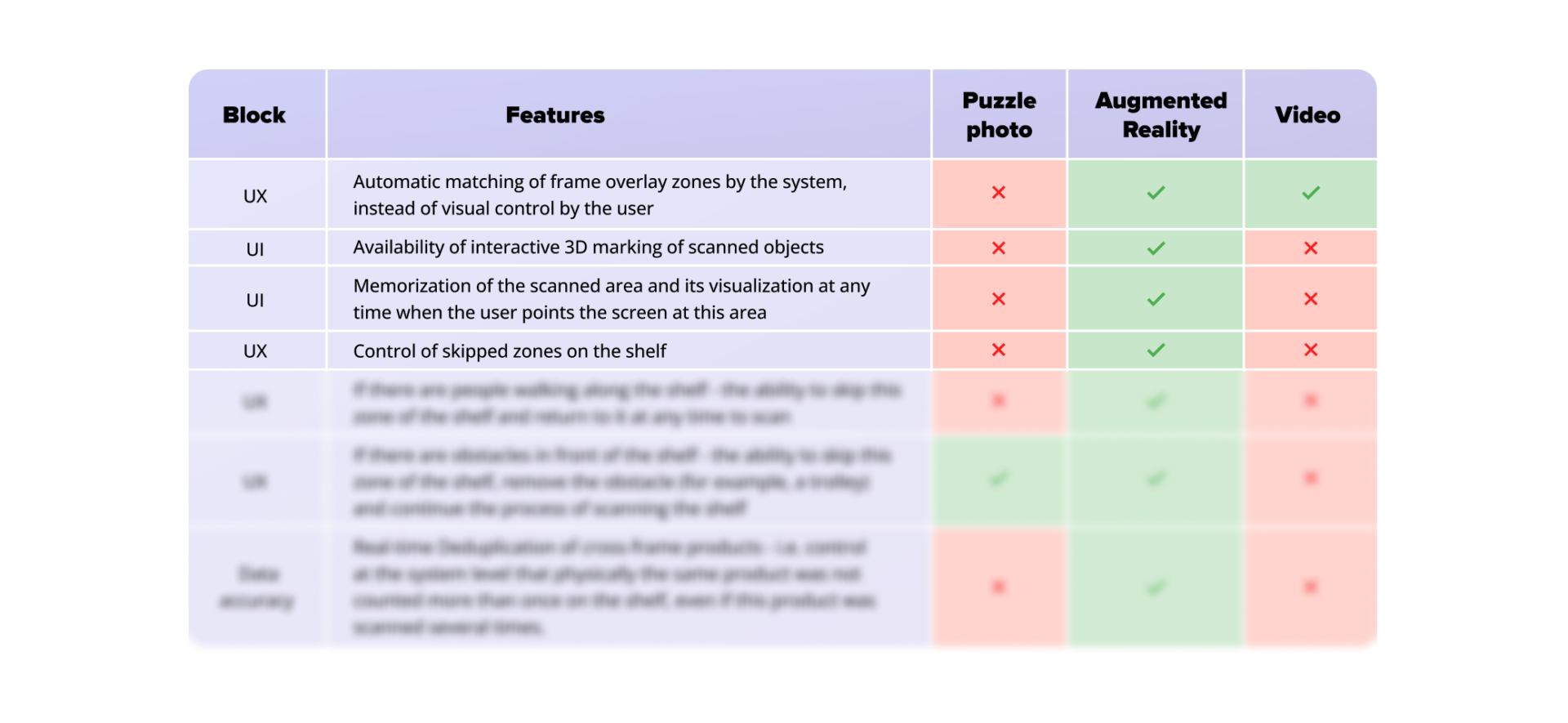
- Full visibility of the entire shelf in real-time, including gaps and missed scanned areas
- Re-scan shelves without data loss, as the system dynamically updates all KPI metrics based on live store conditions.
- Prevent double-counting of the same product, even if scanned multiple times, ensuring system-level accuracy.
Furthermore, AR-driven shelf recognition will offer dynamic real-time guidance for sales agents and enable deeper, data-driven analysis. This advancement provides actionable insights based on shelf recognition technology, helping businesses optimize retail execution more effectively.
Which Approach is Better for Your Business?
When selecting a shelf image recognition system, it’s crucial to evaluate all aspects rather than simply following market trends. Making an informed decision requires understanding which technology best aligns with your business’s financial and technical capabilities and conducting a comparative analysis of the existing solutions.
What’s obvious today is that the manual approach shouldn’t exist anymore in modern FMCG ecosystems. It wastes too many resources and gives too few results in advance. However, the choice between “classic” AI Shelf Image Recognition and Augmented Reality Shelf Image Recognition boosted is more complicated and will depend on the exact needs, opportunities, and requirements of the business.
We suggest starting small. First, it’s crucial to examine the business and answer the most critical questions like which data you need coming from the site, how fast, how often, what should be done with the data next, and so on. Once the strategy is in place, you start with a pilot, testing various technologies and approaches. Next, we define rollout tactics and evolve the organizations’ technical maturity over time.
Image Recognition Solutions is still just a tool that has to be used by people to be helpful. That’s why, considering Digital Transformation of the entire organization of a “simple” CPG software solution implementation, be aware to consider business first and find a partner who can support the journey along the way.