What is FMCG Automation?
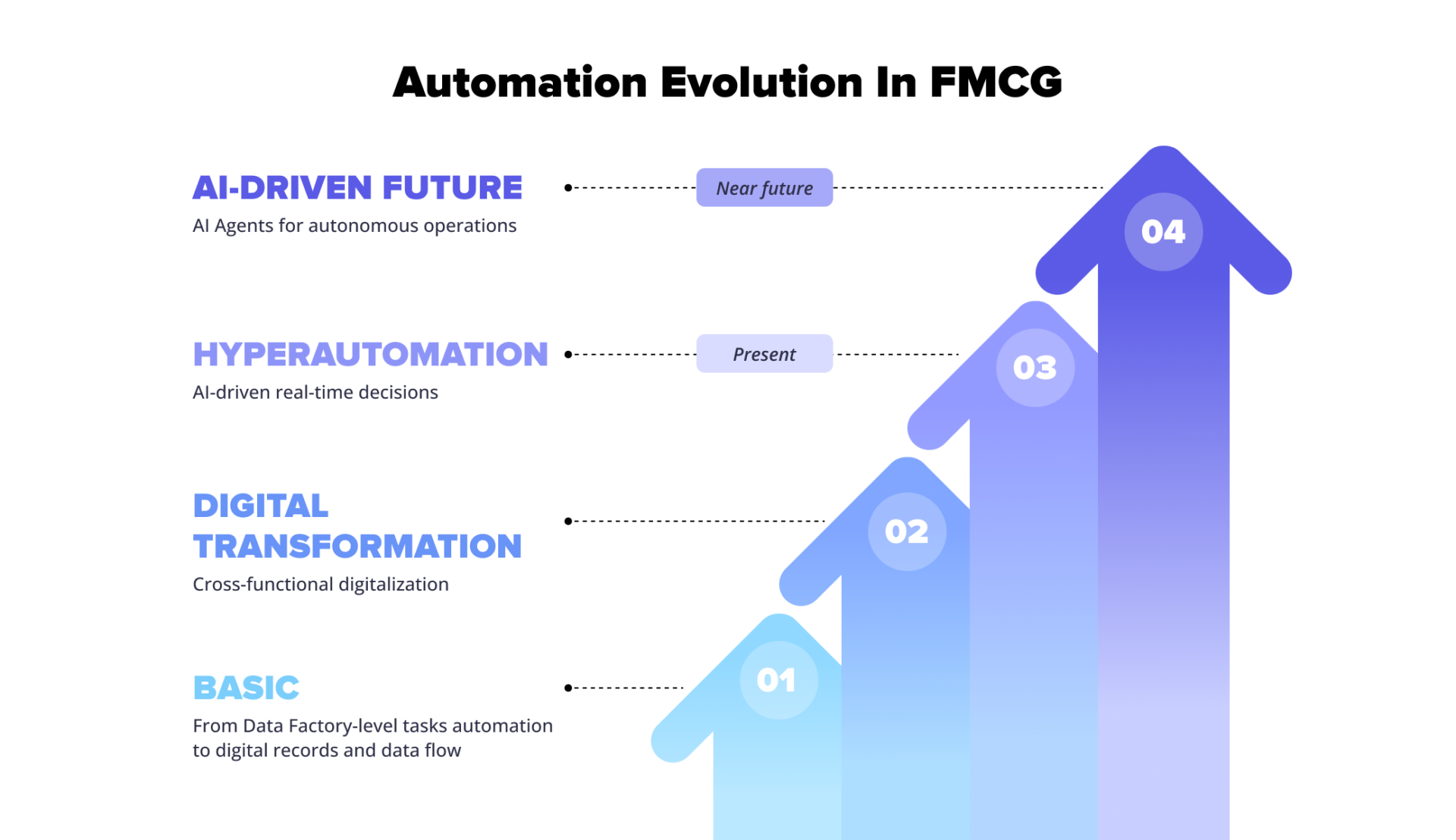
For decades, FMCG (Fast Moving Consumer Goods) companies have been using technology to streamline routine tasks. But in recent years, automation has evolved far beyond simple task execution. What once meant “using technology to perform tasks with less human involvement” is now moving toward minimizing or even eliminating human intervention altogether.
So the question is no longer if machines can replace humans, but should they? And more importantly, is replacement really the goal of FMCG automation?
The purpose of modern automation is not to remove people from the equation but to empower them to equip decision-makers with accurate, timely, and actionable insights. In an industry as fast-moving as FMCG, only those who can react instantly to market changes and anticipate them can stay ahead.
That’s why today we speak about the shift to hyper-automation – an approach that integrates multiple technologies like SFA (Sales Force Automation), RPA (Robotic Process Automation), AI/ML, AI Agents, IoT (Internet of Things), BPM (Business Process Management), and other automation systems for the FMCG industry. It’s no longer just about automating isolated processes but about developing a holistic strategy for digital transformation in FMCG.
Today, the FMCG industry stands on the brink of a tectonic shift. Long-established human roles are being redefined by advancing technologies. Yet, many processes that could already be automated are still performed manually. So, where should companies look for the greatest benefits of automation? And which areas deserve focused investment to deliver the highest impact?
Key Areas of Automation in FMCG
Each business function has its own specifics and different levels of automation potential for routine tasks and human involvement. Among the areas most impacted by automation are the following:
FMCG Logistics Automation
Optimizing supply chains is a critical factor in Fast Moving Consumer Goods. With FMCG logistics automation systems, a core part of broader automation systems for the FMCG industry, companies can use real-time product tracking and predictive analytics to significantly reduce costs and increase delivery accuracy, and improve overall operational efficiency.
FMCG Warehouse Automation
Modern warehouses are equipped with sensors, robotic lifters, and automated sorting lines. FMCG Warehouse Automation helps minimize the human factor, reduce inventory-related errors, and lower energy consumption and operational waste through optimized automation.
Customer Service Automation
Customer service in FMCG is evolving rapidly with the adoption of Generative AI and Agentic AI technologies. AI agents now autonomously handle common customer queries, order status updates, and feedback loops – without human intervention. These systems not only enhance the quality and availability of customer service but also free up support teams to focus on more complex, high-value interactions. For FMCG brands operating at scale, customer service automation is becoming a key differentiator in driving both customer loyalty and operational efficiency.
FMCG Promo Automation (Trade Promo Management and Optimization)
Modern tools for trade promotion management allow real-time planning, tracking, and evaluation of campaign effectiveness. They include functionalities for budget optimization and ROI forecasting. Predictive FMCG analytics and AI/ML forecasting enable data-based decisions for promo strategy, pricing optimization, and mechanism selection – transforming trade promotions from one of the biggest cost lines into a revenue generator.
Another area with significant potential to improve promo profitability is enhancing execution at the retail level. Ensuring campaigns start on time, verifying correct pricing, availability of promotional POSMs and displays, and maintaining sufficient stock levels has always been a challenge for FMCG companies.
Today, promo execution can be automated through seamless integration of TPM, SFA, and Shelf Image Recognition technologies. Promotion data flows directly to field teams, generating tasks for campaign preparation and in-store execution. Meanwhile, real-time retail data is analyzed and transformed into actionable recommendations – helping identify execution gaps, detect recurring issues, and support smarter decision-making during future planning cycles.
FMCG Marketing Automation
CPG (Consumer Packaged Goods) marketing platforms enable automatic collection of consumer behavior data, audience segmentation, and launching of personalized campaigns. This reduces time spent on analysis, cuts costs, and boosts communication effectiveness.
FMCG Sales Force Automation
Sales Force Automation (SFA) tools provide field reps with all necessary data on store history, inventory levels, visit history, and performance tracking. This enables faster, more informed decisions. But true transformation happens when SFA integrates with tools like AI Product Recognition with Augmented Reality capabilities.
Read also: Benefits of SFA
Yet many CPG companies still rely on manually collected data using basic “pen-and-paper” methods. This approach is not only time-consuming and labor-intensive but also delays the analysis and limits the value of insights – making them relevant mostly for retrospective reviews rather than real-time action.
Modern AI Image Recognition for FMCG, on the other hand, offer instant shelf insights and automatically recommend corrective actions, enabling faster, data-driven execution in the field and helping teams achieve ideal retail execution.

All of these tools serve a shared purpose – minimizing the time between data emergence and decision-making. Automated systems collect, process, and visualize data as insights, recommendations, or even ready-to-execute decisions. They may cover different functional areas, but they all support the same goal: minimizing manual effort in data collection and analysis for faster and more accurate decision-making.
Learn about building effective sales processes supported by automation in our FMCG sales strategy guide.
How to Succeed with Decision-Making Automation in FMCG?
Automating decision-making in FMCG goes beyond just replacing manual work with digital tools. It’s about building a system that enables fast, accurate, and scalable decisions across the organization. Here’s how to do it right:
Start with Clean, Reliable Data
Automation is only as good as the data behind it. Invest in systems that ensure consistent data collection across all key functions – sales, logistics, trade marketing, and field execution. Make sure your data is structured, up-to-date, and trustworthy.
Connect Your Digital Solutions and Data Sources in one ecosystem
Don’t let your teams work in silos. Unify data from multiple systems (ERPs, CRMs, TPM tools, etc.) into a single ecosystem with one analytics data platform. A centralized view enables better visibility, cross-functional insights, and faster response times.
Harness the Full Potential of AI for Smarter Decisions
AI is the backbone of effective decision-making automation in FMCG. Use FMCG machine learning models to uncover patterns in historical data, forecast outcomes, and simulate different scenarios before acting. AI transforms raw data into intelligent recommendations – helping teams make faster, more confident choices. As your AI maturity grows, you can gradually introduce AI agents to handle repetitive decision loops and free up human resources for more strategic thinking.
Automate Where It Makes Sense
Not every decision needs to be fully automated. Identify high-frequency, data-heavy decisions (e.g. promo optimization, supply chain management, sales forecasting) and focus automation efforts there.
Keep Humans in the Loop
Successful automation doesn’t remove people – it empowers them. Make sure your systems are explainable, transparent, and designed to assist users, not override them – streamlining their workflow and supporting more confident decisions. Focus on delivering timely insights and actionable recommendations that help teams make smarter decisions and build trust in the system.
Beyond FMCG Automation: Building a Smarter Organization
Automation has now entered areas that were once considered the exclusive domain of humans, , such as creativity and decision-making. Today, Generative AI automates a tremendous part of creative processes, and according to Gartner’s forecast, at least 15% of day-to-day work decisions will soon be made autonomously by AI agents. But in the race for AI leadership, we must remember that AI is just a technology. It won’t work effectively without the other pillars of FMCG digital transformation – people, processes, and data.
Watch our podcast: Mythbusting FMCG Digital Transformation
This is the foundation of the AI-Driven Ecosystem concept: integrating tools, business functions, and data streams across the organization to achieve data completeness and quality, optimize business processes, and enable cross-team collaboration within organization – all in pursuit of shared strategic goals. Only when these elements work together can Fast Moving Consumer Goods companies unlock the full value of AI and drive meaningful, scalable impact with greater flexibility across the business.