In 2024, CPG companies allocated the majority of their Trade Promotion Optimization spending to software solutions.
This ongoing dominance tells us that technology has become central to making promotions more effective and predictable.
However, here’s the catch: purchasing a TPO platform doesn’t guarantee that your team can actually embed it into your current processes, systems, or day-to-day workflows.
Most organizations discover a gap between what the software can do and what their internal setup allows.
In this article, we will explain:
- What TPO is and how it differs from Trade Promo Management
- How TPO software works in day-to-day business
- Which capabilities should be in place first
- How to move from manual processes to an optimization-driven workflow
Let’s start with the basics – the Trade Promotion Optimization definition.
What is Trade Promotion Optimization?
Trade Promotion Optimization (TPO) is the process of applying advanced analytics and predictive models to understand which past and current promotions are effective, why they are effective, and how to improve future ones.
It is the next step of analysis after Trade Promotion Management (TPM).
TPO often refers also to the software that enables the process we just described.
What Trade Promotion Optimization Does
Trade promotion management and optimization can be viewed as one framework made of two complementary layers.
The management layer is the base handling the operational side – planning, execution, and settlement.
The optimization layer builds on this foundation and performs the following functions:
- leveraging data and AI to analyze historical promotions,
- predicting outcomes with TPO models,
- optimizing spend across promotions and channels,
- enhancing strategy with actionable insights.
Let’s break down what Trade Promotion Optimization does at a functional level.
Leverages Data and AI to Analyze Historical Promotions
AI models (ML included) are highly dependent on data. Everything matters: the quantity, quality, and structure of the historical sales, promotion, and retailer information.
Collecting this data – especially older historical records – is one of the biggest FMCG challenges, because systems have changed over time and consistency is often limited.
When Trade Promotion Management software is in place, it ensures that all promotional activities are accurately and consistently recorded. This historical record is what enables Trade Promotion Optimization algorithms to function.

Based on that data, a Trade Promotion Optimization model picks up trends that teams often miss, such as promo fatigue, periods where smaller discounts still drive strong demand, or tactics that consistently outperform others.
Predicts Outcomes with Trade Promotion Optimization Models – the Scenario Ranking
Proper Trade Promotion Optimization analytics enable teams to project expected sales, volume, profit, and uplift before a trade promotion in CPG runs.
No more experiments. Instead of evaluating a single promotion plan, the system generates multiple scenarios, calculates their projected performance, and ranks them from strongest to weakest.
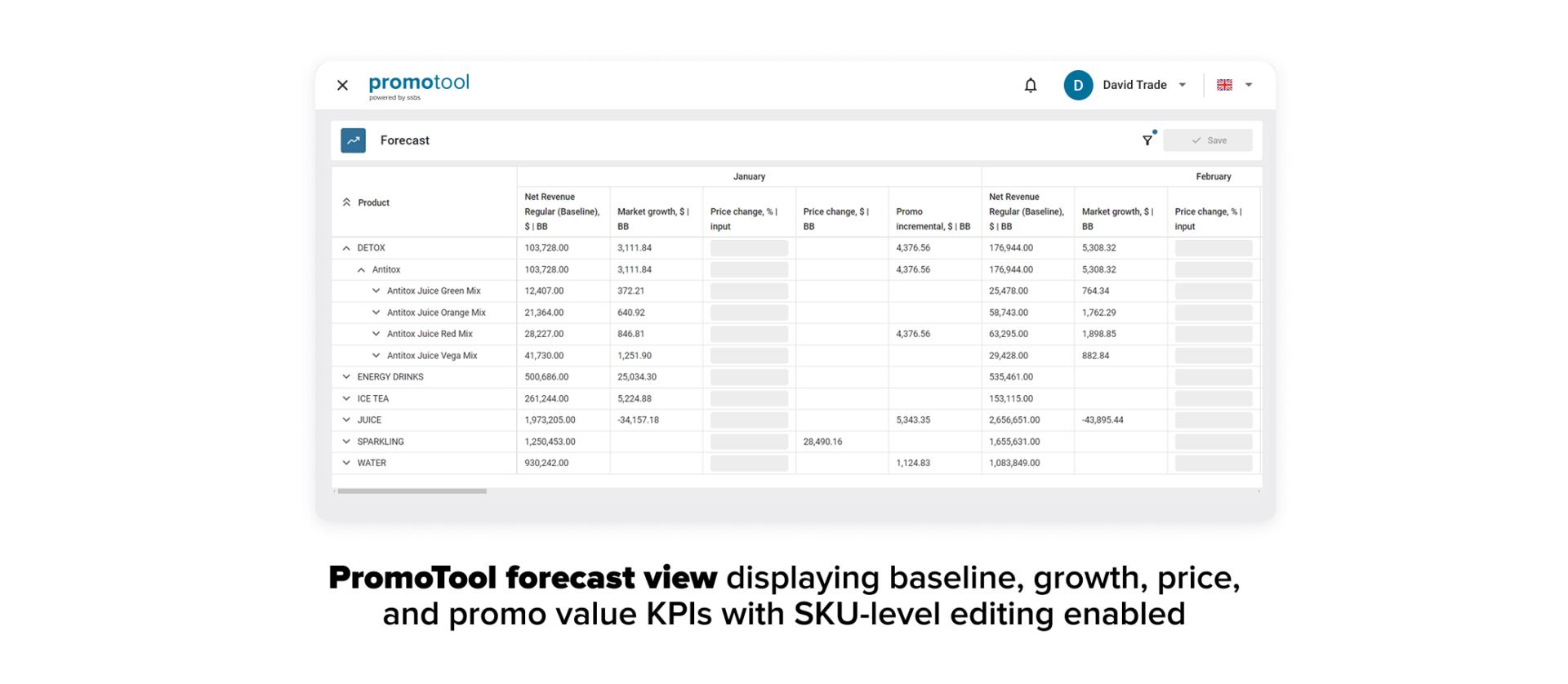
For instance, it can instantly show that a 15% discount at Retailer A is among the top-performing scenarios due to high uplift and profit. The same mechanic at Retailer B falls to the bottom of the ranking because it barely breaks even.
Optimizes Spend Across Promotions and Channels
TPO compares different promotion mechanics (price cuts, bundles, displays) and ranks them by predicted ROI. It helps teams decide where to invest, where to scale back, and which retailer or week will generate the strongest return.
Enhances Strategy with Actionable Insights and Prescriptive Recommendations
A proper Trade Promotion Optimization model turns analysis into specific recommendations. Moreover, each recommendation is tied to the goals your team sets.
For example, if the target is a 20% sales increase, the system might suggest running a 10% discount in Week 32 at Retailer A while skipping Retailer B, where the expected impact is minimal.
In essence, Trade Promotion Optimization takes the data captured by TPM and turns it into guidance on what to run, when, where, and at what cost. It reveals which promotions truly work, forecasts how future ones will perform, and recommends the options that deliver the highest return.
Basically, TPO helps teams invest their budget where it will create the greatest impact.
Assessing Your Company’s Current Stage Before TPO
Brands in the consumer products industry don’t usually leap straight from spreadsheets to AI-powered Trade Promotion Optimization. They advance step by step, gradually building the capabilities and processes needed to make each stage work.
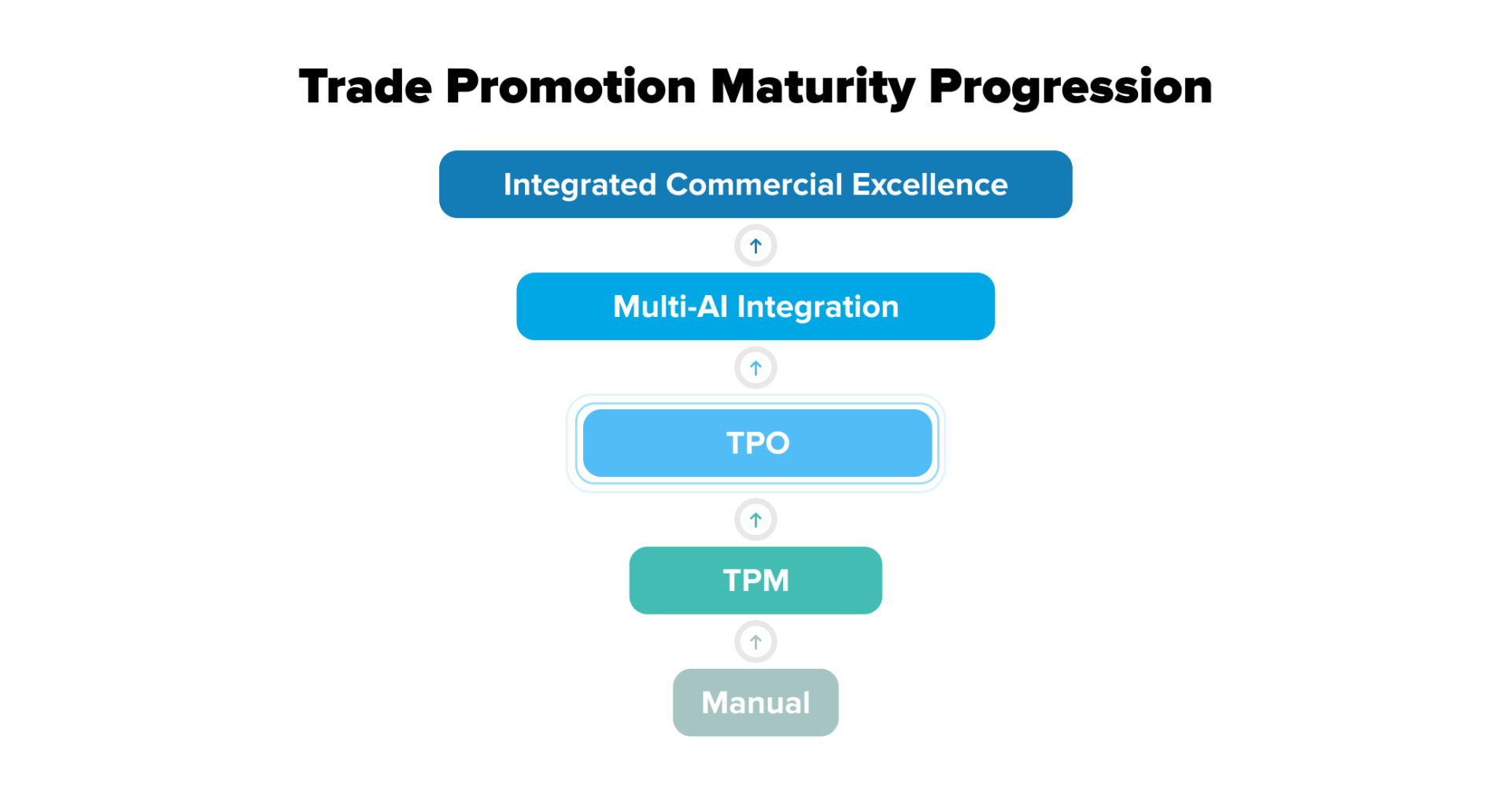
The steps of trade promotion maturity progression:
- Manual work with scattered spreadsheets is the starting point. Data is stored in separate files, reporting is inconsistent, and teams heavily rely on manual updates.
- The implementation of Trade Promo Management establishes clear workflows, budgets, and tracking. Essentially, it’s dashboards that provide a comprehensive view.
- TPO uses trade promotion forecasting, scenario planning, and AI to predict promotion outcomes and recommend how to allocate budgets to maximize ROI and minimize waste.
- Advanced AI tools (AI agents or chat-based assistants) extend standard TPO functionality to pull insights on demand, answer questions, monitor anomalies, etc.
- Integrated Commercial Excellence seamlessly connects TPM, TPO, and AI tools to create a predictive, unified ecosystem.
So, before TPO can be implemented, you must cover the distance from basic data hygiene to operational discipline.
Non-Negotiables for Adopting a TPO software
What exactly should you establish to be able to adopt TPO:
- Reliable data – clean, structured, and comprehensive data, including both Sell-in (shipments) and Sell-out (actual sales to consumers), as well as historical promo information, captured through different systems (FMCG Distributor Management, for example).
- Standardized processes – clear workflows, approvals, and promo definitions.
- Centralized visibility – one source of truth instead of scattered files.
- Consistent execution – accurate and uniform promo entry, as well as tracking.
- Financial discipline – clear budgeting, accrual and evaluation rules.
- A working TPM system – aligned reporting and dashboards teams can rely on.

With the right foundations established, the next step is understanding the key components that shape a strong Trade Promotion Optimization strategy.
Key Components of a Trade Promotion Optimization Strategy
Finding a good TPO tool doesn’t mean the strategy builds itself. Technology supports the process, but the real impact comes from applying the essential components of a strong strategy.
Clear Objectives and KPIs for Promotions
A strong Trade Promotion Optimization strategy starts with defining what “success” looks like for each promotion. The goals must be measurable and aligned with broader commercial targets.
Examples:
- Objective: Drive trial of a new product → KPI: % of new buyers, distribution gain, trial uplift.
- Objective: Increase revenue in a declining category → KPI: incremental sales volume, incremental margin, ROI.
- Objective: Support a retailer activation week → KPI: compliance rate, execution quality, uplift vs. benchmark.
Without clear objectives, the Trade Promotion Optimization model cannot accurately evaluate whether a promotion is worth repeating, scaling, or redesigning.
Strategic Promotion Planning and Allocation
Examples of strategic planning within the Trade Promotion Optimization process in practice:
- Using TPO outputs to shift spend from low-ROI mechanics (such as deep discounts) to higher-ROI tactics (like bundles or displays).
- Allocating budget across retailers based on predicted profit contribution rather than equal splits or historical patterns.
- Spacing out promotions to avoid promo fatigue, where repeated discounts stop driving incremental demand.
- Planning promotions around known seasonal peaks – for instance, running a lighter discount in December because demand is naturally higher.
This ensures the entire promo calendar is optimized, not just isolated events.
Data Analysis and Predictive Modeling
When used strategically, predictive modeling becomes the foundation for cannibalization prediction, scenario planning, and scenario ranking we’ve mentioned earlier.
Examples:
- Predicting that a 15% price cut in Week 32 at Retailer A will generate the highest uplift due to seasonality, but the same cut in Week 10 yields minimal impact.
- Identifying that secondary displays consistently double uplift, even when discount depth remains unchanged.
- Revealing elasticity by product or variant – for instance, discovering that the 500g SKU reacts strongly to discounting while the 1kg SKU barely moves.
- Forecasting cannibalization effects, such as a promotion on the 500g SKU increasing its sales by 20% but reducing sales of the 1kg SKU by 5%, helps planners weigh trade-offs within the portfolio.
Furthermore, modeling can show how competitor promotions influence your own uplift and how to adjust your tactics accordingly.
Continuous Improvement Through Feedback and Learning
TPO isn’t a “set it and forget it” system. The models and strategy become more powerful when teams loop actual results back into the planning cycle.
Examples of how improvement happens:
- Comparing predicted vs. actual performance and adjusting the next promotion accordingly.
- Refining the model after discovering that uplift predictions were slightly inflated during holiday peaks.
- Learning that certain mechanics perform better at one retailer but not another, and adapting retailer-specific playbooks.
- Updating the strategy after identifying diminishing returns – for instance, reducing the frequency of 30% discounts at a retailer where uplift has flattened.
Over time, the brand develops sharper promotional instincts and stronger negotiating positions in its categories.
Trade Spend Management’s Place in the Process
Trade promotions represent a big share of the trade budget, but most TPO/TPM tools only deal with promotions, and not the broader trade investments behind them.
Annual agreements, rebates, fixed fees, and the reconciliation work around them are typically handled in separate commercial or finance systems.
A few platforms are finally closing that gap by adding trade spend management features. Our PromoTool is one of them. It lets teams manage agreements, rebates, and fixed fees in the same place where they plan and track promotions.

One of our clients, a major poultry producer and exporter, first adopted PromoTool just to bring more order to its trade spend.
Once the rollout expanded, they began to see significantly larger gains: teams worked together more efficiently, promotion planning became simpler, and they finally had a clear view of contract terms and total investment.

Let’s wrap up the basics of the Trade Promotion Optimization process and software for optimization of trade promotions by summarizing the key benefits CPG companies (or FMCG – there’s no big difference between FMCG and CPG in this context) gain after integration.
Key Benefits of Trade Promotion Optimization
The real value of TPO becomes clear when you look at how it changes promotion outcomes and decision quality.
Increased Profitability and ROI
Instead of repeating the same discount because “it worked last year,” companies can see which mechanics deliver the most margin, which retailers respond best, and where the spend quietly disappears. This often leads to more effective promotions, better use of the trade budget, and a measurable jump in profit per event.
Improved Sales Lift and Market Penetration
With TPO, the commercial team can finally grow baseline sales instead of relying only on discount-driven spikes. Over time, the brand gains stronger shelf presence, more repeat purchases, and a wider shopper base, without inflating trade spend.
Data-driven Decision Making
A proper TPO system analyzes every promotion against historical performance patterns, price elasticity, competitor behavior, and expected ROI. Instead of negotiating on intuition, account managers can walk into retailer meetings with clear data: “Here’s what this mechanic will deliver, and here’s why it outperforms the alternatives.”
Enhanced Efficiency and Collaboration
While a proper TPM rollout ensures accurate execution and internal alignment, TPO takes collaboration a step further by enabling data-driven joint planning with retail partners.
Instead of limiting discussions to annual negotiations about the number of promotions or funding terms, TPO allows manufacturers and retailers to co-develop trade promotion strategies based on historical performance, predictive modeling, and shared goals. This approach helps both parties optimize promotional timing and placement.
Now, let’s shift focus to the implementation part.
Moving from TPM to TPO: A Phased Approach
Based on years of experience in providing tech solutions for the consumer goods industry, the most successful transition from manual to TPM and later TPO adoption happens in phases. This way, each phase builds on the last and delivers tangible value on its own, creating successful digital transformation in FMCG.
Let’s skip the first stage – basic automation and visibility into promo effectiveness – since we’re focusing on companies that already have a TPM foundation in place.

Data-Driven Planning
With TPM already ensuring reliable data, standardized processes, and centralized visibility, companies can move from reactive decisions to structured, data-led planning.
At this stage, forecasts become more granular (down to the customer or store level) and promo planning becomes automated and transparent.
- Timeline: 5–10 months
- Impact: More accurate planning, reduced waste, better alignment across teams
Predictive Scenario Modeling with AI/ML
Once planning is structured, Trade Promotion Optimization models can start delivering foresight. Promotions can be predicted, scenarios simulated, and baselines automatically generated. Teams gain a clear view of what works best, where, and when.
- New capabilities: Scenario ranking, ML-based uplift predictions, AI-driven recommendations
- Timeline: 6–14 months
- Impact: Optimized promotion mix, higher ROI, improved sales, and profit lift
Advanced Optimization & Strategic Planning
With clean data and predictive models in place, AI/ML can support long-term, strategic decisions. Companies can model commercial outcomes months or even years ahead, identify the most profitable strategies, and integrate optimization into broader business planning processes.
- New capabilities: Long-term AI-driven planning, revenue growth modeling, integrated business planning scenarios
- Timeline: 5+ months
- Impact: More effective, forward-looking promotion strategies, sustained business growth
Conclusion
Adopting TPO successfully requires more than just installing software – it demands technological readiness, reliable data, and a strategic approach.
Companies that achieve this maturity can move beyond reactive promotion management to proactive, data-driven decision-making with retail partners.
Furthermore, Trade Promotion Optimization is just the beginning: advanced AI tools, such as intelligent agents and chatbots, are already emerging to further automate analysis, surface actionable insights in real time, and support even faster, smarter promotional decisions.
In other words, mastering TPO lays the foundation for the next wave of AI-driven trade promotion innovation.