FMCG companies spend about 20% of revenue on trade promotions. 59% of businesses fail to generate profit from those promos, McKinsey reports.
Could that loss of money be predicted with AI?
In theory – no doubt.
In practice, forecasting trade promotions requires substantial data that companies often struggle to provide for ML models. Moreover, no single model can reliably reflect all real-world demand dynamics simultaneously.
Effective trade promotion forecasting rarely relies on just one AI approach. And even a tool with a perfect combination of algorithms and models is not enough on its own.
In this article, we will explain:
- What indicators need to be and could be modeled
- In which cases are simple statistical methods sufficient
- When machine learning becomes necessary
- Why some effects cannot be reliably predicted at all
- How these limitations can be addressed
Let’s start with the basics.
What Is Trade Promotion Forecasting?
Trade promotion forecasting is the process of predicting the results of upcoming or currently running promotions.
By “the results,” we mean any KPIs that your team uses to define the financial and operational outcome of a promotion. That could be:
- sales lift
- incremental volume
- revenue
- margin
- ROI
The goal is to determine these numbers before a promotion starts (or early during its run). This way, the team can decide whether to execute the promo at all or where adjustments are needed.
Trade promotion forecasting is built around two crucial indicators – baseline and uplift.
Definition: Baseline vs Uplift (Incremental Sales)

To calculate the predicted KPIs that feed into ROI calculation in FMCG, you first need a reference point – a baseline.
Baseline is the expected sales without a promotion. It reflects regular price, normal distribution, and usual buying patterns.

Once you know this number, you can measure what past promotions added on top of normal sales and estimate what future promotions are likely to add – this is the uplift.
Uplift and incremental sales are often used interchangeably, but they slightly differ.
Incremental sales are the additional units sold above the baseline. It’s not always a good thing, because more volume doesn’t automatically mean more profit.
Extra sales may come at the cost of heavy discounts, lower margins, or higher trade spend. In some cases, the promotion only shifts purchases that would have happened anyway or steals volume from other products.
Uplift, by contrast, puts that extra volume into context. It expresses the size of the increase relative to normal sales, usually as a percentage of the baseline.
For example, if a product normally sells 1,000 units and a promotion generates 200 incremental units, the uplift is 20%.

Key Components and Process
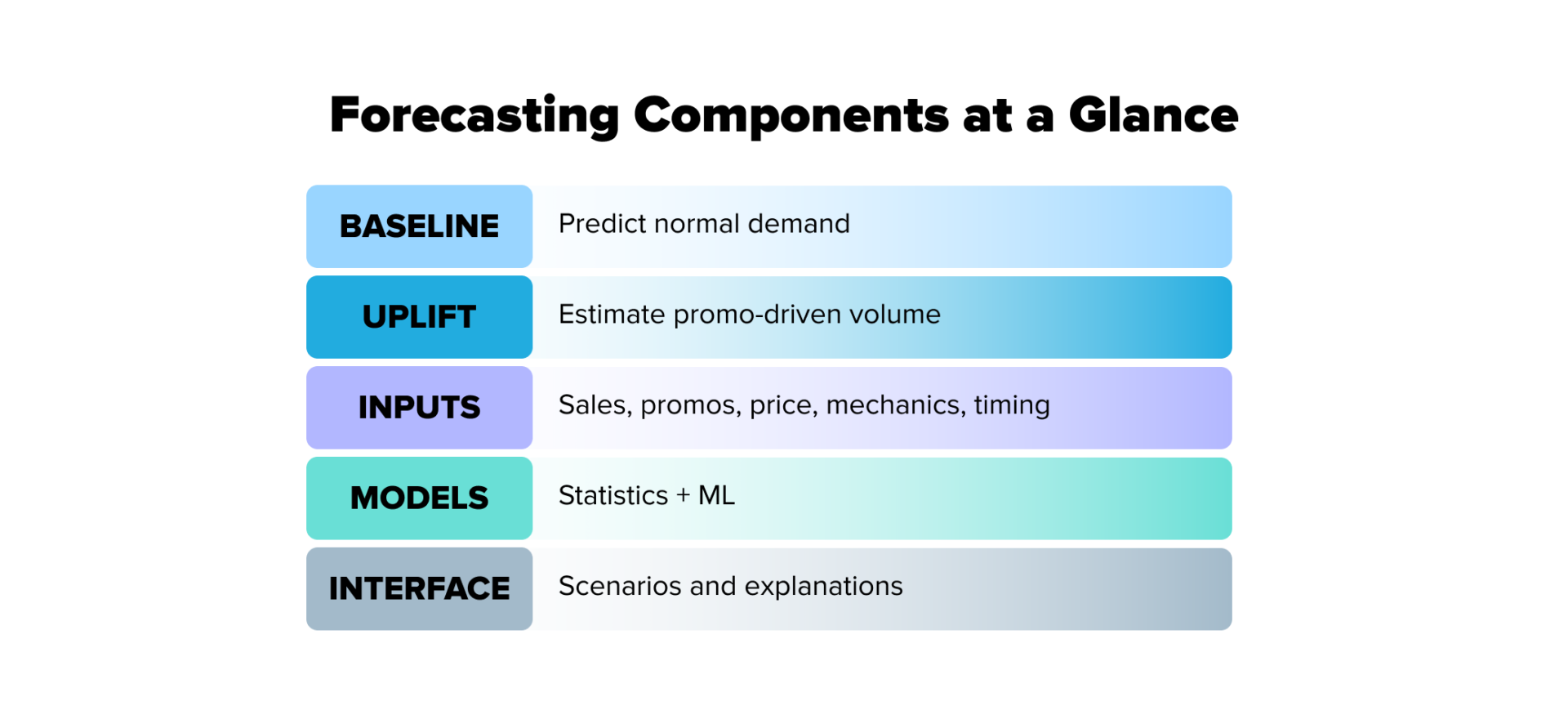
Trade promotion forecasting follows a fixed sequence. Each step depends on the previous one.
Baseline Forecasting
Normal demand is not only calculated from past data, but can also be predicted.
ML models forecast trade promotion by using historical sales data and adjusting for factors such as seasonality, trends, distribution changes, and availability. As a result, they can estimate how much a product is expected to sell without promotion.
Why does this matter?
Imagine a product that sold 1,000 units last July. This July, distribution is wider, and the category is growing.
If you look only at last year’s number, you might assume demand will be the same. A baseline forecast, however, may predict 1,150 units even with no promotion at all.
If a promotion later delivers 1,300 units, the real uplift is 150 units, not 300.
Without baseline forecasting, sales teams would credit the promotion for growth that would have happened anyway.
Baseline can be extremely hard to find. Why – we explain a bit later, in the part about key challenges.
Uplift Prediction
Companies use uplift prediction because it helps them decide:
- Whether a promotion is worth running at all
- How deep the discount should be
- Where to run it
- How much product to produce and ship
Inputs
To make a forecast, the model doesn’t use everything. It relies on a small, defined set of data:
- Sales history
- Promotion history
- Prices and discount depth
- Promotion mechanics
- Distribution and availability
- Calendar effects (seasonality, holidays, paydays, weather-related periods).
Modeling
Forecasting is usually done by combining statistical methods with machine learning models:
- Statistical models help establish a stable baseline.
- Machine learning models then estimate how different promotion parameters change that baseline.
For a user, it may just look like a ready-to-view dashboard.
Or even as a chat interface inside the tool – functionality that Trade Promotion Management software from SSBS offers.
The foundation of this functionality lies in generative AI models (large language models). With their help, users can ask questions such as “Why is the uplift lower this year?” or “What happens if I reduce the discount by 5%?” and receive a clear explanation or scenario-based answer.

The conversational layer doesn’t replace the models that forecast trade promotion. It sits on top of them and helps users understand what the non-conversational AI calculated behind the scenes.
One model rarely handles baseline, uplift, and makes those calculations usable and easy to understand at the same time.
Why It Matters: ROI, Inventory, Retailer Alignment
Some promotions are developed by brands, and others are initiated or heavily shaped by retailers. Brands are often asked to support specific mechanics, timings, and discount levels.
When promotions are not fully dependent on brands, forecasting can only provide one thing: knowledge of what will happen to the budget.
It shows the expected spend, funding requirements, and financial exposure, even if the promotion setup itself cannot be changed.
When brands are in charge, forecasting plays a broader role. It helps compare scenarios, choose discount depth, define mechanics, and decide where promotions actually create incremental value.
All of these directly impact ROI, inventory planning, and execution quality.
Key Challenges: Baseline, Complex Promo Response, Data Integration
There are a few challenges most companies face when adopting tools to forecast trade promotion.
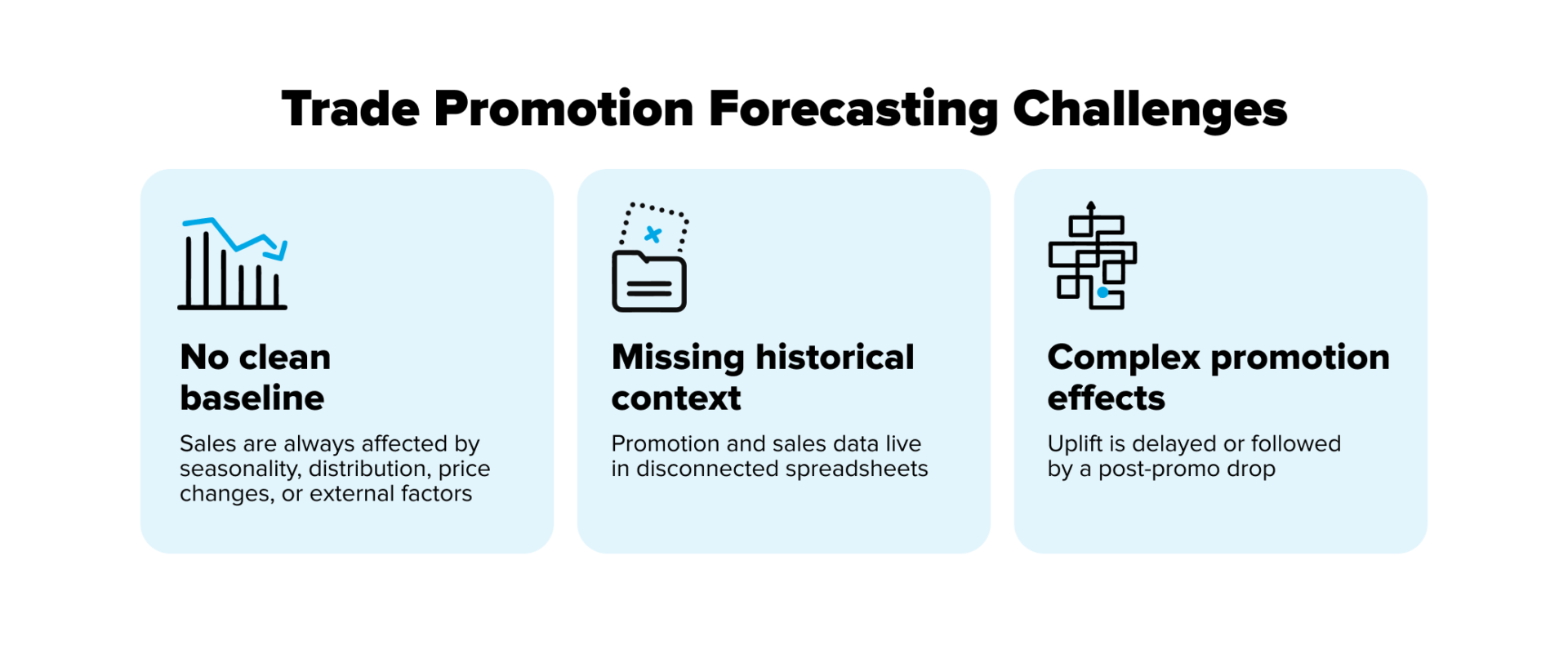
A Baseline Is Hard to Define Because Truly Clean Periods Are Rare
Sales are rarely influenced by a single factor. Even without a formal promotion, volume can be affected by seasonality, weather, assortment changes, price adjustments, competitor actions, out-of-stocks, or distribution shifts. In many categories, there are very few weeks when nothing impacts sales.
As a result, what looks like a baseline on paper may already include hidden uplift or hidden decline.
This is why baseline modeling is often the hardest part of trade promotion forecasting.
How to resolve this problem?
Stop looking for a “perfect” clean period and treat the baseline as a calculated model, not a fixed number.
Instead of guessing at normal sales, adjust for known factors such as seasonality, distribution changes, out-of-stocks, and past promotions. This requires historical data with context – something spreadsheets are bad at preserving.
The Lack of Historical Data
In many organizations, historical sales and promotion data live in spreadsheets. Files get copied, edited, renamed, and partially overwritten. Context is lost.
Before any AI-driven tools that automate trade promotion analysis can be applied, businesses need a system that continuously gathers and stores data.
How to resolve this problem?
Start by adopting an effective Trade Promotions Management system. Such a solution provides a solid foundation for building a consistent promotional history, linking sales to promo mechanics and prices, and preserving context over time.
Complex Promo Response
Promotion effects are often non-linear and delayed. A promotion may look successful during the promo week, but lead to a sales drop afterward. Without accounting for these patterns, forecasts overestimate real incremental impact.
How to resolve this problem?
Model promotion response as a behavior pattern, not a fixed rule. Use historical data to learn how demand reacts to different discount levels, mechanics, durations, and timing – by retailer and by category.
Read also how to overcome trade spend management challenges and what tools to use for it.
How It Works in Practice
What we generally know about AI in trade promotion often reflects ideal scenarios. In real life, trade promotion forecasting models work with incomplete data, overlapping effects, and operational constraints.
We’ve already covered both basic requirements and the challenges of providing them. Now, let’s look at how this actually translates into a working setup inside a company.
Tools
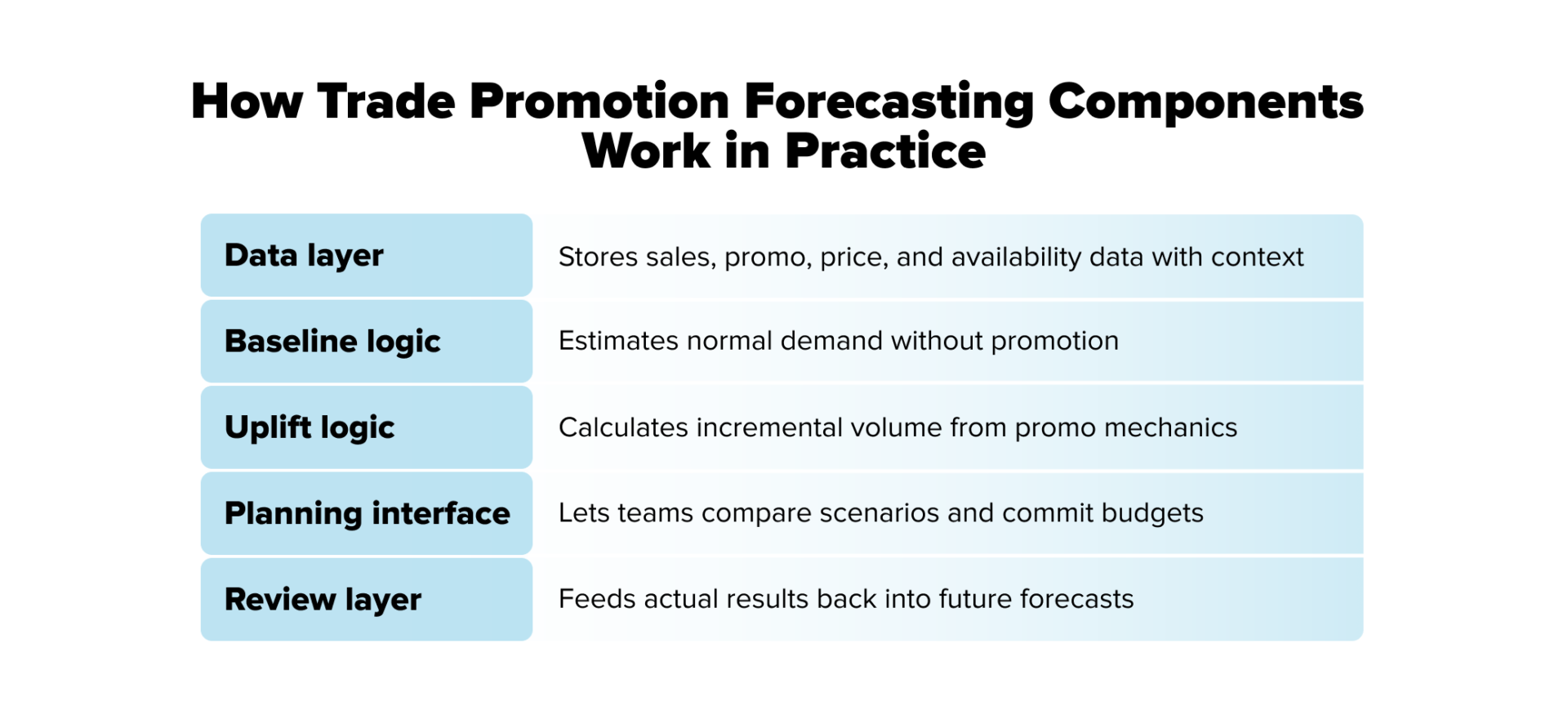
In practice, you don’t just use trade promotion forecasting models on their own. AI and statistical algorithms are usually a part of a tool (or a combination of tools).
You can build a custom setup using technologies that already exist on the market. This might include a data repository, forecasting logic, and a planning interface layered on top.
Some companies develop these pieces internally.
Others use Trade Promotion Management platforms that already combine data capture, baseline calculation, uplift modeling, and planning workflows. Such software can be easily tailored to specific processes and categories.
The difference is experience.
Off-the-shelf TPM/TPO platforms are built with a clear view of how trade promotion practices and technology have evolved. They reflect feedback from many companies dealing with the same issues. Edge cases, data gaps, and operational shortcuts are usually already known.
That tends to make them more stable in daily use.
Workflow
ML-driven tools can shape workflow, or workflow can shape tools. Both options are acceptable in practice.
In some organizations, existing planning processes are well established.
In those cases, tools are adapted to match how sales teams already plan, approve, and execute promotions. Promotion forecasting supports the workflow by fitting into known decision points and approval steps.
In others, the tools introduce better practices.
Mature TPM and TPO platforms (often discussed in the context of TPM vs TPO) reflect workflows tested across many companies. They enforce basic discipline around forecasting:
- structured promotion setup
- explicit assumptions
- consistent baseline logic
- mandatory post-promo evaluation
Over time, this reduces ad-hoc decisions and spreadsheet-driven workarounds that distort forecasts.
Neither approach is inherently better.
What matters is whether forecasting is embedded in the workflow rather than treated as a one-off calculation.
Forecasts need to be updated as inputs change and reviewed once results are known.
Optimization
Optimization does not mean letting the trade promotion forecasting system automatically decide which promotions to run. It means using forecasts to compare realistic options and understand trade-offs before committing budget.
Optimization usually starts with constraints. Budgets are fixed. Retailer calendars are partially locked. Production and logistics have limits. The task is not to find a theoretical maximum, but the best outcome within those boundaries.
Teams use forecasting outputs to test scenarios: changing discount depth, shifting timing, swapping mechanics, or reallocating spend across retailers or regions. Each option is evaluated against the same baseline, using expected uplift, margin impact, and budget consumption.
Most optimization happens incrementally. Instead of redesigning the entire promo plan, managers adjust a subset of promotions.
Core Promotion Forecasting Methods: From Statistics to ML
Most companies don’t pick forecasting models directly. They use platforms that already bundle several calculation methods. What matters for the user is what types of forecasts the system can produce based on those models and how those numbers can be used.

Statistical / Time-Series vs Causal Models: When They Work Best
Statistical and time-series calculations are usually responsible for the baseline.
These trade promotion forecasting methods work best for products with predictable demand and fit well into demand planning when promo mechanics change only occasionally.
Causal calculations are used for a different purpose. They help explain why sales change by linking volume to price, discount depth, mechanics, or in-store support.
In practice, this is what lets users see how a change in the promotion setup alters the expected result.
These calculations work best when promotion details are recorded clearly and consistently. When inputs are patchy, the system will still produce a forecast, but the numbers should be treated with more caution when making decisions.
Machine Learning Methods: Capturing Non-Linear Promo Effects
Machine learning methods are used on platforms when promotion response stops being proportional.
For users, this becomes visible when forecasts reflect effects such as:
- Volume only increases once a certain discount threshold is crossed
- Deeper discounts add less and less volume
- The same mechanic performs differently depending on the retailer or timing
These methods adapt better to various promotion setups and large volumes of historical data. They allow platforms to learn patterns that are hard to define with fixed rules.
The downside is transparency. Users don’t interact with the models directly, so they depend on the platform to keep results stable and avoid overreacting to past data when running scenarios.
What PromoTool Can Forecast for your Team
PromoTool is both a TPM and a TPO solution. It has two “parts” you can adopt, depending on your team’s technical and data maturity.
For example, if you still struggle to keep records of past promotions and link them to sales and prices, PromoTool can serve as a TPM foundation.
All calculations at this stage are primarily based on statistical methods, which are well-suited to this type of work.
In this setup, the focus is on structure rather than trade promotion forecasting.
Once this foundation is in place, sales teams can move to the TPO and forecasting layer.
At that stage, PromoTool is ML-driven and can forecast:
- baseline sales without promotion
- expected uplift by promotion, retailer, and timing
- sales, revenue, and profit impact across scenarios

Sales teams can compare options, rank scenarios, and see which promotions are likely to deliver incremental value before committing budget.
Moreover, with a conversational chat-like interface, teams can interact with those forecasts directly.
Instead of working through static reports, users can ask questions and receive immediate, easy-to-understand responses.