Trade promotion strategies used to come first, and tools followed. Now, tables are turned.
The industry has been digitally transforming so quickly that technology no longer plays a purely supporting role.
Data availability, forecasting accuracy, and scenario modeling now actively influence which promotion mechanics are even considered viable.
We’re here to capture the current tech-dominated reality of trade promotion. In this article, we discuss how common trade promotion tactics are being reshaped by data, algorithms, and automation, and how this shift defines the best marketing strategies for trade promotion management in practice for FMCG teams.
You’ll understand which trade promotion strategies still make sense in a tech-first environment, and which ones need to evolve.
Let’s start with tactics, because strategies are shaped by the specific promotion mechanics that can realistically deliver. By looking at that mechanics first, it becomes clearer how broader strategies are being reshaped.
Common Trade Promotion Tactics
| Trade Promotion Tactic | Before (Tool-Supported) | Now (Tech-Driven) |
| Financial Incentives | Fixed discounts based on past habits | Discount size and duration modeled before launch |
| Merchandising & Visibility | Same displays everywhere | Visibility is used only where forecasted uplift justifies the cost |
| Sales & Training Initiatives | Broad execution push | Targeted actions in stores flagged by data |
| Digital & Cross-Promotion | High reach, high redemption | Targeted to segments with proven incremental impact |
Financial Incentives
Bands do not always have full control over promotions. Retailers often dictate price points, timing, and mechanics. It leaves brands with the choice between participation and lost shelf visibility.
In a tech-driven setup, this lack of control doesn’t disappear, but its impact on trade spend budgets becomes more measurable.
When brands do have control, forecasting and scenario modeling make it easier to identify cases in which incremental sales increase volume but fail to deliver the intended margin impact.
Special software like TPM/TPO solutions (often mentioned in the TPM vs TPO discussion) models discount size and duration before launch, and shows:
- How much volume is truly incremental vs. cannibalized
- How much demand is pulled forward from future weeks
- Whether the margin loss outweighs the volume gain
This often leads to smaller, more targeted discounts or no discount at all.
Let’s say a brand plans a 25% discount for four weeks. Scenario modeling shows:
Week 1-2 spike
Week 3-4 flat sales
Strong post-promo dip
The model suggests a 15% discount for two weeks instead. Result: similar uplift, higher ROI, less stock pressure afterward.
Merchandising and In-Store Visibility
There are two main angles from which this topic can be discussed: the tools that make merchandising execution trackable and the growing role of digital in-store merchandising formats.

The Execution Tracking Lence of a Trade Sales Promotion Strategy
Modern tools generate large volumes of store- and execution-level data – from share of shelf and number of facings to planogram compliance and stock availability during visibility periods.
This data is typically captured through:
- Image Recognition and Computer Vision (automatic analysis of store photos)
- SFA or CRM systems equipped with territory and visit management features
- Trade Promotion Management and Trade Promotion Optimization platforms that connect execution data with sales and financial outcomes
Together, these tools allow teams to conduct deep trade promotion analysis. The solutions create a usable signal: what was executed, where, and for how long. Once visibility data is linked to sales and margin data, its role changes from descriptive to decision-driving.
How this impacts trade promotion strategies:
- Separates effective visibility from purely cosmetic execution
- Quantifies uplift from visibility, both with and without discounts
- Helps avoid overpaying for displays that do not generate incremental volume
- Improves forecast accuracy by treating visibility as a demand driver rather than noise
In practice, it means that brands can apply more data-driven best practices for trade promotion strategies, such as:
- Predicting when visibility alone is sufficient to drive sales
- Deciding when visibility needs to be paired with a price incentive
- Limiting high-cost displays to stores where they are forecasted to pay back
Digital In-Store Merchandising Formats
In parallel with better execution tracking, merchandising itself is becoming increasingly digital. Screens, smart labels, and retailer media networks are replacing or complementing traditional physical displays.
Standard digital in-store formats include:
- In-store digital screens and video walls
- Digital shelf labels highlighting promotions or price changes
- Sponsored placements on retailer in-store media networks
- App-based promotions triggered by in-store presence or location
- Interactive kiosks or QR-based product discovery
How digital merchandising changes trade promotion strategies:
1. Visibility becomes flexible
Unlike fixed physical displays, digital formats allow messaging to change by store, timing, stock level, or promo phase. It reduces waste and execution risk.
2. Exposure becomes measurable
Digital visibility generates clear metrics (impressions, duration, frequency), allowing it to be planned and evaluated like a media channel rather than assumed.
3. Merchandising shifts to optimization
Less reliance on perfect in-store execution enables faster testing, mid-promo adjustments, and closer alignment between forecast and outcomes.
The strategic effect it creates:
- Digital merchandising doesn’t replace physical visibility, just makes it adjustable.
- Instead of fixed upfront commitments, brands can test, scale, pause, or redirect visibility spend based on performance.
Sales and Training Initiatives
This type of trade promotion strategy focuses on two areas:
- How well trade promotions are executed in the field
- How to enable better decisions by the people executing them
Technologically mature brands usually have the entire ecosystem of tools for different purposes. A Trade Promotion Management software equipped with optimization features handles the promo planning, forecasting, and optimization directly.
Execution data, however, comes from other systems, such as SFA or CRM tools with Sales Territory Management features, Image Recognition, or inventory tracking solutions.
Since these activities are connected, the tools behind them need to be connected as well.
If execution data remains isolated within a single team or system, it cannot influence planning or performance assessment.
When execution data is linked to promotion plans and financial results, sales and training initiatives become more focused.
Before this level of integration, those initiatives were mainly standardized. Promotions were planned centrally, training explained the mechanics, and sales teams followed fixed visit schedules. When a promotion underperformed, the typical response was to increase visits or ask reps to “push harder.”
Now, sales teams are directed to stores where execution issues affect outcomes, and training is tied to concrete gaps rather than broad, periodic programs.
Digital and Cross-Promotion Tactics
Here, we discuss activities such as coupons, loyalty offers, retail media placements, and app-based promotions.
Despite the digital format, these tactics remain part of trade promotion, since they are executed through retailer channels and tied to in-store performance.
For example, brands may work with local influencers to promote a specific in-store offer available only in selected retail chains. The influencer’s content points followers to a named retailer and a limited-time promotion.
This is still a trade promotion because the goal is to drive shoppers to the store and support a specific in-store discount, rather than general brand awareness.
The main changes in this type of trade promotion marketing strategies are driven by better data. Brands can compare sales performance in stores and regions with and without digital activity.
Now, it is easier to see whether digital activity supports in-store promotions, adds incremental volume, or mainly overlaps with demand that would have happened anyway.
Key Elements of Effective Trade Promotion Strategies
The mechanics may differ, but the strategies that work share a common set of foundations shaped by data, connectivity, and measurability. These elements define how modern trade promotion strategies are built, executed, and adjusted in practice.
In practice, no matter the strategy, this means focusing on the following elements:
- Data-driven planning
- Retailer collaboration
- Integrated execution across channels
- Performance monitoring and ROI tracking
- Targeted and segmented promotions
Let’s discuss each of them.
Data-driven Planning
Planning starts from what the data allows, not from a preferred mechanism. The availability of store-level sales, execution signals, and historical response determines which promotion types are considered.
Strategies are shaped around what can be forecasted and measured with reasonable confidence, not around legacy playbooks.
Retailer Collaboration
As more promotion levers sit inside retailer systems (loyalty platforms, for instance), effective strategies rely on tighter alignment with retailers.
Some retailers treat their core suppliers as strategic partners and are willing to align on promotion strategy, timing, and mechanics rather than operate through isolated, transactional deals.
Integrated Execution Across Channels
Price, visibility, digital support, and field execution are planned together and adjusted together. One of the best practices for trade promotion strategies is to assume overlap between levers and to focus on how they reinforce (or cancel out) each other.
Performance Monitoring and ROI Tracking
KPIs are built into the strategy from the start. Promotions are designed so their impact can be measured at the store, region, or segment level.
Targeted and Segmented Promotions
Uniform rollouts are replaced by selective deployment. Tech-driven strategies of trade promotion define where a promotion should run, for whom, and under what conditions. Segmentation applies not only to shoppers, but also to stores, regions, and execution intensity.
Advantages and Limitations of Technology-driven Trade Promotion Strategies
Digital solutions, especially those that use AI in trade promotion, are often presented by their providers as if they can solve every possible challenge instantly.
In reality, even the most advanced, technology-driven trade promotion strategies have limits. These limits come from the data available, the systems involved, and the people who use them.
Therefore, understanding realistic benefits and limits is crucial for the effective application of best marketing strategies for trade promotion management.
Practical Benefits of Technology-Driven Trade Promotion Strategies

More informed decisions before launch
Forecasting and scenario modeling support decisions on discount depth, timing, and mechanics before a promotion goes live.
Greater transparency across planning and execution
Assumptions, inputs, and expected outcomes are visible to all teams involved. This makes it easier to understand why a promotion was approved, what it is expected to deliver, and which trade-offs were accepted.
Better use of trade spends
Budgets are allocated more selectively through trade spend management, focusing on stores, regions, or segments where returns are expected, rather than spreading spend evenly.
Earlier detection of execution issues
Connected execution data makes it easier to spot risks such as missing displays or stock shortages while a promotion is still running.
Clearer performance evaluation
Even without perfect attribution, brands can assess promotion impact at the store or regional level and separate incremental results from baseline demand.
Common Limitations and Risks
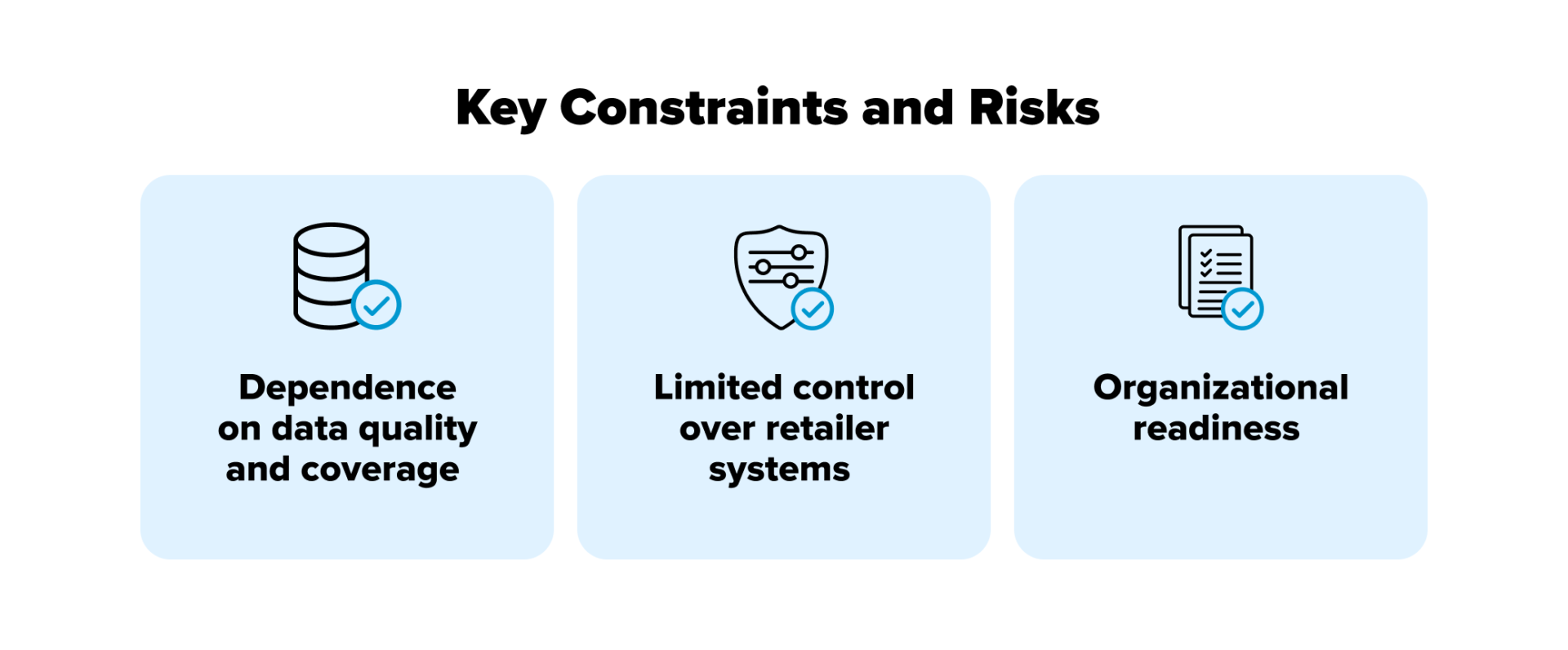
Dependence on data quality and coverage
Forecasts and models are only as good as the data behind them. Gaps in execution data or inconsistent retailer reporting can limit accuracy.
Limited control over retailer systems
Many key levers (promotion calendars, assortment decisions, shelf allocation) remain under retailer control, which constrains how strategies can be applied.
Organizational readiness
Tools may be in place, but without alignment across sales, marketing, and supply chain teams, insights are slow to turn into action.
Conclusion
The most effective strategies are not defined by a single tactic or tool. They emerge from the ability to connect data across planning, execution, and performance, helping teams act on those signals consistently and manage the trade spend promotion strategy and challenge more effectively.
That means fewer blanket promotions, more targeted deployment, and a clearer understanding of which levers truly drive incremental results.