Nvidia’s CEO, Jensen Huang, called 2025 the “year of robotics” because AI agents, humanoid robots, and autonomous vehicles are reaching performance levels we used to only imagine. Moreover, they don’t need custom infrastructure to plug into operations.
The recent statistics provided by Forum Ventures back this observation up. According to the study, 48% of companies across industries already use agentic AI, and another 33% are testing the waters.
What about the FMCG field? AI in FMCG isn’t a new concept, and adoption of AI agents is happening faster than you might think. We’ll prove that to you with real-life examples.
But before we discuss the cases, let’s quickly unpack what makes this type of AI in the FMCG industry different and when it’s actually worth applying.
What are AI Agents?
An AI agent (or agentic AI) is a software component that autonomously performs some tasks within other solutions or across entire tech ecosystems. In simple terms, it’s an AI-powered assistant capable of doing one specific task in a particular environment and still solving a complex challenge.
How is it different from traditional automation tools? The difference lies in how reactive vs intelligent the system is.
Traditional automation tools follow predefined rules. But these systems can’t “think” beyond those rules.
An AI agent doesn’t wait for predefined events. It monitors data continuously, spots patterns people might miss, and acts on its own. That’s what sets agentic AI FMCG automation apart from traditional rule-based tools.
Even within AI in FMCG, there’s a significant difference between systems that just provide insights and those that perform tasks autonomously. Let’s talk about this before we move on to application scenarios.
AI-Powered Software vs Agentic AI in FMCG: The Difference and What to Choose
Imagine a fast-moving consumer goods company attempting to streamline two processes, core parts of the route to market in FMCG – data analysis for marketing and automating stock replenishment.
Let’s say the marketing team needs to analyze vast amounts of data, such as sales numbers, promo performance, and customer feedback, at once. They decided to opt for an AI-powered system that can spot patterns, forecast demand, and suggest strategic actions.
The AI tool surfaces insights. People review them, weigh the options, and make the final call.
Why a fully scaled AI-powered solution here? It handles complex FMCG analytics across many variables and assists in decision-making.
Now, let’s move on to the supply chain team. Their challenge is more specific – to automate stock replenishment. They went with an AI agent for that. The AI-powered component (agent) focuses only on inventory levels at distributor warehouses and automatically places orders when stock runs low to prevent stockouts.
Why the agentic AI adoption here? Because it’s designed for one focused task, no people are needed.

Now, it’s finally time to discuss the applications of agentic AI in the FMCG sector.
Agentic AI Use Cases in FMCG
Many FMCG pain points can now be solved with greater speed, accuracy, and autonomy than ever before. So, we’ll explore some of the most annoying and time-consuming problems FMCG companies face and show how FMCG companies using AI agents are already tackling them successfully.
Let’s start with the document management since it’s a chronic headache in many industries, not just FMCG.
Document management
People within the same company often end up dealing with documents in every format you can think of – PDFs, scanned pages, Excel files, even phone snapshots. There can be dozens (sometimes thousands) of them, and just finding the right one can be a challenge in itself.
If one person doesn’t process a document on time, someone else down the line will be stuck waiting.
Agentic artificial intelligence in the FMCG industry performs incredibly well in dealing with these sorts of issues. Let us prove with two examples from our own practice.
Brief Preparation and Unification
For companies managing multiple brands across different markets, FMCG marketing briefs can quickly turn into a headache. Everyone has their own version – their favorite format, way of writing, and definition of what makes a “good” brief. So instead of clarity, teams end up with a pile of inconsistent documents. And when does execution depend on those briefs? Timelines slip.
That was precisely the case for one of our clients. To solve this problem, we built a web-based AI assistant to bring structure and speed to the briefing process. Here’s how our AI agent helps:
- Walks users through a clear, step-by-step process
- Uses a consistent, expert-approved template
- Offers real-time tips and suggestions based on the company’s playbook
- Speeds up the writing process without sacrificing quality
- Reduces back-and-forth and misalignment across teams
- Ensures all briefs follow the same structure and standards

Before, writing a brief could take hours or even days. Now it’s done in minutes. Teams get a solid first draft almost instantly – and from there, it’s just a matter of refinement. The result? Faster approvals and smoother handovers.
Document Search Automation
Finding the right document shouldn’t feel like detective work. But, in many FMCG companies, it still does. Emails come in fast, reference numbers get lost in threads, and before you know it, someone’s spent half an hour just trying to track down an invoice.
That’s exactly what was happening with one of our clients, so we built them an AI agent to handle the whole process.

Here’s what the AI agent does:
- Reads new emails as they arrive and creates a case automatically
- Pulls out reference numbers without needing any prompting
- Digs up the right document in seconds
- Makes sure the person requesting it has access
- Replies right away with the file attached
And if you prefer to keep a person in the loop? The system can pause for a quick confirmation before sending anything out.
Order Management Automation
Even when an FMCG company follows best practices for order collection (like having sales reps use SFA or offering customers a B2B eCommerce platform), problems can still arise with certain customer types, accounts, or sales formats. This often leads to a lot of manual work.
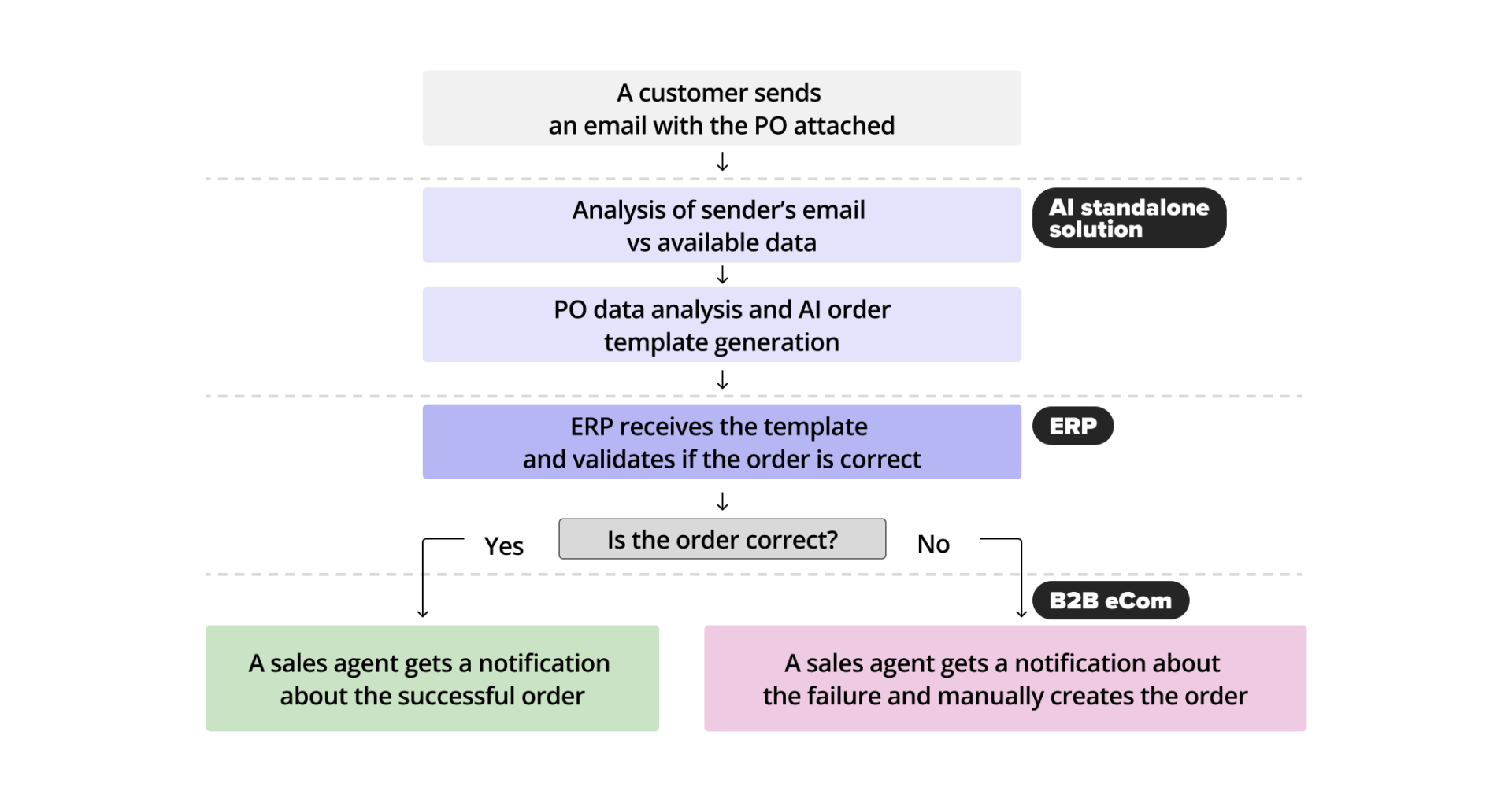
To solve this challenge for one of our clients, we built an AI-powered PO2Order Flow system that turns emailed purchase orders into ready-to-go sales orders in seconds.
What the AI agent does:
- Reads documents straight from emails, no matter the format
- Fills in any missing info from internal systems
- Creates a standardized file ready for the ERP
- Flags any issues and notifies admins about them
What used to take 15 minutes now takes 10 seconds: no extra tools or significant changes for customers.
Procurement Assistance
Procurement in FMCG is a constant juggling act. Teams deal with fragmented data, inconsistent formats, fluctuating prices, and supplier communications that still rely heavily on emails, PDFs, and phone calls.
Add to that the pressure to act fast and understand the dynamics of relationships with each supplier, and it’s easy to see why procurement becomes a major time sink.
Fortunately, there’s a way to automate this process. It isn’t simple, but it is possible.
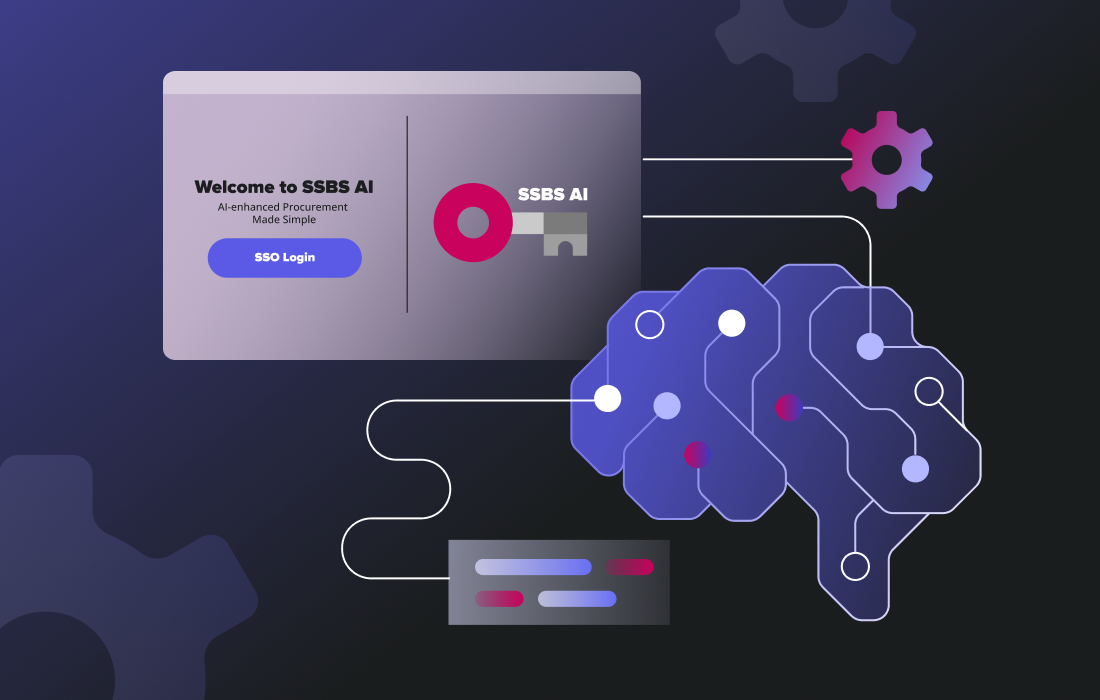
How can we be so sure? Because we built a web-based AI agent that handles those exact complexities.

Powered by generative AI, the tool cleans up and enriches PR and PO lines, making sure everything is clearly described and easy to process. It also does:
- Pulls key data from attachments using FMCG image recognition
- Matches extracted info to the right PR lines
- Recommends the best pricing based on past orders
- Automatically emails to suppliers requesting discounts
- Helps shape replies for smoother negotiations
The result? Fewer manual tasks and faster decision-making. This is particularly valuable for newcomers, who are unfamiliar with the history of relationships with each vendor.
Read also about the ROI calculation formula in FMCG that helps understand your digital solutions’ impact.
Visual Data Interpretation
PDFs are hard to process for many non-AI tools. The challenge becomes even greater when the data is in the form of images, audio, or video. Traditional systems find it nearly impossible to process these types of files without manual input.
We’ve discussed this problem in the document management section, but it’s not just a document management problem. Visual, audio, and video data appear across all sorts of business processes.
For an AI agent, it’s an easy task. It can “read”, interpret, extract, and put where needed this information as if it were just a document full of structured information.
The ability of modern technology to process and interpret visual data has huge potential in the FMCG industry, with one of its most common applications being shelf image recognition.
Let’s look at the example from our client.
Manual checking promo catalogues for the client’s team used to take hours, and even then, it was easy to miss some deals or misread sales offers. Pages were blurred, product variants were overlooked, and people’s fatigue led to errors.
Yet, these catalogues hold critical information: who’s running which promo, at what price, and how your brand is positioned against competitors.
What solution did the company use? Our AI Promo Assistant.
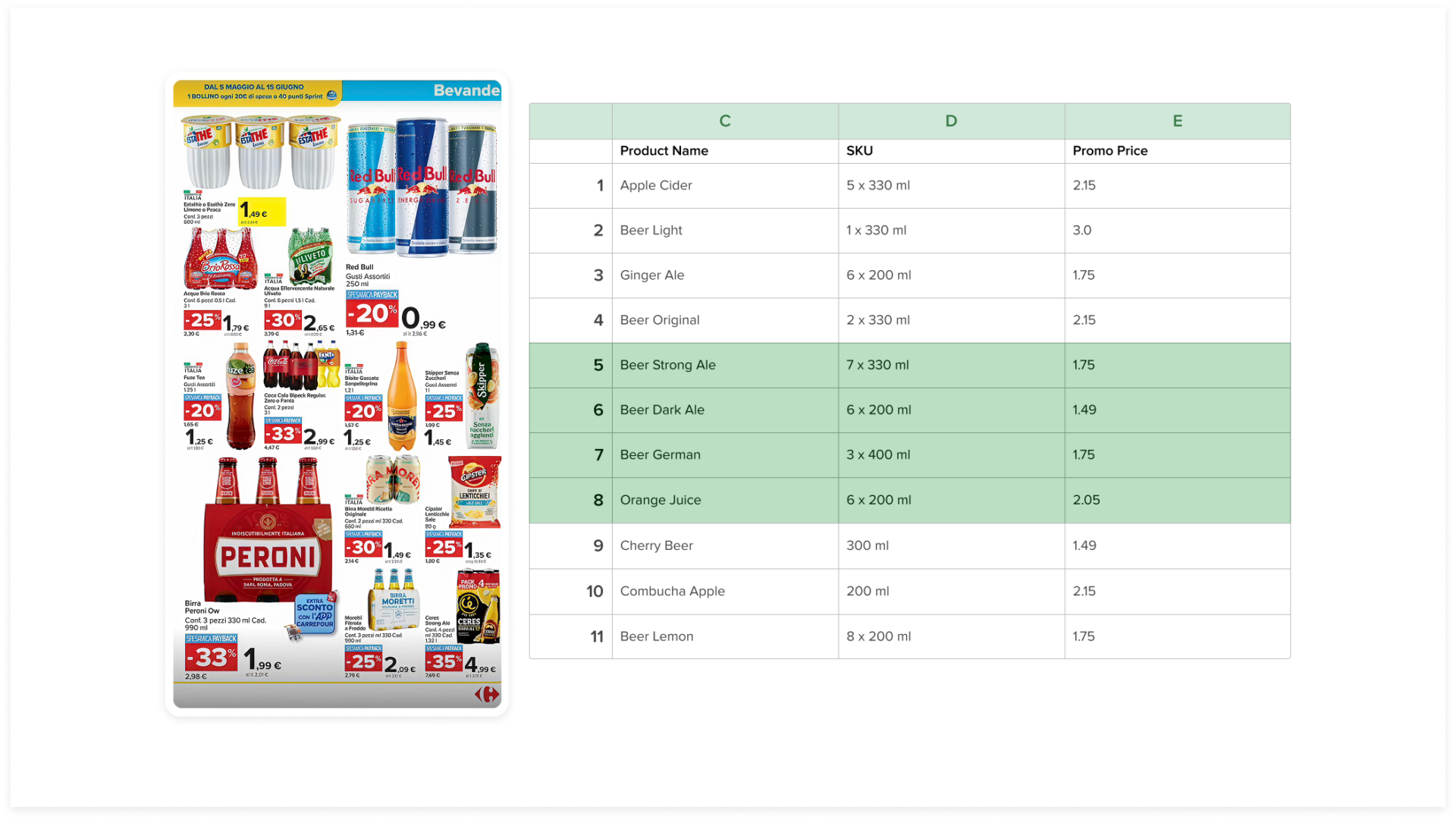
By combining AI product recognition with visual data parsing, the assistant automates what used to be a slow and error-prone task. How the AI agent works:
- Retailer identification
The system scans the catalogue and immediately identifies the retailer, adapting to their layout and promo style.
- Product and UOM identification
Each product is recognized with its name, pack size, and unit of measure – whether it’s a 500ml juice or a 3x150g soap multipack.
- Original and discount price detection
It automatically captures both the regular and promo prices, even when they’re presented in visually complex formats like “Buy 2 for 99.99.”
- Promo position identification
Page position and prominence are assessed to evaluate visibility – was your product on the cover, top half, or buried in the fine print?
- Report generation and storage
All the parsed promo data is compiled into a structured report and stored on SharePoint. No more digging through folders – it’s centralized, searchable, and shareable.
Each case is an inventive way to solve a massive set of problems with minimal disruption to the existing tech ecosystem or workflow. Instead of forcing major system overhauls, these AI agents integrate smoothly into what’s already there.
Conclusion
Agentic AI is a recent development. That’s why Google is full of generic ideas on how to use it for fraud prevention, supply chain optimization, and more, but lacks real-world agentic AI use cases in FMCG.
These agents can indeed fully solve the most complex and annoying industry challenges. Still, hands-on examples show that you wouldn’t have to make big changes in your tech ecosystem to integrate them. Moreover, they work across tools and platforms, filling gaps between disconnected systems completely autonomously.
You make a small change – an AI agent takes care of your whole operational challenge.
If you suspect there are areas in your business where an AI agent could drive efficiency but aren’t sure where to start or how it should work, we’re here to help.
Drop us a line for a consultation, and we’ll help you identify the most impactful applications of AI in FMCG for your business.