95.5% of companies using eCommerce already rely on AI in some form, according to a survey.
In B2B, adoption is slightly behind but moving fast. Around two-thirds of such companies already use AI. Most others are actively evaluating it.
For business in FMCG, it means:
- AI in B2B eCommerce is no longer an “early adopter” topic.
- Expectations are already set – buyers experience AI elsewhere and expect the same here.
- There is still a window to stand out – full integration is not yet the norm.
In this article, we will use that window to showcase how AI in B2B eCommerce differs for FMCG compared to other industries and what it actually adds to a platform in practice.
Why FMCG eCommerce Has Different AI Needs Than Other Industries
B2B FMCG eCommerce isn’t really similar to other B2B models. But we will not go deep into all of the distinctions. Instead, we’ll focus on those that directly shape AI use cases in B2B commerce platforms.
| Why FMCG needs different AI | |
| FMCG Reality | AI Role |
| Constantly changing pricing & promos | Adjust offers and catalog per customer in real time |
| Frequent, repeat orders | Auto-build reorder baskets and suggest quantities |
| Complex pricing & trade deals | Apply correct pricing logic automatically |
Commercial Conditions Change Constantly
The core products themselves don’t change that much. A tin of Heinz baked beans or a bottle of Coca-Cola is largely the same year after year.
However, pack formats and sizing, pricing, promotions, and availability vary by customer, channel, and timing.
If there’s AI inside a platform, it continuously adjusts pricing, promotions, availability, and recommendations. Thus, each buyer will see their own version of the catalog at the right moment.
Orders are Frequent and Repeatable
Usually, brands adopt B2B eCommerce with AI platforms to better serve small and remote shops.
Such retailers reorder regularly, depending on delivery cycles. Orders are similar each time, with small changes based on demand, stock, or promotions.
It creates the need for AI to even more automate routine buying than the platform already does.
For example, AI in B2B Commerce often builds reorder baskets with the right products and quantities for customers. It allows retailers to avoid stockouts.
Pricing and Promotions are More Complex
FMCG/CPG B2B pricing isn’t linear. It includes overlapping discounts, trade deals, and customer-specific conditions. It’s either tons of work for people or a task for an AI model that can manage this in real time and at scale.
Together, these factors make FMCG eCommerce require a different AI approach than most other industries to achieve meaningful ROI in B2B eCommerce.
AI Use Cases in B2B Commerce
AI in B2B Commerce platforms is typically used to improve specific steps in the order-creation, processing, and optimization.
| AI use cases in B2B eCommerce platforms | ||
| Area | AI Use Case | What It Delivers |
| Customer experience | Reorder suggestions, smart search, recommendations, chatbots | Faster ordering, better customer satisfaction |
| Operations | Demand forecasting, anomaly detection, and content automation | Fewer errors, better stock planning, less manual work |
| Pricing & marketing | Promotion analysis, price guidance | Better performing and personalized promos, more precise pricing decisions |
| Risk & security | Order and behavior monitoring | Early detection of errors, fraud, or unusual activity |
Customer Experience and Sales Enablement
Basically, it’s about helping buyers place orders faster.
What specific AI-driven functionalities do brands use in their platforms:
Reorder suggestions
AI builds a ready-to-order basket based on past purchases and current context.
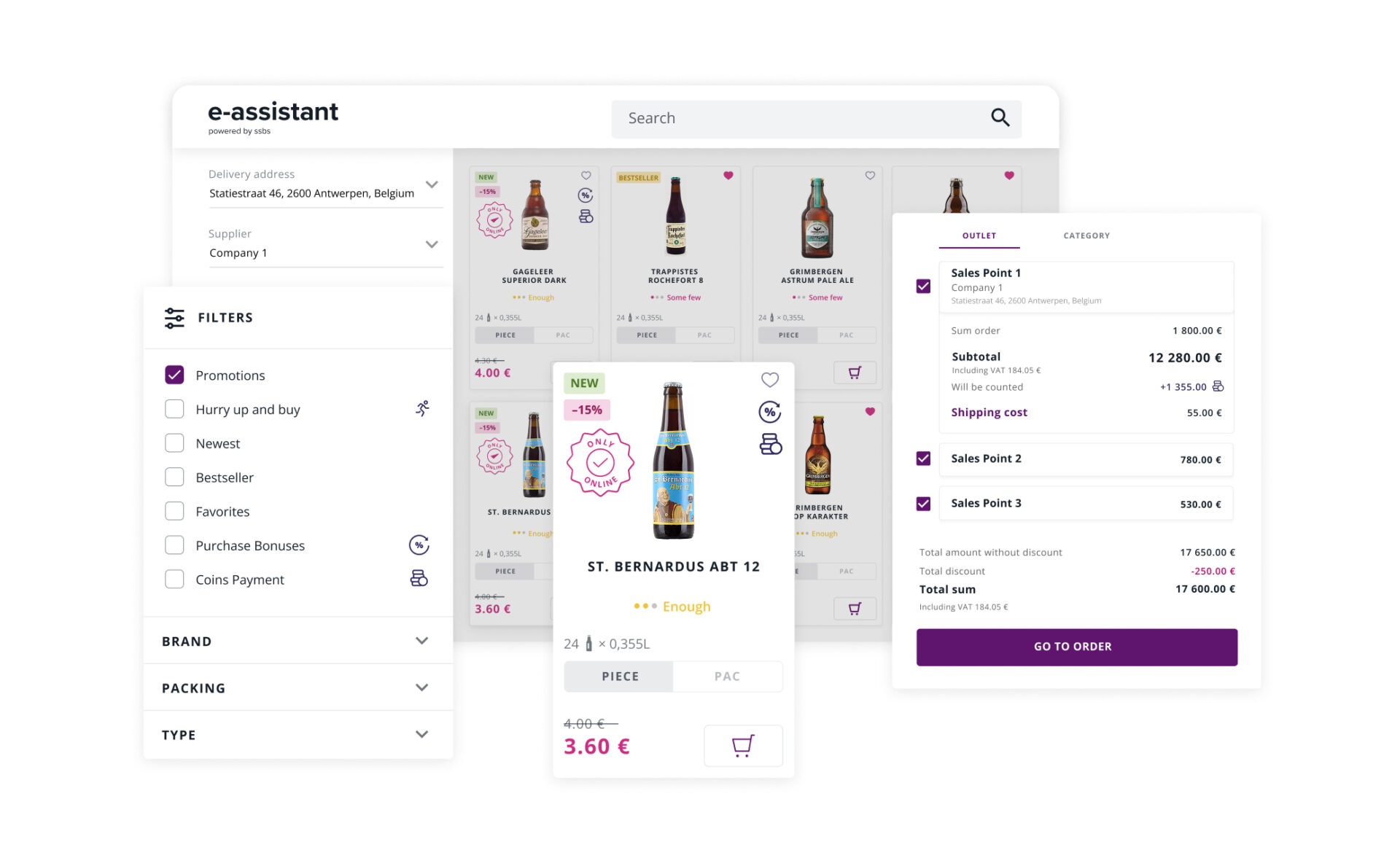
For instance, a retailer logs in and sees a pre-filled order that has been adjusted for current promotions.
Context-aware product search
Intelligent search understands intent, not just keywords. For instance, “cola promo” returns relevant SKUs and promotional packs.
Next-best product suggestions
AI recommends relevant additions during ordering. Like adding snacks triggers a suggestion for a matching beverage.
AI chatbots for customer service
Chatbots help buyers find products, check order status, or resolve issues directly in the platform.
For example, a retailer can ask about product availability, delivery timing, or current promotions and get instant answers without contacting a sales rep. It improves customer satisfaction through faster, more convenient support.
Operations and Process Efficiency
Once orders are placed, the focus shifts to order accuracy and demand planning. What AI can provide:
Demand forecasting for replenishment
AI predicts short-term demand based on past orders, seasonality, and external signals. For example, ahead of a heatwave or promotion, the system suggests increasing quantities for fast-moving items to avoid empty shelves.
Order anomaly detection
The technology flags unusual orders before they are processed. In practice, if a retailer orders 5× more than usual, the system highlights it for review. This way, it helps catch errors or unexpected spikes.
Automated product content updates
When a new SKU is added, the platform pulls product data from existing sources. It can be ERP systems, supplier feeds, or product master data. AI then uses this information to generate or update product descriptions in the eCommerce catalog. It brings automation to product content creation.
So, when a new pack size is introduced, the system automatically generates a ready-to-use description from existing product details (e.g., brand, ingredients, packaging), with no manual setup required.
Marketing, Pricing, and Revenue Strategy
This is where the role of AI in modern B2B eCommerce is to support day-to-day commercial decisions.
Personalized campaigns and content inside the platform
AI can also generate and adapt promotional content for each buyer directly within the eCommerce environment. That includes banners, product highlights, messaging, and even simple ad visuals.
Instead of running one generic campaign for all customers, the platform tailors how offers are presented based on buyer behavior, order history, and preferences.
For example, a high-volume buyer sees a homepage banner focused on bulk deals and fast reordering.
Meanwhile, a price-sensitive customer is shown a limited-time discount with clear savings highlighted.
A buyer who hasn’t ordered in a while receives a reactivation message with a curated product selection.
Promotion performance analysis
B2B eCommerce AI compares expected vs actual results and highlights what worked for the buyer. It shows which offers were actually picked up and which were ignored.
For example, after a promotion, the system highlights that a smaller discount performed just as well as a deeper one. Meaning buyers responded without needing aggressive pricing.
Price guidance
An ML model can suggest pricing adjustments based on how different buyers respond.
Let’s say a retailer regularly orders certain SKUs at standard prices. Pushing a discount to them on these products isn’t unnecessary. Meanwhile, among more price-sensitive buyers, targeted discounts are more likely to influence their decisions, effectively personalizing the experience for each customer.

Security, Risk, and Fraud Prevention
Artificial Intelligence in B2B eCommerce also helps monitor activity in real time and flag issues before they become costly mistakes.
Suspicious order detection
An AI-driven system learns what “normal” ordering looks like for each buyer and flags anything that falls outside that pattern.
If a retailer suddenly orders an unusual mix of products or a much higher volume than usual, the system highlights it before the order is approved. In such cases, sales reps get a chance to confirm whether it’s intentional or a mistake.
Access and behavior monitoring
If an account logs in from a new location and starts placing atypical orders or changing key details, the system raises a warning or temporarily limits actions until it’s verified.
What Needs to Be in Place for Those AI Use Cases to Work
AI has not only perks but also requirements. Let’s be real: for some companies, these technologies are out of reach until they fix the basics.
| The Foundations Behind Effective AI in B2B eCommerce | ||
| Requirement | What It Enables | What Happens If Missing |
| Data readiness | Accurate suggestions, search, and pricing | AI outputs are unreliable or irrelevant |
| System integration | Real pricing, promos, and recommendations | Generic outputs that don’t match business logic |
| Internal ownership | Continuous improvement and control | AI becomes unmanaged and underused |
| Process alignment | Seamless use during ordering | Buyers ignore AI, more friction than value |
Data Readiness
The lack of data is the number one reason manufacturers can’t add AI capabilities to their eCommerce platforms.
AI features in B2B eCommerce rely on data-driven inputs:
- consistent product data (SKUs, pack sizes, attributes)
- clean order history from the platform
- accurate pricing and promotion data per customer
If this data is incomplete or inconsistent, AI features such as reorder suggestions, intelligent search, and pricing guidance won’t work properly.
For example, if the same product appears differently in the catalog and in past orders, the system can’t reliably suggest it for reorder.
System Integration
AI within a B2B eCommerce platform only works when the platform is deeply integrated with core systems such as SFA, TPM/TPO, and ERP.
Each of these systems provides a different piece of reality that AI depends on:
- ERP – stock, base pricing, order fulfilment
- SFA – sales activity, visits, negotiated deals, field insights
- TPM/TPO – trade spends (in case of SSBS’ PromoTool), promotions, and customer agreement conditions (including off-invoice terms, retro bonuses, and custom pricing logic)
The integration changes what AI can actually do inside the platform.
For example:
- A buyer sees prices and discounts that reflect their exact agreement, not just standard pricing
- Promotions shown in the platform are aligned with planned trade spends, not generic campaigns
- Recommendations can factor in targets, commitments, or incentives defined in TPM
Internal Ownership
Someone in the business has to be responsible for how AI is used and how it performs inside an eCommerce platform. Usually, it falls under the person responsible for the B2B eCommerce platform as a whole.
That’s the only role with enough visibility across:
- commercial logic
- customer experience
- data inputs from different systems
This also highlights one of the challenges of B2B eCommerce, because that person is usually already responsible for:
- platform performance
- adoption
- content and catalog
- integrations
Adding AI to the platform, if it wasn’t equipped with this technology from the beginning, quickly becomes an extra responsibility.
Without a clear focus and a goal, AI becomes:
- another feature to maintain
- another source of issues when data or logic is off
- something that is technically present, but not actively managed
To avoid this, AI needs to be treated as part of the platform’s core features, not an add-on.
That means the platform owner should:
- track how AI impacts business metrics
- regularly review outputs and relevance
- coordinate with sales, trade marketing, and IT when adjustments are needed
Process Alignment
Even well-functioning AI won’t deliver value if it doesn’t fit into how customers actually order.
For example:
- Reorder suggestions are shown on a separate page instead of during basket building, so they’re skipped
- Product recommendations that require extra clicks or navigation are often avoided
- Suggested products that can’t be added to the cart in one step most likely will be abandoned
Another common issue is when AI suggests something, but the platform doesn’t let the buyer act on it immediately.
- “You may need this product” – but no quick add-to-basket
- “You’re close to a bonus threshold” – but no visibility of how to reach it
- “This promo is relevant” – but not applied or clearly reflected in the cart
From the buyer’s perspective, this creates more friction than value, while the role of AI in modern B2B commerce is to simplify and speed up decision-making.
Where to Start with AI B2B eCommerce (without Overcomplicating It)
Start by assessing your current platform and then decide:
- What functions can be added to improve the existing ordering flow right away?
- Are there any limitations in the current setup that will block meaningful AI use?
- Whether extending the platform makes sense, or if it’s time to replace it entirely.
Adding AI Functions to the Existing Platform
If you already have a B2B eCommerce platform, the first step is not to rethink everything, but to evaluate what can be added to it.
In many cases, modern platforms already support basic AI features or can be extended with them.
Look for ready-made AI tools to fill the gaps in your platform or build your own models.
AI tools (buy) are faster to implement and require less effort. However, there can be troubles with integration.
Custom models (build) give more control and can reflect your exact pricing logic, promotions, and customer behavior. But they may be costly, and will definitely require strong data, ongoing maintenance, and technical expertise.

Building or Buying Your New Platform
When the current platform has a rigid architecture that makes changes slow or expensive, then adding AI becomes a workaround rather than a solution.
Therefore, if the AI features are so critical, it’s easier to switch from a legacy system to a more modern one. The technology is evolving quickly, so the new setup must be able to keep up with AI in B2B eCommerce over time.
You have two options: build your own platform or adopt a ready-made FMCG-focused solution.

Building your own platform
In practice, building one means you are responsible not only for the platform, but also for:
- continuously adapting it to new AI B2B eCommerce capabilities
- maintaining integrations and data consistency
- evolving AI logic as business needs change
Many companies rely on software development teams for this. And there are plenty of capable vendors. However, many of them approach FMCG as just another industry, often simply trying to expand their portfolio by adding a few relevant cases.
The risk is not technical execution. It’s the lack of a deep understanding of:
- pricing and agreement structures
- trade promotions and TPM dependencies
- how ordering actually works in FMCG
Without that, both the platform and the AI inside it can fall out of sync with the business.
Adopting a ready-made FMCG-focused solution
In this case, instead of building and maintaining everything yourself, you rely on a platform that:
- already reflects FMCG-specific commercial logic
- is pre-integrated or designed to work with ERP, SFA, and TPM/TPO
- evolves over time, including its AI capabilities
This matters because AI is not a one-time feature. It requires continuous improvement. And here’s how to choose a vendor that doesn’t just offer AI today but keeps improving it as new capabilities emerge.
What to Ask Vendors Before You Commit to a New Platform or AI Solution
Not all “AI-enabled” platforms are equal. Some are just standard solutions that come with a few built-in features, while others are designed to evolve over time. Let’s look at what to ask to check it.
How does your AI use our data in practice?
Look for a clear explanation. How does order history influence outputs? How is it structured and refreshed? If the answer is vague, the AI is likely generic.
Where does AI show up in the ordering process?
In B2B eCommerce, value is created during the ordering process. Product recommendations, pricing guidance, and promotions should be visible and actionable where the buyer makes decisions, not in separate sections.
How do you handle pricing agreements, trade promotions, and customer-specific conditions?
AI should account for real commercial rules. If these are missing or simplified, the outputs won’t match how your business actually works.
Who is responsible for making AI work over time?
AI needs continuous adjustment – data, logic, and alignment with business teams. A good vendor will support this process, not just deliver the initial setup.
Conclusion
AI in B2B eCommerce is no longer a question of “if” or even “when.” It’s already here, and buyers expect it.
But the real difference is not in having AI – it’s in how well it is connected to the business.
In FMCG, where pricing, promotions, and ordering logic are constantly shifting, AI only works when it is built into the platform’s core. It needs access to real data, alignment with systems like ERP, SFA, and TPM/TPO, and a clear role in the actual ordering flow.