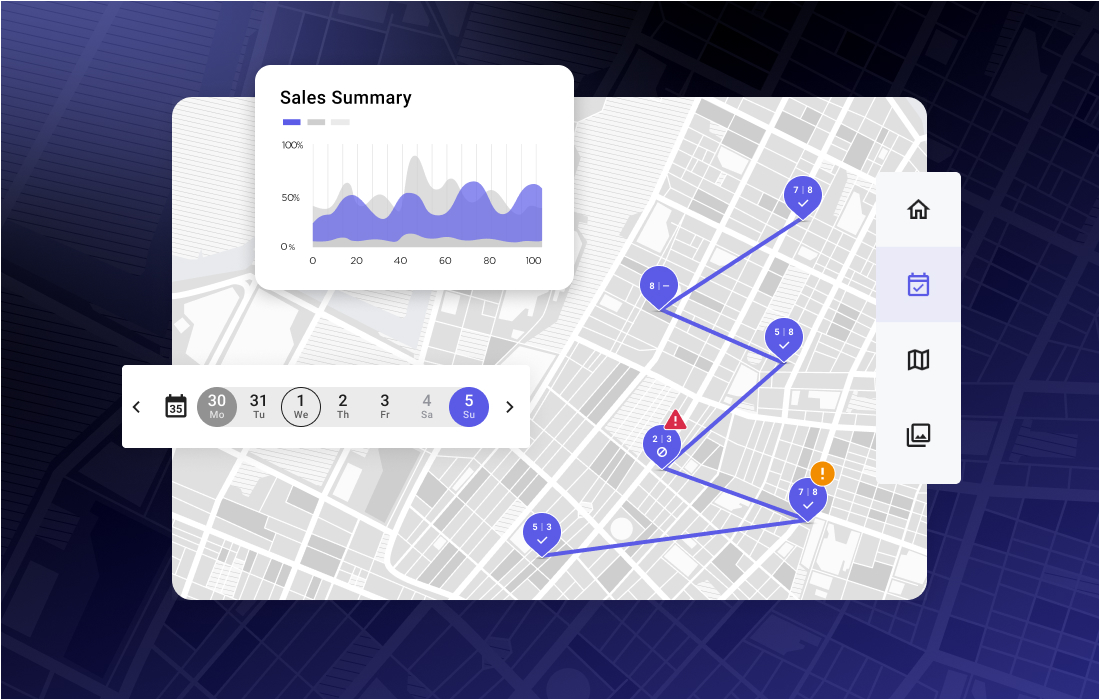
Long gone are the days when sales reps moved from store to store with a paper list. They sold, fixed shelves, and wrote reports by hand. Managers waited days or weeks to understand what actually happened in the field.
That way of territory management in sales no longer fits today’s markets.
The process has changed because the tools have changed. Routes are planned digitally. Visits are tracked in real time. Tasks are checked on the spot. Photos and data show what was executed, not what was reported later.
This shifts the whole process. In this article, we look at how territory management in sales should be built in 2026.
What Is Sales Territory Management?
Sales Territory Management is the process of defining which sales representatives sell to which customers, and of setting and updating sales territories and account ownership.
Tools That Are Typically Used to Support Territory Management in Sales
There are three types of solutions:
- Standalone Sales Territory Management software
- Special territory modules that could be built into broader Customer Relationship Management (CRM) systems
- Sales Force Automation (SFA), despite its primary focus on sales execution, often includes territory management capabilities in modern systems. This allows organizations to assign accounts, define specific territories, and balance workloads directly within the platform that reps use in the field.
The Difference Between Sales Territory Management and Sales Force Automation Software
| STM | SFA | |
| Focus | Planning territories & accounts | Day-to-day sales execution |
| Users | Sales Ops / Managers | Field Reps / Managers |
| Key functions | Assign accounts, balance workloads | Track visits, capture territory sales activities |
| Goal | Optimize coverage | Ensure reps follow the plan |
It is used to decide which customers and prospects belong to which territory, assign accounts, balance workloads, and update specific territories as market conditions change.
The solution is primarily used to optimize coverage.

FMCG Sales Force Automation software, on the other hand, focuses on day-to-day execution.
It helps sales reps manage visits, capture territory sales activities, take orders, and track compliance with the planned coverage.
Modern SFA systems may include field sales management features, but their core purpose is to support field execution, not to create territory design from scratch.
Common Territory Types
Most effective sales territory management strategies start with defining the type of territory. Choosing the right structure determines how work is assigned, how often stores are visited, and how results are measured.

Geographic
Territories are divided into regions, cities, or areas. For instance, a rep covers all grocery stores in Camden, London.
Industry/Vertical
Territories are based on the customer’s and potential customers’ industry or market segment. For example, one rep handles all pharmaceutical clients, another handles retail chains.
Account-Based
Specific high-value accounts are assigned to individual reps, regardless of location or industry.
Example: A key multinational client is managed by a single dedicated rep.
Product-Based
Territories are organized around specific products or product lines.
Like when one rep focuses only on dairy products, another on snacks, across all stores in their region.
Why Sales Territory Management Matters
Short answer: It saves time, which leads to saved money.
Longer answer: Companies that bring a plan and automate territory management in sales start collecting real-time data on every visit, task, and route. This information and its effective usage are the exact foundation for building better sales territory management strategies.
An effective sales strategy has a direct impact on increasing productivity, balancing workloads, driving revenue, and improving focus in the field.

Increases Productivity
With proper management of sales territory, reps and their managers spend no time deciding which current customers to visit and more time on execution and selling.
Moreover, specialized territory management modules or tools can show when some visits take longer than others, or when certain stores are consistently missed or underserved.
When such tools are integrated with an SFA or digital sales platform, the rough data alone gives a lot of context on the causes of underperformance.
One of our clients, a global pet food producer, achieves exactly that by using our SFA solution with built-in territory management features.
The field data showed that the company’s reps typically spent around 75% of their time in stores taking orders.
Since each visit takes about 25 minutes, there is almost no time left for properly executing and pitching products, promotions, and in-store standards. The company addressed the issue by adopting a B2B eCommerce platform to automate order placement.
As a result, reps no longer had to manually take most orders during store visits. Order placement shifted to the digital channel, while data from SFA and territory management features continue to guide reps and show issues and opportunities for improvements.
Balances Workloads
When territories are assigned fairly, no rep is overburdened. Furthermore, each visit is planned with a clear duration, travel time, and visit frequency in mind.
This allows managers and sales leaders to compare workloads across reps and adjust territories when one rep consistently runs out of time while another has spare capacity.
Drives Revenue
Effective management of sales territories brings not only a plan and structure to field visits, but also consistent data from execution.
When a dedicated digital solution is used, every visit, task, and outcome is captured and linked back to the territory, account, and rep.
With this data, companies can take concrete actions that drive revenue potential:
- Execution control in priority outlets – Compare planned tasks to actual execution. Check that promotions, price changes, and displays are done correctly. Proper execution in top stores increases sell-out and order volume.
- Territory-level sales performance visibility – Track sales and execution by territory. Shift effort to fast-growing areas or intervene in underperforming ones before revenue is lost.
- Territory audit over time – Measure how customer performance changes after each sales action. Keep territory sales activities that help boost revenue growth. Stop those that don’t.
Improves Focus
Sales managers are usually responsible for a wide range of functions and activities. They need well-established processes for the management of sales territory and software that supports sales operations. This way, routine planning and control become structured and focused.
Imagine a busy manager who balances paperwork, meetings, trade credits, overdue payments, route planning, and field execution. There’s no time to compare routes, visits, and reports line by line.
With the right software, the manager can see a clear overview of field activity. Routes, visits, and time spent per stop are visible in one place. Instead of monitoring everything, the manager looks for exceptions.
Let’s say the system shows the travel time between stores was planned at 10 minutes, but some reps take 25 minutes or more. The manager sees this immediately. The delays may be due to traffic, poor routing, or an unrealistic territory setup.
Inside the system, they create a meeting with those reps to determine the issue and after assign some personal follow-up tasks.
This shifts the manager’s focus from checking and comparing to problem-solving.

Key Components of Sales Territory Management
Sales Territory Management cannot work effectively without technology. The number of customers, reps, and daily changes is too high to manage manually.
Therefore, all the modern components we discuss here are closely tied to mapping software that supports various sales territory management strategies.
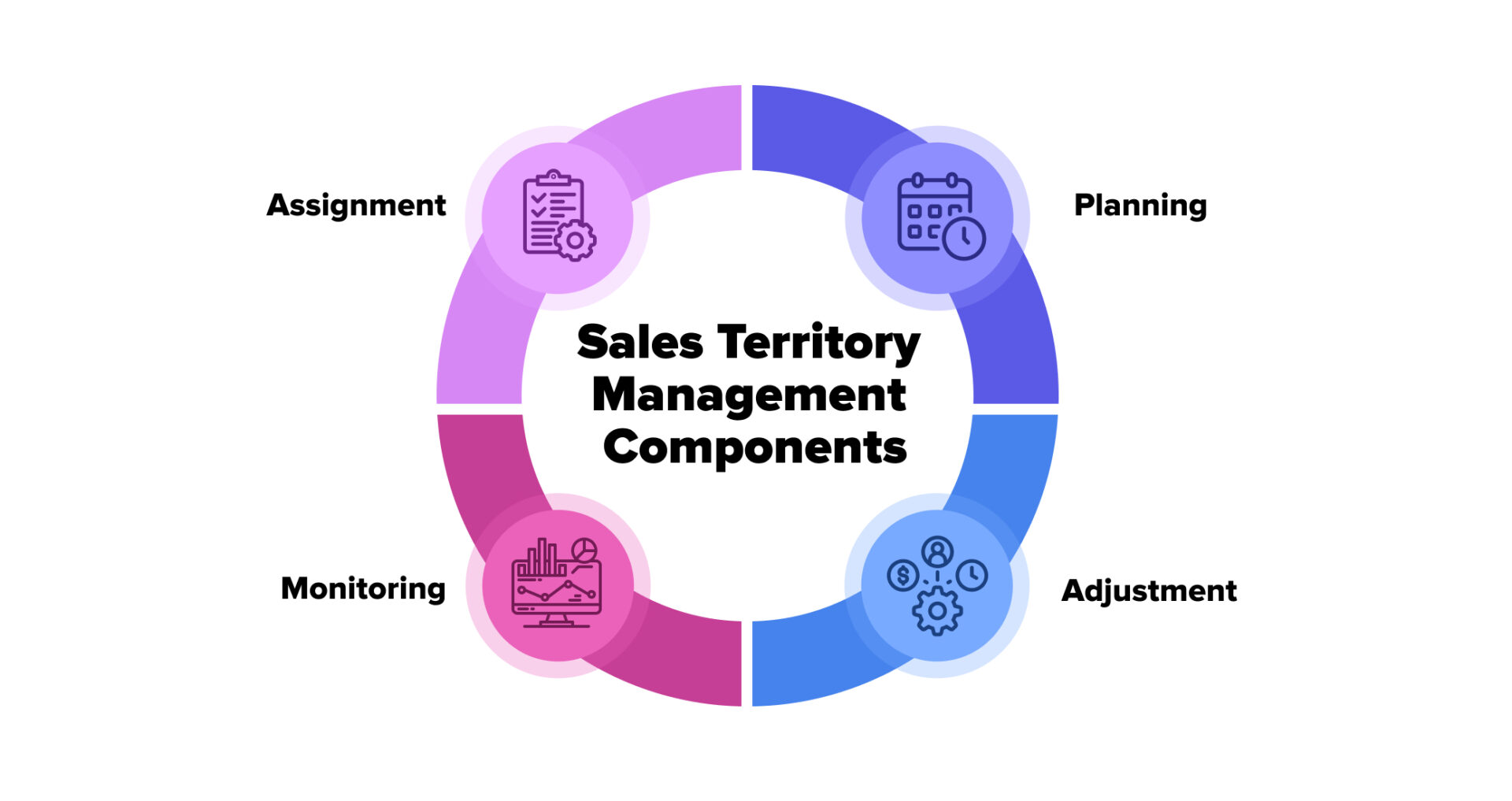
Planning
The right tool (or combination of systems) replaces assumptions with data.
Managers plan territories using customer sales potential, visit frequency, travel time, and past sales performance.
This leads to realistic territories and achievable coverage plans.

Assignment
Accounts must be based on capacity and priority, not just geography, to create balanced territories.
With the right systems to support assignment, workloads are sized by factoring in the number of customers, visit time, and travel distance.
Each rep has clear account ownership, and managers can immediately see when a territory is overloaded or underutilized.
Monitoring
For modern sales territory management, it is crucial to organize work in a way that shows what actually happens in the field as it happens.
Managers should see planned versus completed visits, task execution, timing, and in-store results directly in the system, measured through clear field KPIs.
Reps report activities on the spot, supported by photos and execution data, which provides objective evidence.

Control is based on real-time activity and outcomes, not delayed reports or follow-up calls.
Adjustment
When issues occur in the field, there is no time to delay adjustments. Missed visits, broken routes, or weak execution affect sales immediately.
Businesses must be equipped with tools that show in real time how reps move, which stores they visit, and how they perform. Managers need to see where the plan breaks and the historical record behind it.
These tools must also allow managers to act within the same system. They should be able to open the exact issue, schedule a meeting with the rep, assign follow-up tasks, and track whether the problem is resolved.
Territory management becomes a continuous adjustment process instead of a periodic review.
Best Practices for Territory Management in Sales
Technology-driven Sales Territory Management does not replace proven principles. It strengthens them.
What used to depend on experience, static plans, and delayed reports is now supported by data, automation, and real-time visibility.
Technology elevates familiar Sales Territory Management best practices, and makes them measurable, faster, and easier to adjust.
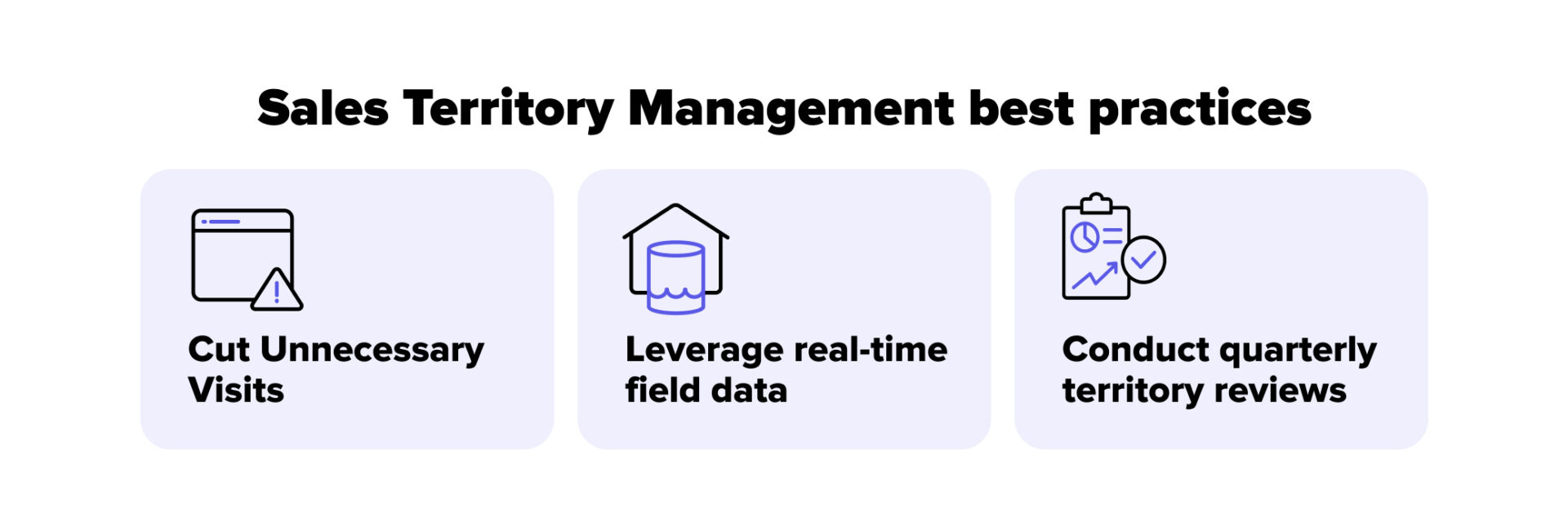
Cut Unnecessary Visits
One of the most practical sales territory management tips is to reduce physical visits to small, remote PoS and serve them digitally.
Sending reps to low-volume locations too often increases travel time without improving results.
B2B eCommerce platforms help reduce this load by shifting routine orders to digital channels. Sales reps can then focus visits on outlets where in-person work actually impacts sales.
Leverage Real-Time Field Data
There’s no chance a modern company that works with hundreds of outlets can manage field teams and daily sales operations without accurate, up-to-date field data.
Visit status, time on site, photos, and task completion should be captured as the work happens. This data serves as a core input for the management of sales territory, not just a reporting layer.
It’s also crucial that the system supporting this data is integrated with the rest of the tech ecosystem. When field data flows into CRM, sales analytics, and planning tools, territory decisions reflect the full picture instead of isolated field activity.
Conduct Quarterly Territory Reviews
Quarterly reviews were often subjective and slow.
Today, best practices for sales territory management go further, and sales managers need access to vast amounts of data from SFA, Territory Management software, FMCG Distributor Management, and execution tools like an FMCG Image Recognition solution. With those in place, reviews are fully data-driven.
Sales leaders compare planned versus actual coverage, results, and effort. This way, changes in territory design are based on evidence, not opinion.
Conclusion
Modern sales territory management uses data and real-time tracking instead of paper lists and delayed reports.
This digital transformation makes FMCG companies shift their approach in sales territory management strategies from reactive to proactive.
Instead of discovering issues weeks after they occur, managers see underperforming territories, stockouts, or missed opportunities within hours.
However, the right tools and the ecosystem around them create only information. It’s the people who decide what to do with it.
The companies that gain a competitive advantage aren’t the ones with the best software. They’re the ones whose field reps actually use it. And whose management picks solutions that fit their sales team’s processes and structure.


